Malaysia sits at a steady 86°F with warm seas year-round, yet it's entirely possible to arrive at your dream island and find it closed due to a storm. The culprit is the monsoon, which splits the country into two coastlines running on opposite calendars.
Malaysia is one of those countries where "it's always summer there" is literally true: average air temperature runs 81–91°F (27–33°C) year-round, water at 82–88°F (28–31°C) in any month. It would seem like you could book a ticket any time.
But here, seasonality doesn't run on a thermometer — it runs on wind and rain, and failing to account for which monsoon is blowing in a given month can mean your beach vacation simply doesn't happen.
Two Monsoons, Two Calendars
Malaysia sits nearly on the equator, and its climate is governed by two alternating monsoons.
- The northeast monsoon (November–March) brings rain and storms to the east coast of the Malay Peninsula and the coast of Borneo. During this period, hotels on the east coast close, boat service to the islands stops, and the sea turns dangerous for swimming.
- The southwest monsoon (June–September) arrives off the Indian Ocean and affects the west coast, but far more mildly: rain falls more often, but without storms — the islands stay open, and swimming remains possible.
The logic is simple: when one coast is having a bad time, the other is doing well. The whole strategy comes down to making sure you're on the right side of the peninsula in a given month.
The East Coast: The Best Islands, and When They're Open
The eastern islands are the crown jewel of Malaysian beach travel: clear water, coral reefs, sea turtles, minimal development. But they all share one trait: from November through February, they're effectively closed. Hotels shut down, ferries stop running, and the sea turns rough enough to make swimming impossible.
Season on the eastern islands runs March through October, peaking April–September.
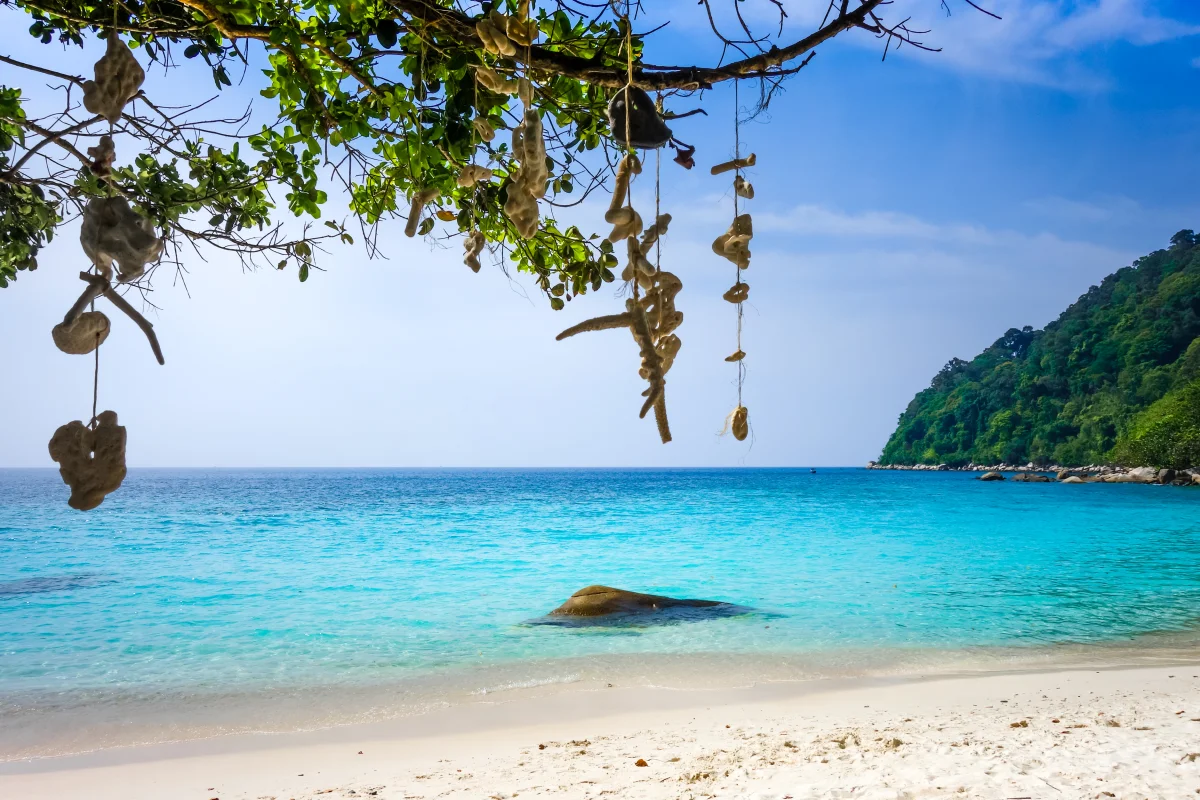
The Perhentian Islands — two islands connected by a coral reef: Besar (quiet, family-friendly) and Kecil (budget-friendly, popular with younger travelers). The water is so clear you can spot fish from the pier. Best snorkeling runs May–August, when visibility peaks.
The islands close entirely from early November through early March — no hotels, no restaurants operating.
Redang — larger than the Perhentians, with more developed infrastructure. Fine white sand and a sandy bottom make it one of the best beaches for anyone who dislikes coral and pebbles underfoot. Closes on the same schedule as the Perhentians.
Tioman — the largest of the eastern islands, once named one of the world's ten most beautiful islands by Time magazine. Jungle, waterfalls, and reefs all on a single island. Some hotels stay open even during the off-season, but weather in November–January is unpredictable, and boat service runs irregularly.
Lang Tengah — a tiny island under a square kilometer, with a single hotel and a single reef. Suited to travelers who want total quiet and are willing to accept minimal amenities. Open only March through October.
The West Coast: Islands for Every Season
The western islands run on different rules — they stay open year-round, since the southwest monsoon doesn't bring storms, only more rain. The main destinations:
Langkawi — Malaysia's largest resort island, with its own airport, a cable car, duty-free shopping, and beaches for every taste. The best beach is Pantai Cenang: a long stretch of white sand with a gentle entry.
The driest months are December–March — exactly when the east coast is closed. From April through November, rain becomes more frequent, but the island operates without restriction.
Penang — more a city on an island than a resort: George Town's street art, temples, street food, colonial architecture. Beaches exist, but fall short of the eastern islands' water clarity. The best time is January–March, the driest and sunniest months.
Borneo: A Story of Its Own
The Malaysian portion of Borneo — the states of Sabah and Sarawak — runs on its own schedule. It too has magnificent islands, but the monsoon seasons play out differently there.
- The Tunku Abdul Rahman Islands, off Kota Kinabalu, are five islands with coral reefs, just 15 minutes by boat from the city. Accessible year-round, but the best weather runs March–September.
- Sipadan, one of the world's top dive sites and a fixture on every ranking list, limits visitor numbers to 120 divers a day, with permits needing to be booked months in advance. Best visibility runs April–June, though diving is possible year-round.
Keeping It Straight: A Season Cheat Sheet
- December–February → the west coast: Langkawi, Penang. The east is closed.
- March–May → everywhere works: the east reopens, the west is still dry, and Borneo is at its best.
- June–September → the eastern islands peak (Perhentian, Redang, Tioman). Rain picks up in the west, but nothing critical.
- October → a transitional month: the east starts closing, the west still holds up.
- November → the east is closed, and the west's best season begins.
What to Keep in Mind Before Booking
Even during dry season, Malaysia gets rain — it's the tropics, and a half-hour downpour can happen on any given day. The difference between seasons isn't the presence or absence of rain — it's the intensity and duration of it, and whether boats to the islands are running at all.
Before booking a specific island, it's worth checking whether it operates on your chosen dates: some hotels on the Perhentians and Redang close as early as late October and don't reopen until mid-March. Langkawi and Penang carry no such risk — they welcome visitors year-round, just with varying amounts of sunshine depending on the month.