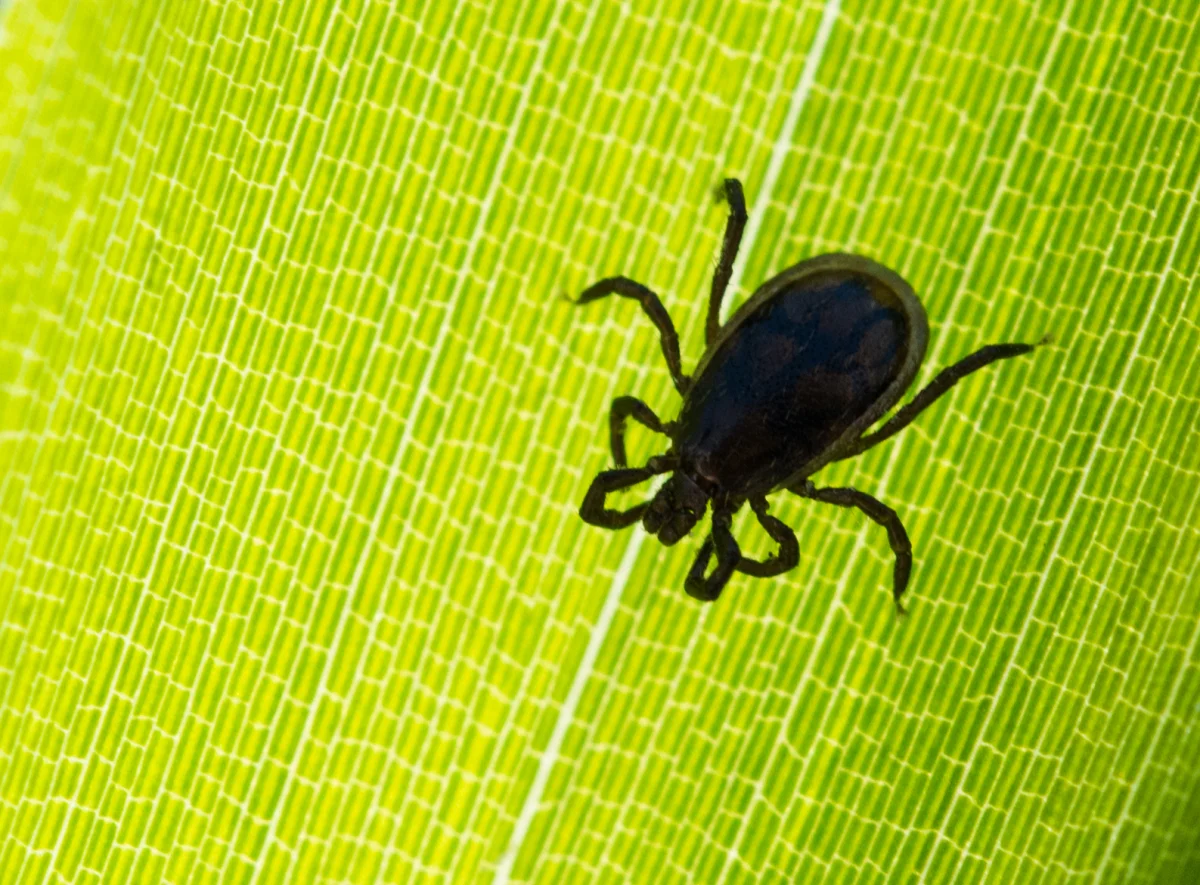
There are still snowdrifts in the forest and the snow has only just melted at the dacha, yet the first tick bites are already appearing in the official reports. Ticks don't need summer heat for this: a few warm days and a sun-warmed clearing are enough.
Many people assume ticks are a May and June problem. But in 2026, the first reports of tick bites in Russia started coming in as early as early March, when there was still snow on the ground in many regions. And in autumn, ticks can sometimes be found right up until the first snow.
The thing is, ticks are cold-blooded. Their season is set not by the calendar but by temperature and humidity, so the weather forecast can tell you when to take extra care in the forest and at the dacha.
Where Do Ticks Spend the Winter?
Ticks see out the winter in the top layer of soil and the forest litter, under fallen leaves and snow. During this time they're in a state of torpor and don't move.
Snow acts like a blanket: under a thick snowdrift, the ground barely freezes, and the ticks survive comfortably until spring.
That's why a snowy winter without severe frosts suits them well. Ahead of the 2026 season, biologists were indeed expecting high tick numbers: the winter had been snowy, and most of the population had overwintered well.
At What Temperature Do Ticks Wake Up?
They wake up in several stages, each with its own threshold:
-
The temperature rises to +1…+5 °C. Ticks come out of torpor and start stirring in the leaf litter.
-
The average daily air temperature stays above +5…+7 °C. Ticks climb onto last year's grass and shrubs and start looking for a host. This marks the start of the season.
-
The air warms to +10…+15 °C. Mass activity begins. In most regions, the peak comes in May and June, and during the day ticks are most active in the morning and evening.
What matters isn't the temperature on any one day but sustained warmth. A short thaw in February is unlikely to wake ticks up. A week of sunny weather in late March very well might.
Why Do Ticks Appear While There's Still Snow on the Ground?
In spring, the forest warms up unevenly. On south-facing slopes, forest edges and sunny clearings, the snow melts earlier and the ground warms faster than in the shade of a spruce wood. That's where ticks wake up first.
Igor Glamazdin, director of the Institute of Veterinary Medicine, Veterinary and Sanitary Expertise and Agricultural Safety at the Russian Biotechnological University, warns:
"Even with snow cover still partly on the ground, ticks can become active in sunny patches of forest or on lawns."
When Does the Season Start in Different Regions?
According to Rospotrebnadzor, Russia's consumer health watchdog, tick activity across the country as a whole usually begins in the last ten days of March. But the timing varies greatly depending on the region, the depth of the snow cover and the spring weather.
-
Southern Russia. The season starts earliest here. In 2026, by March 11, Rospotrebnadzor had counted about 100 reports of tick bites in 19 regions, and almost half of them were in Krasnodar Krai and Crimea.
-
Central Russia. The first ticks appear in late March or in April, depending on when the snow melts. The peak usually comes from late May to mid-June.
-
The Urals and Siberia. Ticks wake up as the first patches of bare ground appear, or, if spring drags on, closer to its end. In Altai Krai, for example, there hadn't been a single reported bite as of March 16, 2026: with sub-zero temperatures, the ticks stayed in the soil. Yet in the neighbouring Altai Republic, the first case of a tick attaching itself was recorded as early as March 13.
Why Are There Fewer Ticks in Summer?
Ticks have a weak spot: they don't cope well with heat and dryness. To avoid drying out, at the height of summer they retreat into the forest litter, thick grass, ravines and shady spots near water. In the July heat, there are fewer of them in open, sun-baked clearings.
But this is only a breather. As soon as it turns cooler and the air gets more humid at the end of August, the ticks come back out onto the grass.
Rospotrebnadzor warns of a second peak of activity in late August and early September. It's weaker than the spring one, but noticeable, especially in European Russia.
In Siberia and the Urals, there's usually almost no second wave. The main species there is the taiga tick, and as Sergei Leonovich, a doctor of biological sciences and leading researcher at the Zoological Institute of the Russian Academy of Sciences, has noted, it very rarely has a second peak of activity.
When Does the Season Really End?
The first frost doesn't mean the ticks have gone. Andrei Zinoviev, professor and head of the Department of Zoology and Physiology at Tver State University, explains that the season only ends with sustained cold, when the leaf litter freezes and the forest is covered in snow:
"Even the first frost doesn't necessarily end the season."
According to him, a combination of moderate warmth and high humidity is particularly favourable for ticks in autumn. As long as there's no snow and daytime temperatures rise above +5 °C, you can quite easily come across a tick in a forest, a park or an overgrown plot.
In Moscow and the Moscow region, according to Leonovich, bites are recorded right up until mid-October, and in a warm autumn you can find ticks even later.
How to Read the Weather
- Watch the average daily temperature, not the calendar
If the average daily temperature stays above +5 °C for several days in a row and the snow has already melted in open areas, the ticks have most likely woken up. This applies in March and in November alike.
- In spring, sunny forest edges are the most dangerous
While there's still snow in the thicket, the ticks are already waiting in warm clearings, on south-facing slopes and along the edges of forest roads. These are exactly the places that tempt you out for a walk in spring, and exactly where you need to be careful.
At the height of summer, ticks hide in tall grass, bushes, ravines and near water. A walk through a dry pine forest in the heat is usually safer than one through a damp, shady hollow.
- Plan walks around the time of day
Ticks are more active in the morning and evening, when it's cooler and more humid. Paths without tall grass are safer than cutting straight through the bushes.
- Don't let your guard down in autumn
After rainy weeks in September and October, ticks come back out onto the grass, just when mushroom pickers and dacha owners are no longer expecting them. Light-coloured clothing, trousers tucked into socks and a check after your walk are needed in the "velvet season", the mild early autumn, too.
- At the dacha, clear away grass and leaves
Ticks stay where it's damp and there's shelter: in tall grass, piles of last year's leaves and the undergrowth by the fence. A mown plot with the leaf litter cleared away is far less attractive to them.