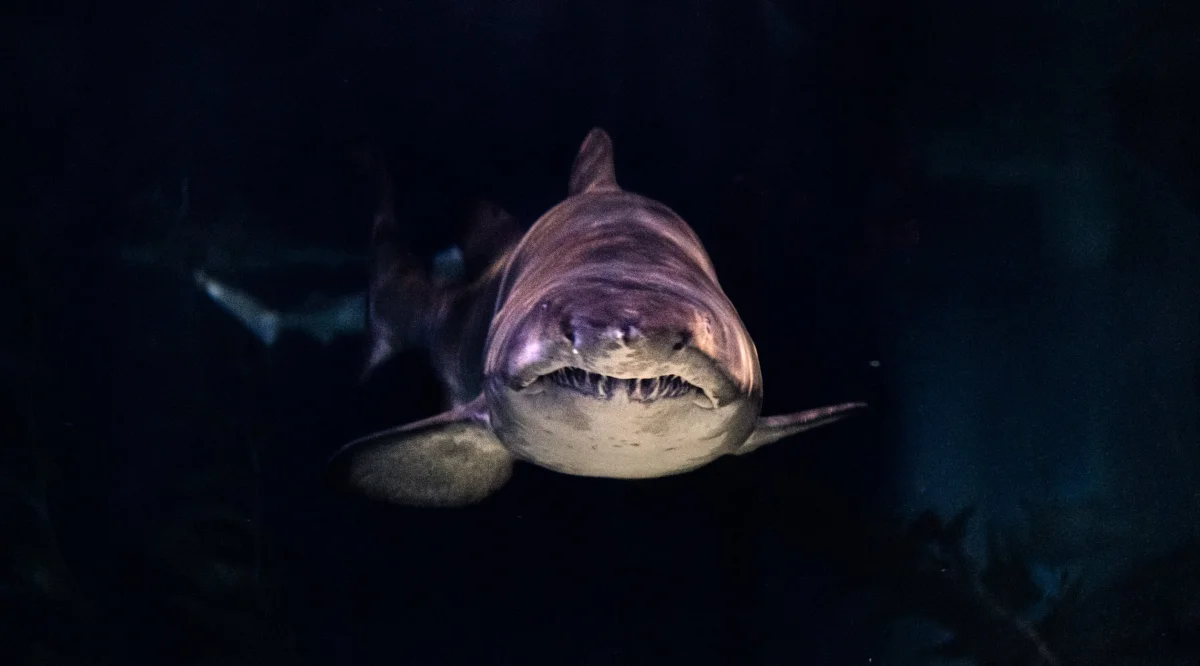
Let us recall that the victim of the attack was a 23-year-old Russian man, who died in the maw of a meter-and-a-half-long predator. And recently people fled a beach in Tuapse with screams – they spotted a fin at the water’s edge and took it for a shark. It turned out to be a dolphin. But every holidaymaker has a reasonable question – are there in fact bloodthirsty sharks in the Black Sea?
In the Black Sea not a single case of a shark attacking a human has been recorded. Although quite a few of these predators do live here. But the small size of the Black Sea spiny dogfish and the catshark does not allow them to hunt large prey. And they pose no threat to people.
Although the Black Sea is connected to the Mediterranean through the Bosporus Strait. And it is well known that real monsters dwell in the waters of the latter. The mako, the great white shark, and other members of this family have a reputation as merciless killers. Scientists believe that these predators could quite possibly end up in the Black Sea.
Why don’t sharks swim into the Black Sea?
.jpg)
There are several obstacles that will not allow man-eating sharks to be the full-fledged masters here. The noise from the constant movement of ships through the Bosporus scares the predators away. In addition, the fairly cold waters of the Black Sea are an environment in which large sharks simply cannot survive. However, ichthyologists are already sounding the alarm. Global warming on the planet could fundamentally change the situation. And in some places the Black Sea is already warming up considerably.
For now, the not overly salty water serves as yet another barrier in the path of the ferocious predators. And there is a scientific explanation for this. As it turns out, a huge freshwater lake once existed in the place of the Black Sea.
And yet there is no need to frighten yourself with images from the famous film «Jaws». In the near future neither the bull, nor the tiger, nor the white shark will even show their noses in the Black Sea. The whole point is that its waters are saturated with hydrogen sulfide. And at a depth of just 50–60 meters there is no large wildlife at all. That is why the sea monsters are doomed to starve to death.
Dangerous inhabitants of the Black Sea
.jpg)
Far greater concern is caused by other inhabitants of the Black Sea. The greater weever – is a cute-looking little fish that is forever hiding in the sand. However, the moment you touch it, you immediately get serious poisoning. The venom glands on its fin and gills secrete a powerful toxin. There are known cases of people dying.
The stingray is among the most dangerous rays for humans. This creature loves to lie in ambush. And it leaps out of hiding, striking with its tail. The barb on its tip is simply soaked in venom. If you do not seek medical help in time, paralysis and cardiac arrest are possible.
The Atlantic stargazer – an unsightly brown fish – is entirely covered in slime. Out of curiosity people sometimes try to catch it. And for the fisherman this sometimes ends tragically. At first the slime causes a burn. And through the pores of the skin a venom penetrates that causes pulmonary edema.
Jellyfish and sea scorpionfish, which are often hard to spot, are another scourge for those swimming in the Black Sea. We should note that a real threat to human health is posed by the toxic waters near industrial enterprises. And having once sampled the meat of a mussel caught here, you can be seriously poisoned.
And the Black Sea also abounds in underwater currents that even an experienced swimmer is powerless against. Even on the shore a certain danger lies in wait for holidaymakers. For example, oleanders – extraordinarily beautiful flowers that grow profusely on wild beaches – have a poisonous fragrance. And they cause poisoning: nausea, heaviness in the chest, headache.
Swim with sharks or dive 33 meters deep: the 6 most unusual swimming pools in the world