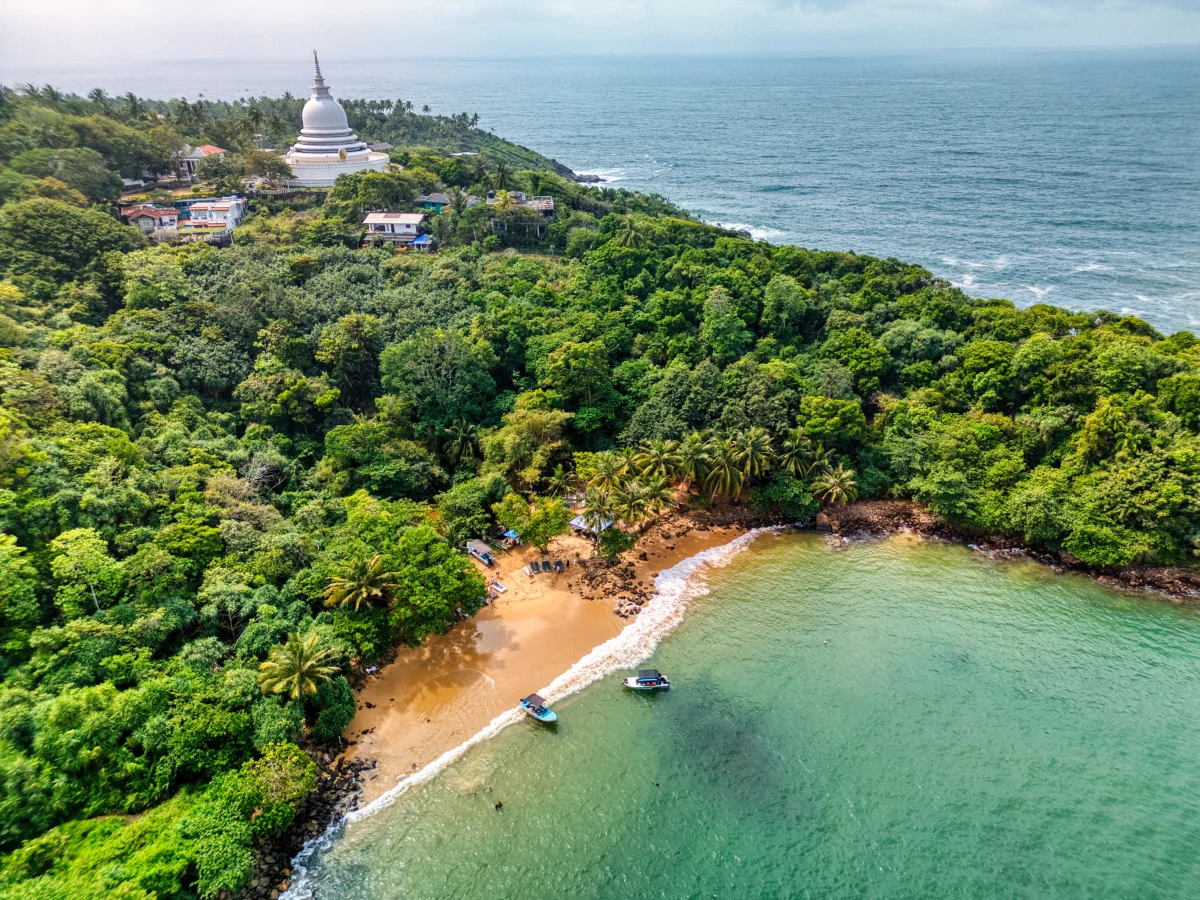
Sri Lanka doesn't have an "off-season for the whole island" concept — it has two coastlines that take turns hosting tourists. While one is caught in a storm, the other sits under calm skies and sun.
Sri Lanka is an island roughly the size of Lithuania, yet it has more distinct weather zones than the entire Baltic region combined. Air and water temperatures stay constant year-round: 82–90°F (28–32°C) outside, 81–84°F (27–29°C) in the ocean. What forces you to swap a swimsuit for a rain jacket, or vice versa, isn't the thermometer — it's the monsoon, and there are two of them, each hitting a different half of the island.
Two Monsoons, Two Coastlines
Sri Lanka's entire climate calendar is shaped by the alternation of two winds.
- The southwest monsoon (also called yala) blows from May through September. It brings rain, waves, and storms to the west and south coasts — home to the island's most famous resorts: Negombo, Bentota, Hikkaduwa, Unawatuna, Galle, Mirissa. During this stretch, the east coast stays dry and sunny.
- The northeast monsoon (maha) arrives from October–November through January–February. Now the rain and waves shift to the east and north coasts, while the west and south enter their best season.
The logic mirrors Malaysia's: when one coast is having a bad time, the other is having a good one. But there are nuances.
The Southwest Coast: Main Season Runs November–April
This is where most Russian tourists head, and it's home to the bulk of the island's hotel infrastructure. The best months are December–March: dry, sunny, calm ocean, with humidity that's easy to tolerate.
Negombo is the closest beach to Colombo Airport, just 10 kilometers away. Convenient for a first or last night, but the ocean here stays rough even in season, and the beach isn't the cleanest. Not the best choice for an extended stay.
Bentota offers a wide sandy beach and the calm lagoon of the Bentota River on the other side of the spit. The lagoon works well for kayaking and birdwatching, while the ocean side handles swimming — one of the best options for families.
Hikkaduwa is a resort village with a coral reef right off the shore: sea turtles swim up to swimmers, and snorkeling is possible without a boat. The vibe is relaxed, with plenty of budget accommodation and beach bars in the evening.
Unawatuna is a compact bay shielded from waves by a coral reef — one of the few beaches where comfortable swimming is possible even during the transitional months. The downside is that the bay is small and gets crowded at peak season.
Mirissa is the main spot for blue whale watching. Whale season runs December–April, with boats heading out early in the morning. The beach is beautiful, framed by palm trees and Parrot Rock, but the waves run stronger than in Unawatuna.
The East Coast: Season Runs May–September
Eastern Sri Lanka is a different world: less developed, cheaper, with wilder beaches and clearer water. When the southwest monsoon is drenching Hikkaduwa and Mirissa, this is where the best time of year unfolds.
Trincomalee is a port city home to one of the world's finest natural harbors. The main beach is Nilaveli: a long stretch of white sand, gentle entry, calm water. Half an hour away by boat sits Pigeon Island, a coral islet with excellent snorkeling, home to reef sharks and turtles.
Pasikuda is a shallow bay with a sandy bottom, water warming to 86°F (30°C). Waves are minimal and the depth increases very gradually — ideal for kids. Infrastructure is more modest than the southwest, but a few good hotels do exist.
Arugam Bay is Sri Lanka's surfing capital. People don't come here for calm swimming — they come for the waves: surf season runs April–October, peaking July–August. The atmosphere feels like Bali a decade ago: guesthouses, mopeds, yoga studios.
Why Rain in Sri Lanka Isn't a Dealbreaker
Monsoon rain in Sri Lanka isn't European all-day drizzle. In most cases, a downpour arrives in the afternoon or at night, leaving the morning sunny. Even at the height of the southwest monsoon, the south coast still gets 4–5 hours of sun a day.
The monsoon's real problem isn't the rain — it's the waves.
The ocean turns rough, currents strengthen, and red flags go up at many beaches. Swimming on days like this is dangerous even for confident swimmers. It's the state of the ocean, not the volume of rainfall, that determines whether it's worth traveling to a given coast in a given month.
Transitional Months: April and October–November
Between the two monsoons, there are brief windows when the island is relatively dry everywhere. This includes April (the southwest monsoon hasn't started yet, and the northeast has already ended) and, to some extent, early October. During these weeks, you can combine coasts without being tied to one side of the island.
But there's a catch: the transitional months are the most unpredictable. Rain can arrive suddenly from either direction, and the ocean behaves erratically. If your trip is short and you'd rather not gamble, it's safer to stick with peak months: December–February on the southwest, or June–August on the east.
The Mountains Work Year-Round
The central highlands — Nuwara Eliya, Ella, Kandy — run on their own schedule. It's cooler here (59–77°F / 15–25°C), with rain possible in any month, but without monsoon-level storms. Tea plantations, a train ride through mountain tunnels, waterfalls, and the Temple of the Sacred Tooth Relic in Kandy are all accessible year-round and make a great complement to the beach portion of a trip.
The classic itinerary — a week on the coast plus 3–4 days in the mountains — works in any season, as long as you match the right coast to your dates.
A Simple Cheat Sheet
- December–March → southwest and south: Bentota, Hikkaduwa, Unawatuna, Mirissa, Galle. Peak season, best weather, whales.
- April → workable anywhere, with a caveat for unpredictability.
- May–September → east: Trincomalee, Nilaveli, Pasikuda, Arugam Bay. Surfing in the south.
- October–November → transitional period, the southwest starts reopening, the east starts winding down.
Water temperature won't help you choose — it stays the same everywhere, year-round. What decides it is wind, waves, and hours of sunshine — and those are tied to coast and month.