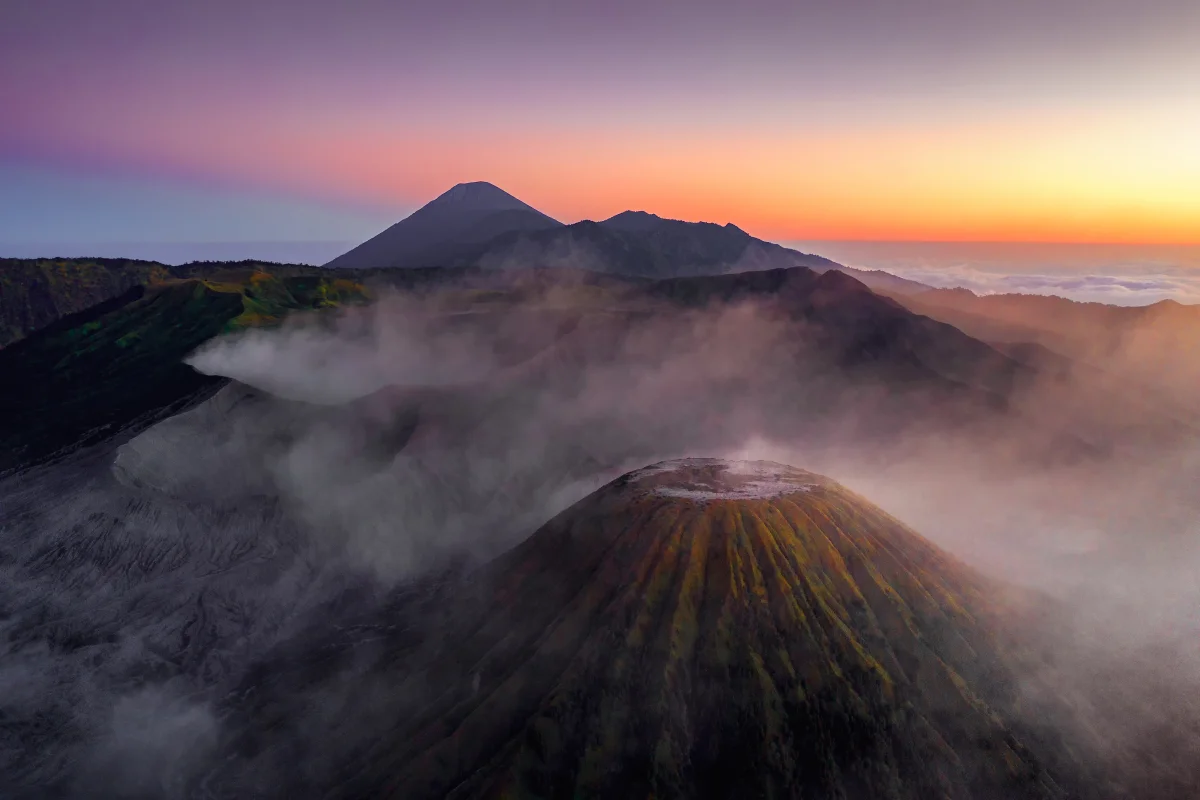
For people living in Kamchatka, an eruption is almost an everyday piece of news, but for a tourist on the slopes of Etna or Klyuchevskaya Sopka it's an ordeal worth preparing for in advance. The main danger of a volcano isn't lava at all, and the rules for behaving near one are very different from what you see in films.
On the morning of July 10, 2026, the Kamchatka volcano Shiveluch sent a cloud of ash about 12 km into the air. The nearby village of Klyuchi was lucky: the ash didn't reach it.
"If it's not heading our way, we breathe a sigh of relief," said Mikhail Busargin, a member of the village council who has lived near volcanoes for more than 50 years.
In 2023, when the wind turned towards the village, Klyuchi was hit by its heaviest ashfall in 60 years.
What Really Makes a Volcano Dangerous
Lava is the most spectacular part of an eruption, but not the most dangerous. It moves relatively slowly, and you can almost always get away from it. The real dangers come from other phenomena:
-
Pyroclastic flows: a red-hot mixture of gas, ash and debris that races down the slope at hundreds of kilometres an hour, at temperatures of several hundred degrees. You can't outrun them, so the key is not to be in their path.
-
Lahars: mudflows of ash, water, melted snow and rocks. They travel along riverbeds and valleys and can reach far from the volcano.
-
Volcanic bombs: chunks of red-hot rock that the volcano hurls hundreds of metres or even kilometres.
-
Gases: carbon dioxide, sulphur compounds and hydrogen sulphide. They're heavier than air and collect in low-lying areas.
-
Ash: fine, sharp particles of volcanic glass that the wind carries tens or hundreds of kilometres.
If You're Near a Volcano During an Eruption
The most dangerous situation is being on the slope at the moment of an unexpected explosion. That's what happened on Etna on June 2, 2025: after part of the crater collapsed, a pyroclastic flow came down the slope, and tourists who had climbed above 2,500 metres had to run back down the path. Fortunately, the flow went into an uninhabited area.
"There was a strong explosion and the crater collapsed, but fortunately it fell into a deserted area," said Salvo Cocina, head of Sicily's civil protection service.
If you find yourself close to a volcano:
-
Leave immediately. Don't stop for photos or videos: the situation changes within minutes.
-
Don't go down into valleys or riverbeds. That's exactly where lahars and pyroclastic flows go, and gases collect in low ground.
-
Move along ridges and high ground, away from gorges, and don't linger on the downwind side, where the ash is carried.
-
Protect your breathing and your eyes. A respirator and goggles, or if you have none, a damp handkerchief or scarf and sunglasses. It's best to take out contact lenses.
-
If rocks are falling and there's nowhere to shelter, curl up and cover your head and neck with your arms.
If Ash Starts Falling
For most people who live or holiday near volcanoes, the main danger is ash. It isn't soot but fine, sharp particles of volcanic glass. It irritates the eyes and airways and clogs engines, and when it gets wet it becomes as heavy as cement.
The Kamchatka branch of MChS, Russia's Emergencies Ministry, advises closing windows and doors during an ashfall and not going outside unless necessary. If you do have to go out, wear a respirator or a cotton-gauze mask. When you get back, don't bring the outer clothing you wore outside into the house.
At home, switch off the air conditioning and ventilation, close the chimney damper, store some water and check that you have food for several days. Ash can disrupt the water supply and the power grid.
If You're in a Car
In heavy ashfall, it's best not to drive at all. Ash drastically reduces visibility, makes the road slippery and can disable the engine.
If you do have to drive, close the windows, switch off the air conditioning and the outside air intake, and drive slowly with your headlights on.
After the journey, check the air filter and replace it if necessary.
After an Eruption
Don't go outside until the ash has settled. Clean up using damp methods while wearing protective clothing, and keep children away. If you live in a private house, clear the roof: wet ash can be so heavy that the roof gives way.
Follow announcements from MChS and the local authorities: lahars can keep occurring for a long time after an eruption, especially after rain and snowmelt.
Where Are Russia's Volcanoes?
Russia's active volcanoes are in Kamchatka and the Kuril Islands. There are seven volcanoes around Petropavlovsk-Kamchatsky, four of them active.
Volcanologist Sergei Samoilenko, founder of the Vulkanarium centre, names Avachinsky as the most dangerous for the city: it's about 25 km away.
In summer 2025, against the backdrop of earthquakes, rescuers advised tourists not to visit five active volcanoes, including Avachinsky and Klyuchevskoy. And Klyuchevskaya Sopka, the highest active volcano in Eurasia, regularly erupts with lava and ash.
How to Prepare for a Trip to a Volcano
Only go with a guide.
"Volcanoes are not a fairground ride," Sergei Samoilenko has warned.
Without an experienced guide, even a volcano that looks calm can turn out to be dangerous: sudden changes in the weather, snowy and icy slopes, mudflows.
Check the warnings before you climb. Look at the announcements from MChS and KVERT, the Kamchatka Volcanic Eruption Response Team. On Etna, tourists went up despite a warning issued that same morning.
Don't get close to the crater. Even during calm lava eruptions, it's worth keeping about 200 metres from the crater.
Take some basic protection. A respirator, goggles, a bottle of water and a scarf all take up little space but may come in handy if an ashfall starts unexpectedly.
Remember the wind. The first thing people in Klyuchi do is check which way the wind is blowing. It's the simplest way to tell whether you'll be covered in ash.