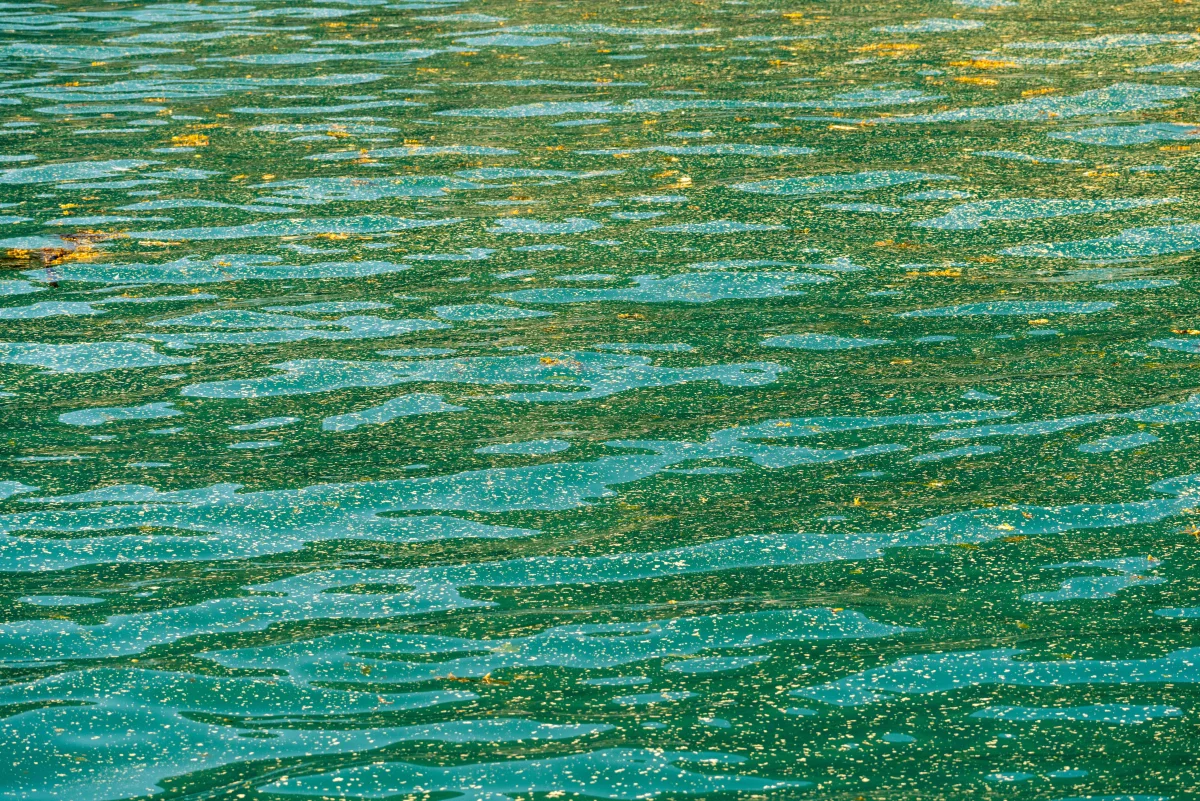
In August, on Anapa's sandy beaches, you often have to wade into the sea through a strip of green mush, and the air by the shore smells not of the sea but of rotting weed. There's a single culprit behind this scene, and its behaviour is quite predictable if you know what to look for.
It's a familiar story for many: on the first day of your holiday the sea is crystal clear, but a couple of days later green threads are floating by the shore, your feet get tangled in algae and dark heaps are drying out on the sand. The locals shrug and say: "The kamka has arrived."
Anapa gets more criticism for this than other resorts, even though algae grow all along the Black Sea coast. The reason lies in the resort's particular features, and those same features determine which beaches, and which weeks, give you the best chance of clean water.
What Is Actually "Blooming"?
In Anapa, the word "bloom" usually refers not to microscopic algae but to kamka, the local name for a green filamentous alga, Cladophora.
The alga lives in the Black Sea all year round, and in summer, in warm water, it starts to grow rapidly.
Cladophora isn't poisonous in itself. The trouble begins when masses of it are washed ashore: the algae fill the shallows for several metres, and sometimes for tens of metres, settle on the sand and start to rot. That's where the green murk at the water's edge and the distinctive smell come from.
Andrei Frolov, co-chair of the Union of Environmental Organisations of Moscow, calls it a normal seasonal process:
"It's a seasonal phenomenon. When the water warms up, the bloom begins. How large it is depends on the temperature and the strength of the current."
Why Anapa in Particular?
The main reason is shallow water. The northern part of the coast, from central Anapa to Dzhemete, Vityazevo and Blagoveshchenskaya, consists of long sandy beaches that slope gently into the sea. The shallow water near the shore warms up quickly, and Cladophora loves warmth, shallows and still water.
The second reason is weak currents. In Anapa Bay, the water is renewed more slowly than along an open, rocky coast, so algae brought in by the waves linger by the beaches. Frolov also agreed that nutrient-rich wastewater could be feeding the algae's growth.
In Sochi, the shore is pebbly, the water gets deep straight away and the sea mixes more actively, so there are algae there too, but masses like those on Anapa's sandy beaches rarely build up.
In Which Months Is There the Most Kamka?
Kamka usually appears from June to September, with the peak in July and August. Conditions become ideal for it once the water warms to +24…+26 °C. That's why the warmest water of the season often coincides with the greenest sea.
-
June. The water is still cooler, and the sea is usually clean. But in hot years, the first build-ups can come earlier.
-
Second half of July. This is usually when kamka starts to pile up noticeably along the shore.
-
August. The most difficult month: the water is warm, calm days are frequent, and the algae have time both to grow and to rot on the beach.
-
September. Things improve after the first autumn storms and the cooler weather. But in a warm autumn, kamka can hang around longer.
Kamka stops growing once the cold sets in and the air temperature drops below +15…+17 °C, and in October the storms finally scatter it.
What Was 2026 Like?
The 2026 season was special for Anapa: the beaches reopened for the first time in a year and a half, following the fuel oil spill in the Kerch Strait in December 2024.
The swimming season officially ran from June 1 to September 30 on the stretches that had been removed from the danger zone, and by mid-August 109 beaches had received approval from Rospotrebnadzor, Russia's consumer health watchdog.
The kamka arrived earlier than usual this year: the first noticeable build-ups appeared as early as spring, and by June algae had been reported on some sandy beaches. In September, large amounts of kamka built up again on some beaches, especially Tsentralny and Lechebny, while in Vityazevo the sea stayed clean on some days.
There are, however, no grounds for claiming that this bloom was caused by the clean-up work or by new sand being brought in.
Where Is the Water Cleaner?
Even at the height of the season, the situation varies greatly from beach to beach. On any given day, kamka may be lying on one stretch while the water a few kilometres away is clean.
-
Sukko and Bolshoi Utrish. Pebble beaches south of Anapa, where the water gets deeper more quickly and mixes better. Kamka turns up here too, but dense build-ups are rarer and don't last as long.
-
Blagoveshchenskaya. An open stretch of coastline in the north, where, with the right wind, the water clears faster than in the bay.
-
Central Anapa, Dzhemete and Vityazevo. Kamka is usually most abundant here, especially closer to town. But even here it can be clean if the wind changed the day before and pushed the algae away. In Vityazevo, for example, the bloom is barely noticeable 50–70 metres from the shore.
How Not to Spoil Your Holiday
If the sea is your priority, plan your trip for June. Your chances of clean water are higher in the first half of summer, although the water isn't yet at its warmest, and in warm years, like 2026, kamka can arrive as early as spring. August is the riskiest month for the sandy beaches.
Watch the wind, not just the date. In calm weather and light winds, algae build up along the shore. A change of wind or a bit of swell can carry them off to the next beach or out to sea within a few hours.
Check the beach on the day you swim. Look at fresh photos and today's webcam footage, not reviews from a week ago.
If your beach has "green soup", it's often enough to drive a few kilometres or choose a deeper pebble beach.
Don't go into the water if it looks like thick green soup, is covered in film or foam, smells rotten, or if there are dead fish by the shore. And only choose officially approved beaches: the list is published by the regional office of Rospotrebnadzor.