
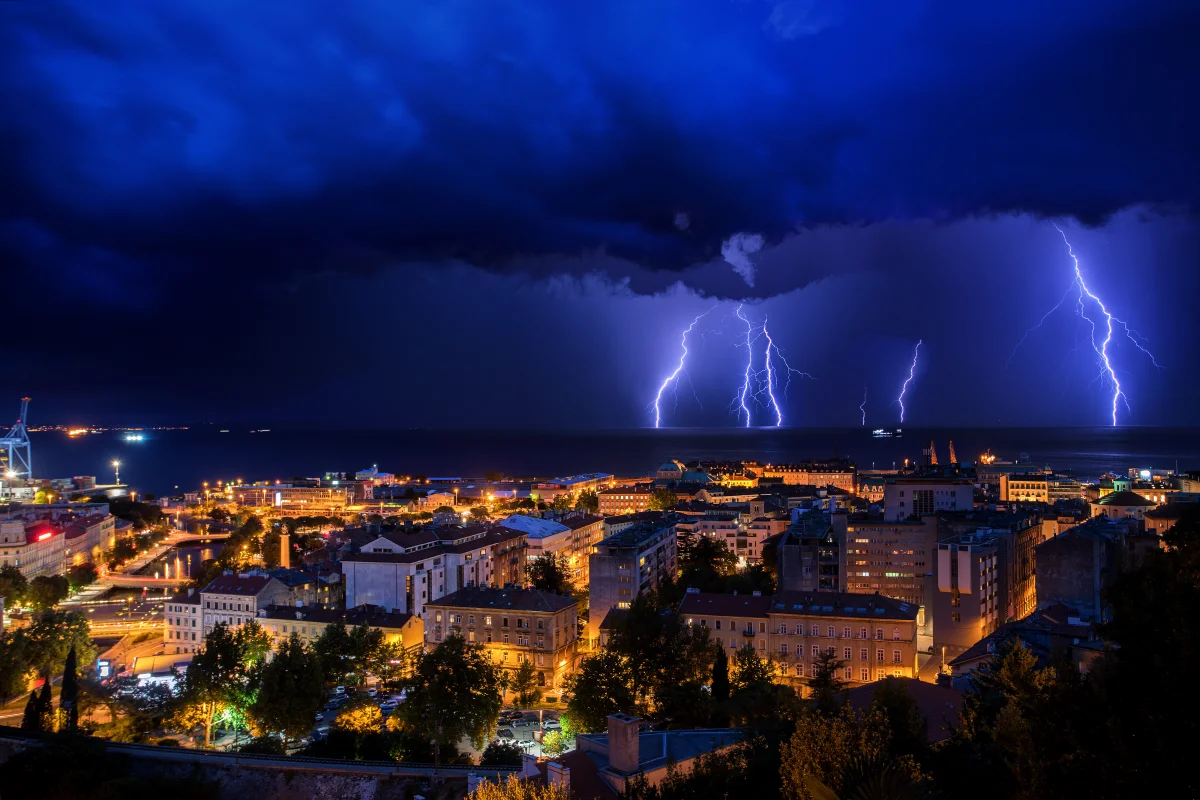
In June 2026, residents of Pionersky near Kaliningrad filmed a glowing ball in a stormy sky. Footage like this turns up every summer, but no scientist can say in advance where and when it will happen next.
Almost everyone has heard of ball lightning, but very few have seen it. Eyewitness accounts are strikingly similar: a glowing ball the size of a football appears during a thunderstorm, floats through the air, sometimes drifts into a house, and a few dozen seconds later disappears, either silently or with a bang.
For a long time, scientists even doubted that the phenomenon really existed. Today there's little doubt left, but ball lightning remains one of the least understood phenomena in the atmosphere. The main reason is that it can't be caught to order.
What Is It?
Ball lightning is a glowing object that usually appears during a thunderstorm. Vladimir Bychkov, a leading researcher at Moscow State University's Faculty of Physics, a member of the Russian Academy of Natural Sciences and chairman of the Russian Committee on Ball Lightning, says the average ball is about 20 cm across, although objects up to 100 metres have been observed.
A ball like this usually lasts about 20 seconds, and its main colours are yellow, orange, red, white and blue. The balls move in either a straight or a winding path.
Bychkov describes its link to an ordinary thunderstorm like this:
"Linear lightning is a product of thunderstorm electricity. Ball lightning is a companion of linear lightning."
Where and When Can You See It?
There's no fixed place where ball lightning regularly appears. It occurs wherever there are thunderstorms, so your chances are highest in summer. In Russia, you're most likely to encounter it in June, July and August, with a peak in July. According to Bychkov, in European Russia it most often forms after 2pm.
The scientist also gives some statistics: "In the European part of the country, over the past four years, from 2022 to 2026, around a hundred ball lightning events have been observed. In Moscow, there are usually around 10 a year."
In early June 2026 alone, reports came in from all over the country:
-
Pionersky, Kaliningrad region — a glowing ball was caught on video in the sky.
-
A suburb of Omsk — ball lightning struck an isolator building in a garden allotment community and caused a small fire.
-
Shenkursk, Arkhangelsk region, and Storozhevsk, Komi Republic — a little earlier, ball lightning reportedly struck residential houses, with no one hurt.
Why Can't It Be Predicted?
Forecasters can predict thunderstorms: where they'll pass, when and how strong they'll be. But ball lightning appears only rarely, for a few seconds and at an unpredictable spot. At present, there's no way to say in advance that a glowing ball will appear in a particular place.
All you can predict are the conditions in which the chances are higher. That's how, in June 2026, Bychkov warned of a "wave" of ball lightning on June 12–13: forecasters were predicting a surge in thunderstorms for those days. The scientist's logic is simple:
"If there are more ordinary thunderstorms, there are also more accompanying phenomena such as ball lightning."
The history of science shows just how rare it is. The first spectrum of natural ball lightning was obtained only in 2012, and even then by chance. Chinese physicists from Northwest Normal University were filming ordinary lightning on the Qinghai Plateau with high-speed cameras and spectrographs when ball lightning, which formed after a lightning strike to the ground about 900 metres from their instruments, appeared in the frame.
The results were published in 2014 in the journal Physical Review Letters. The ball's glow contained lines of silicon, iron and calcium, the main elements of soil. This supported a hypothesis put forward by New Zealand scientists back in 2000: ball lightning may form when linear lightning strikes the ground and vaporises the soil, and the silicon vapour then oxidises in the air and glows.
What to Do if You See It
Stop and avoid sudden movements. Bychkov advises:
"If you suddenly see a flying ball, stop. The ball lives for around a few dozen seconds."
Ball lightning moves with air currents, so if you run, you may create a draught that it will "chase".
Don't try to approach or touch it. According to Bychkov, the ball may drift towards a person, or it may fly past on the air current. It's best to stay where you are and wait for it to move away or fade out on its own.
Seal up the house before a storm. Ball lightning gets into buildings through open windows and doors, gaps, stovepipes and chimneys. The scientist advises closing windows and doors, blocking up gaps and, if you have a stove, shutting the chimney damper.
Don't film it on your phone. Bychkov warns that filming ball lightning on a mobile phone can be deadly dangerous: the ball treats the phone as an antenna and may head towards it. During a thunderstorm, it's best not to use electronic devices at all. If you have seen ball lightning, note down the time, place and weather once it has disappeared: researchers will find this information useful.


