
In August, the grass is green at the Azau Glade at the foot of Mount Elbrus, while higher up the slope lie snows that don't melt even in the fiercest heat. The boundary between these two worlds isn't random: it has its own name and a very specific altitude.
Permanent snow might sound like something from a polar expedition. In fact, you can see it on the equator, in southern Russia and from a plane window over the Alps. All you need to do is go high enough. Exactly how high snow has to be before it stops melting depends on where the mountain is. In some places a few hundred metres above sea level is enough; in others, even six kilometres isn't.
Where Does Snow Never Melt?
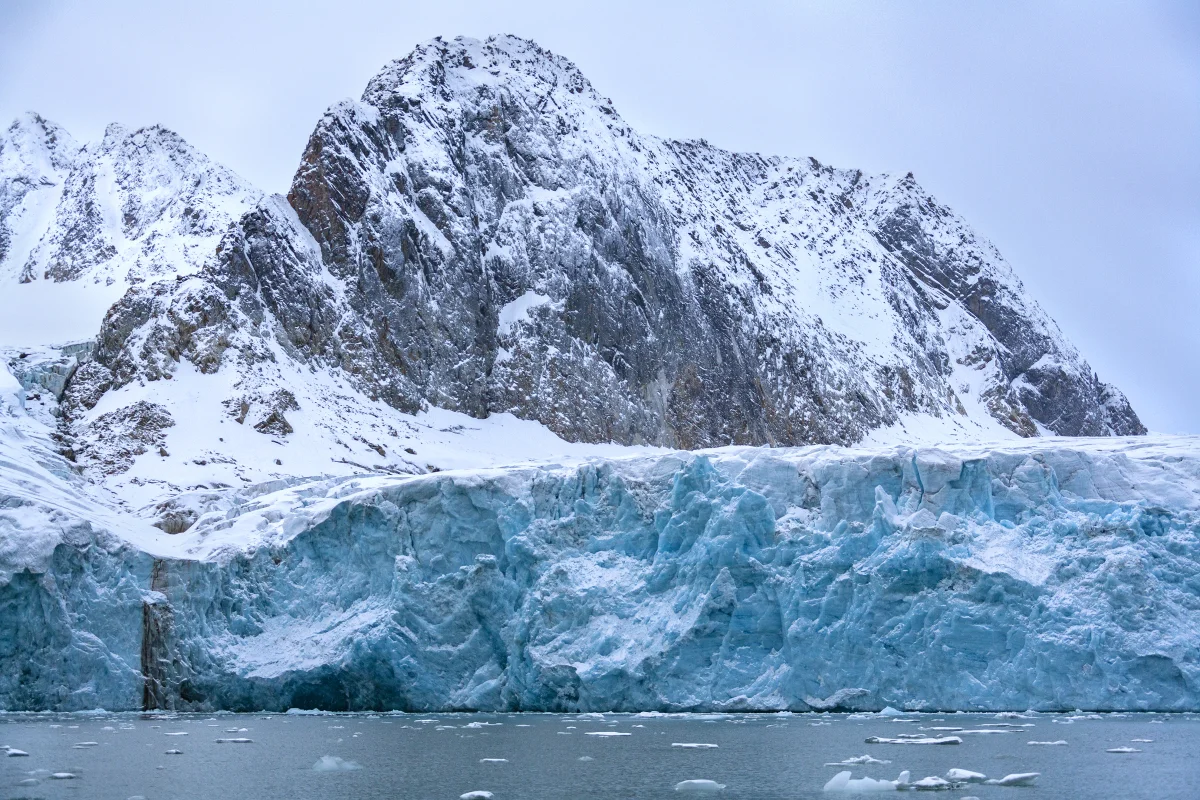
Without any mountains at all, snow and ice lie all year round in Antarctica and Greenland, and on many islands in the Arctic Ocean. In Antarctica, the limit of permanent snow comes right down to sea level; in the Arctic, it lies a few hundred metres higher.
Everywhere else, permanent snow exists only in the mountains. Its lower limit is called the snow line. Above it, more snow falls over the year than has time to melt and evaporate, so it builds up from one year to the next. Below it, everything melts away in summer.
A distinction is drawn between the true snow line, its highest position at the end of summer, and the seasonal snow line. In spring, snow can come much further down, but by the end of August it retreats to its true limit.
At What Altitude Does Snow Stop Melting?
The snow line rises from the poles towards the tropics. Here's its approximate altitude in different parts of the world:
-
Antarctica: 0–400 m. The snow starts practically at the water's edge.
-
Greenland: 100–500 m.
-
Svalbard: 300–600 m.
-
Iceland: 700–1,100 m. The damp oceanic climate allows snow to survive at relatively low altitudes.
-
Scandinavia: 1,000–1,500 m near the Arctic Circle, and 1,200–2,200 m in the south.
-
Kamchatka: 700–1,500 m on the coast, and 2,000–2,800 m in the interior of the peninsula.
-
The Alps: 2,500–2,800 m on the northern fringes of the range, and 2,900–3,200 m in the central part.
-
The Caucasus: 2,700–3,800 m.
-
The Himalayas: about 6,000 m on the northern slopes, and noticeably lower on the southern ones.
-
Kilimanjaro: 5,500–5,600 m, almost on the equator.
-
The Andes in Ecuador: 4,800–5,000 m.
-
The Andes in Bolivia and Chile: up to 6,000–6,500 m.
Why Isn't the Snow Line Highest at the Equator?
You'd expect the highest snow line to be at the equator, where it's warmest. But it isn't. The snow line reaches its greatest height in the dry tropics and subtropics: up to 6.5 km on the Tibetan Plateau and in the Andes. At the equator itself, it drops to about 4.4–5 km.
The reason is moisture. There's a lot of precipitation at the equator, and the snow that falls on the summits has time to build up. In the dry highlands, so little snow falls that even severe cold doesn't help it accumulate.
The most striking example is the volcano Ojos del Salado (6,893 m) on the border between Chile and Argentina, the highest volcano in the world: because of the dry climate, it has almost no glaciers and no permanent snow cover. In the Andes at the latitude of the Tropic of Capricorn, there's no permanent snow at all because the climate is so extremely dry.
The same principle applies in the mid-latitudes. In cold, damp areas the snow line comes down; in warm, dry ones it rises. That's why on Kamchatka's damp coast, the snow line lies 1–1.5 km lower than in the interior of the peninsula.
Why Do the Slopes of the Same Mountain Differ?
Even on a single peak, the snow line lies at different heights. In the Northern Hemisphere, north-facing slopes get less of the sun's warmth, so snow survives lower down there than on south-facing ones. In the Southern Hemisphere it's the other way round: snow lasts longer on south-facing slopes.
But here too, moisture can matter more than the sun. In the Himalayas, much less snow falls on the northern slopes than on the southern ones, which receive monsoon rain and snow, so the snow line is higher on the northern side.
Terrain matters too. In shady gorges and in places where the wind drifts snow, it can survive well below the climatic limit. These patches are called perennial snowfields. In the Urals, for example, permanent snowfields lie far lower than you'd expect from the climate.
What's Happening to Russia's Snows?
Russia has ice caps on its Arctic archipelagos: Franz Josef Land, Novaya Zemlya and Severnaya Zemlya. But its highest permanent snows are in the Caucasus, where the snow line lies between 2,700 and 3,800 metres. Its main symbol is the glacier-covered Mount Elbrus, the highest peak in Russia and, by the most widely accepted definition of the border, in Europe.
But these snows are gradually retreating. According to the Institute of Geography of the Russian Academy of Sciences, between 1997 and 2017 the volume of Elbrus's glaciers shrank by 1.5 cubic kilometres, or 23%. The rate of mass loss tripled compared with 1957–1997. Stanislav Kutuzov, who headed the institute's glaciology department in 2019, noted at the time:
"The Elbrus glacier system is responding to current climate change. Signs that the ice cover on the Caucasian volcano is shrinking can be seen even with the naked eye."
According to the High-Mountain Geophysical Institute, the Azau, Maly Azau and Garabashi glaciers have retreated by about 300 metres over half a century. And according to an international team of scientists, the glaciers of the Greater Caucasus lost about 16% of their area between 1986 and 2014.
How to See Permanent Snow
- Come at the end of summer
In August and early September, the seasonal snow has already melted and the snow line is at its clearest: green slopes and rocks below, and unbroken snow and glaciers above. In a cold summer and straight after snowfall, the boundary looks lower, but that's temporary snow.
- Allow for the temperature difference
In the mountains, every 100 metres of altitude usually brings a drop of about 0.6 °C. Near the snow line it's often around zero even in summer, and in the sun and wind things can change within minutes. You'll need a warm layer, a windproof jacket and closed shoes.
- Protect your eyes and skin from the sun
Snow reflects most of the sunlight, and there's more ultraviolet in the mountains than lower down. You need sunglasses and sunscreen at altitude even on a cloudy day.
- Go by your region
In Russia, the easiest places to see permanent snow are the Caucasus and Kamchatka. In Kamchatka, thanks to the damp climate, permanent snow on the coast starts as low as 700–1,500 metres.


