
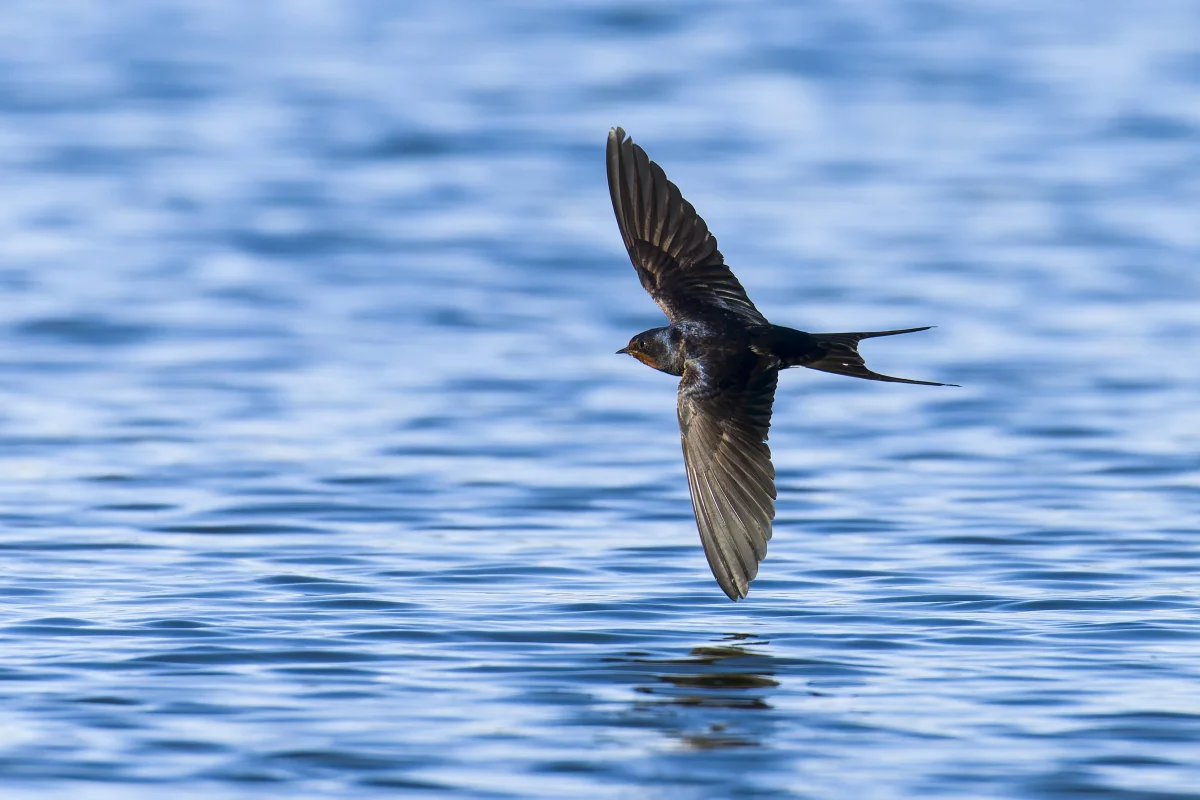
On a summer morning over a village or a dacha settlement, swallows dart about so high they're barely visible, while on another day they skim the grass right at ground level. According to folk wisdom, the first means fine weather and the second means rain, and there really is some straightforward physics behind the saying.
Just about everyone seems to know this one: "Swallows flying high mean fair weather; swallows flying low mean rain." People repeat it at the dacha, on hikes and on fishing trips, and many have noticed that it often comes true.
Similar sayings exist in European, Chinese and North American traditions. In English, for example, people say: "Swallows high, staying dry; swallows low, wet will blow." This overlap between different peoples is no accident: behind the saying lies a very real link between the weather, insects and birds.
Why Do Swallows Fly High in the First Place?
Swallows hunt on the wing. Their food is small flying insects: midges, mosquitoes and flies. The birds don't choose their altitude at will; they fly wherever there's more prey.
In clear, warm weather with high pressure, the sun heats the ground well. Rising currents of warm air, called thermals, lift off it and carry small insects high into the sky. The swallows follow them up.
Especially strong thermals form near sun-warmed walls and roofs, which is why in villages and towns the birds sometimes circle particularly high.
So high-flying swallows are a sign that settled fine weather has set in right now: sunny, dry, with high pressure. As a rule, weather like this lasts for at least the next few hours.
And Why Do They Fly Low Before Rain?
Ahead of a weather front, pressure usually falls and humidity rises. It gets cooler, the wind often picks up and the thermals weaken. In these conditions small insects find it hard to stay aloft: their flight becomes less stable, and they drop closer to the ground, where the air is calmer, sheltering among grass, bushes and trees.
Founder of the environmental service Sokhrani Les ("Save the Forest"), Andrei Khoroshilov, explains that swallows aren't predicting rain when they do this. In his words, they simply have to fly as low as the insects do in order to feed.
You'll often hear another explanation too: before rain, insects' wings get damp in the humid air and become heavier. This is the explanation given, for example, by Roman Vilfand, scientific director of the Hydrometeorological Centre of Russia. Britain's Royal Meteorological Society puts the emphasis elsewhere: on the rising air currents that carry midges aloft in fine weather. Most likely, both mechanisms are at work.
Can You Trust the Saying?
On the whole, yes, but with an important caveat. Swallows are good at showing what the weather is like now, but they can't see ahead. The Royal Meteorological Society stresses that if swallows are feeding high up, pressure is probably high and the weather fine. But the birds can't predict whether there'll be a thunderstorm tomorrow: they're responding to weather that has already set in.
So the saying works as a guide to the next few hours, not to tomorrow. If swallows are flying high in the morning, the day is likely to stay dry. If they suddenly start swooping right above the ground, the atmosphere is already changing, and rain may arrive soon.
There are also situations where low-flying swallows tell you nothing about rain:
-
Over water and damp meadows. Around ponds, rivers and marshes there are always plenty of insects near the surface, and swallows hunt low there even in clear weather.
-
In the evening. As the sun goes down and the thermals die away, the midges drop lower, and the birds follow them.
-
In cold, windy weather without rain. Insects shelter from the wind near the ground, even if no rain is on the way.
Swallows or Swifts?
In towns, the birds racing over the rooftops are usually not swallows but swifts: dark birds with narrow, sickle-shaped wings and a piercing scream. They're often mistaken for swallows, but for the purposes of the saying the difference doesn't matter much.
Swifts feed on the same small flying insects, so they too rise high in clear weather and drop lower before bad weather.
How to Use the Saying Wisely
-
Watch the birds' behaviour over several hours. If swallows have been flying high all morning and start dropping lower by lunchtime, that points to a real change in the weather. A single spell of low flying over a pond means nothing.
-
Combine it with other signs. A falling barometer, thickening cirrus clouds, a strengthening wind and muggy air, together with low-flying swallows, add up to a reliable picture of approaching rain.
-
Don't use it instead of a forecast. If you need to know tomorrow's weather for sure, for haymaking, a hike or a fishing trip, check the forecast. Swallows will tell you whether you need an umbrella in the next few hours, but no more than that.


