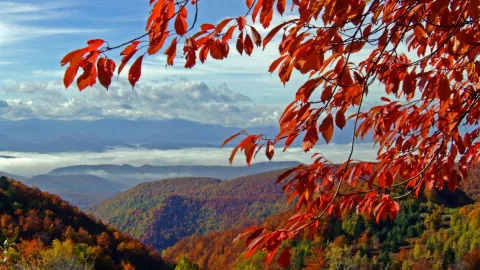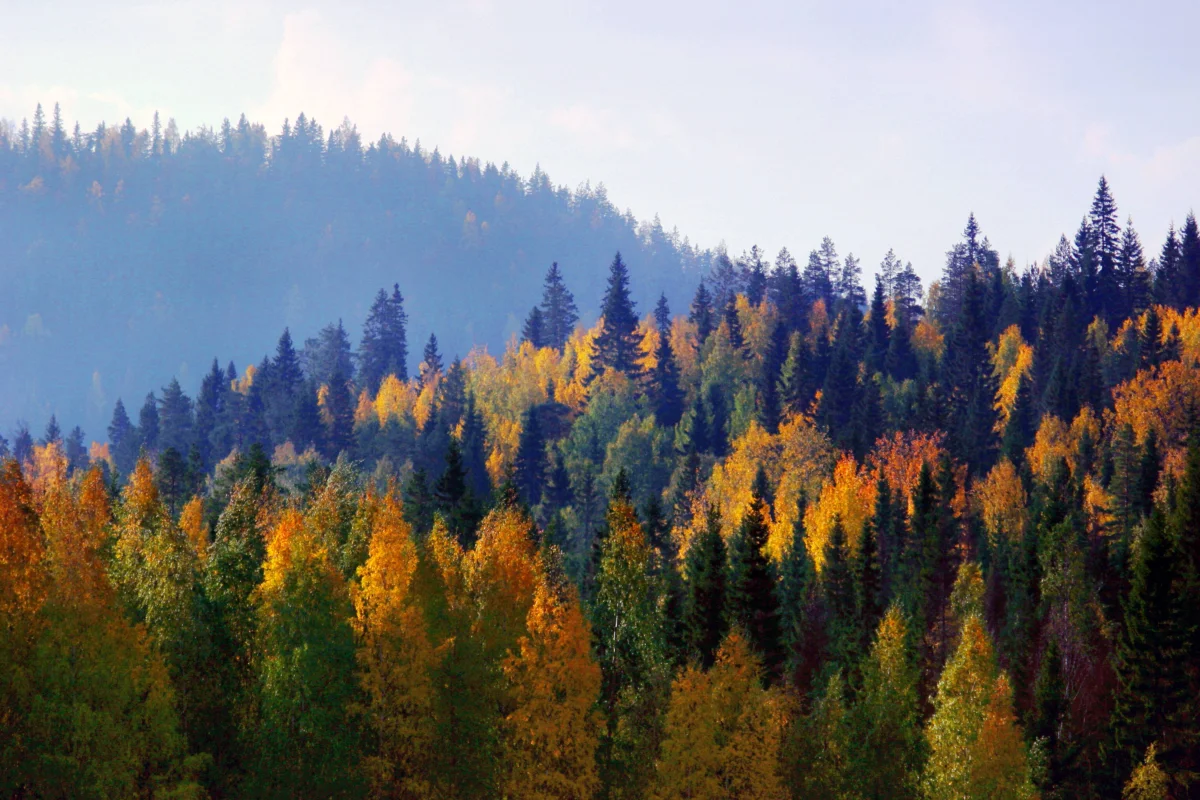
In summer, people head to popular destinations for the warmth; in autumn, they go for the colour. We look at where autumn is at its most vivid in Russia, which weeks to go, and why some forests blaze red while others simply turn yellow.
An autumn trip is always a bit of a lottery. You might arrive in the mountains on exactly the days when the slopes are drenched in gold, or you might be a week late and find bare branches in the rain. Each region has its own peak of colour, and it's short: two or three weeks, sometimes less. But autumn gives you something summer doesn't. There are fewer tourists, tickets and accommodation are cheaper, and familiar places become unrecognisable.
Why Are Some Leaves Yellow and Others Red?
Yellow and orange pigments are present in leaves all summer long; they're just masked by green chlorophyll. In autumn, the chlorophyll breaks down and the yellow shows through. Red pigments, anthocyanins, on the other hand, are produced by the leaves only in autumn, and that takes particular weather.
Nikolai Trusov, a biologist at the Tsitsin Main Botanical Garden of the Russian Academy of Sciences, explains:
"If the carotenoid content is low, and the days are sunny and the nights cold, the leaves turn red because red pigments, anthocyanins, build up in their cells."
That's why the most vivid autumns come in years when dry, sunny days alternate with cold nights. Prolonged rain and overcast weather make the colours duller, and a strong wind can strip all the leaves in a couple of days.
The Kola Peninsula and the Khibiny: An Autumn You Won't See in Central Russia
If you want to see an autumn unlike the familiar golden birches, head for the Kola Peninsula. Here it isn't the forest that changes colour but the tundra: lingonberry, crowberry and dwarf shrubs turn the slopes into a patchwork carpet of yellow, red and pink. Autumn comes earlier above the Arctic Circle than in central Russia, so don't leave your trip until October.
The Khibiny mountains are especially beautiful: the "blazing" tundra sits alongside dark rocky plateaus, lakes and, in places, perennial glaciers. The bonus of a northern autumn is that the northern lights season begins as early as late August, so you can walk through the colourful tundra by day and chase the aurora at night.
Altai: Golden Larches
Altai is often called the country's top autumn destination, and what makes it special is its larches. Unlike other conifers, they turn yellow and shed their needles, so the mountain slopes turn gold and ochre against the snow-capped peaks.
You can catch this landscape in late September and early October, with the exact dates depending on each year's weather. The most spectacular places are the Chuysky Trakt highway, the Seminsky Pass and the Chulyshman Valley.
For a more relaxed trip, there's Lake Teletskoye, which reflects the golden foliage, and the Kurai Steppe, with views of the snowfields of the North Chuya Range.
Baikal: Mists, Cliffs and Empty Shores
On Baikal, the best time for autumn colours is from mid-September to early October. Early autumn weather is often warm and dry, and by this time the summer crowds and ticks have almost disappeared.
The most atmospheric places are Olkhon Island, the Tazheran Steppe and the shores of the Maloye More strait, where autumn mists and cliffs create a picture you won't see here in summer. Another option is the Circum-Baikal Railway: 89 km from Slyudyanka-2 station to Baikal station along the lakeshore, with tunnels and bridges among the yellowing forests.
Karelia and the Leningrad Region: A Classic Golden Autumn
Tour operators call Karelia one of the most beautiful places in Russia in autumn. The best time is September and early October. Most of the forests here are coniferous and don't change colour, but there are enough deciduous trees for patches of gold to flare up against the dark green.
The best-known spots are the Ruskeala marble canyon, Sortavala and the Ladoga skerries. If you're travelling by car, you'll have autumn scenery outside your window for hours.
The classic "Leningrad" autumn can be found in the suburbs of St Petersburg: Peterhof, Tsarskoye Selo, Pavlovsk Park and Oranienbaum. Here the peak comes in late September and early October. In Vyborg, it's worth visiting Monrepos Park in autumn, when yellow and red leaves rustle underfoot.
The Caucasus: The Longest Autumn
In the North Caucasus, autumn arrives later and lasts longer. In Kislovodsk, clear, sunny days with bright foliage last almost until November. Here the leaves don't just turn yellow: guelder rose, hawthorn, dog rose and Virginia creeper add splashes of red, orange and crimson against the conifers.
In the mountains, in Dombay and Arkhyz, the best time is early to mid-October. The autumn forest on the slopes looks especially striking against the high peaks.
Primorye: The Golden Autumn of the Far East
Perhaps the most underrated autumn in the country is in Primorye. Even NASA devoted a feature to its satellite images in 2021, calling the autumn between the Sikhote-Alin range and the Sea of Japan one of the most vivid on the planet. The mixed forests here are extremely diverse, so from space you can see the slopes turning orange, yellow and green all at once.
Primorye's main autumn month is October. After a humid August and an early September with typhoons, the weather turns dry, clear and crisp, and the golden autumn falls right in October.
How to Catch the Peak of Colour
- Take your cue from latitude and altitude
The further north and the higher up a place is, the earlier autumn begins there. The Arctic tundra takes on its colours before anywhere else; in Altai and on Baikal, the peak comes between mid-September and early October; in Karelia and around St Petersburg, in late September; and in the Caucasus and Primorye, in October.
- Watch the weather for a week or two before your trip
Dry, sunny days and cold nights are the best forecast for vivid colours. Strong wind or prolonged rain can shorten the peak to just a few days, so it's worth following local news and social media photos to see how far the forest has turned.
- Leave a few days' leeway
If possible, book a trip with flexible dates or plan your route so that you can shift it by a couple of days depending on the weather.
- Dress in layers
In the mountains in autumn, it can be around zero in the morning, warm in the sun during the day and cold again by evening. You'll need a jacket, a jumper, a hat and waterproof footwear, especially in the Khibiny and Altai, where the first snow can fall at any moment.