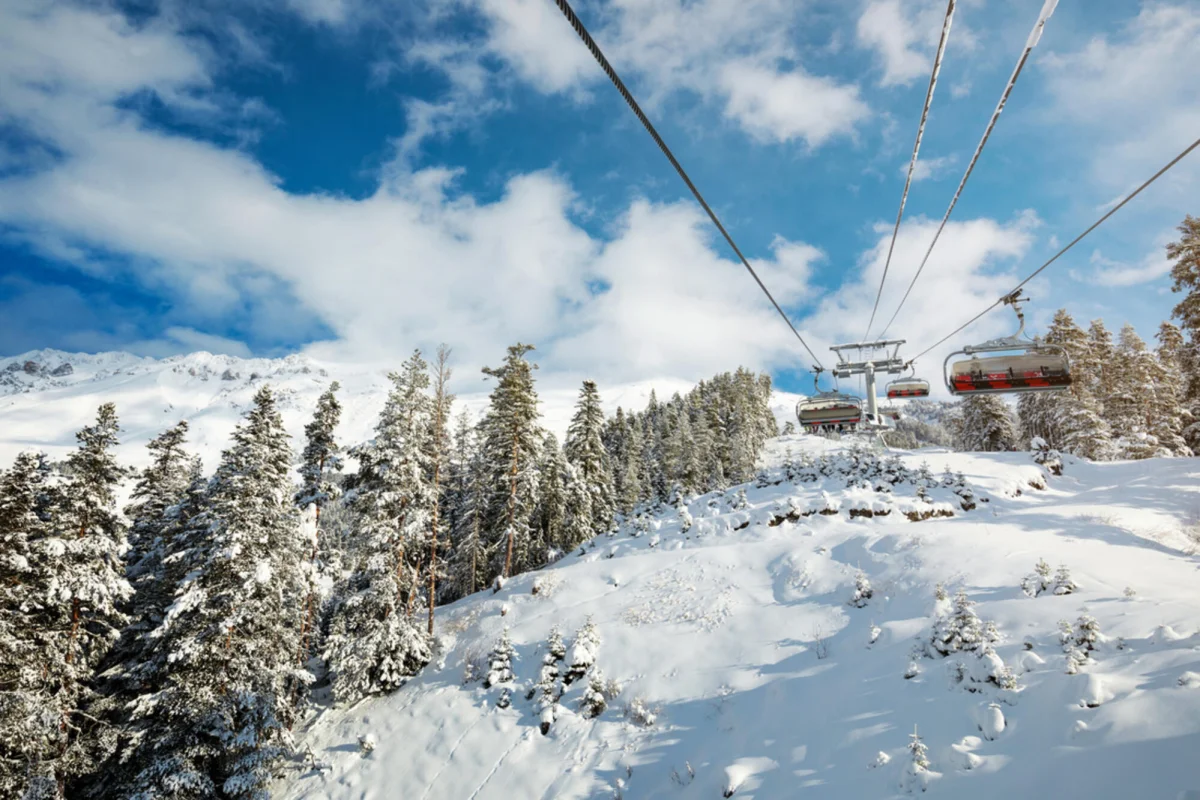
Arkhyz is the youngest of Russia's major ski resorts — its first cable car only opened in 2012. But over the past decade, it's grown into a full-fledged destination, where the season starts earlier and the weather runs steadier than its more famous neighbors.
Choosing between Krasnaya Polyana, Elbrus, and Arkhyz, many people start with trails and prices — and only think about weather afterward. That's a mistake: climate is exactly what makes Arkhyz stand out. It's milder than Elbrus, sunnier than Sochi, and the winter rain that occasionally ruins skiing in Krasnaya Polyana is rare in Arkhyz.
How Long the Season Lasts
Ski season in Arkhyz runs from late November through late April, and in snowy years, into early May. Exact opening dates depend on weather and the snowmaking system's operation, and shift a bit each year:
- 2022/2023 season — opened December 1.
- 2023/2024 season — November 25.
- 2024/2025 season — a record-early opening on November 15.
- 2025/2026 season — test skiing November 21–23, with the full season starting in early December.
Closing typically falls in the second half of April. In 2024, skiing continued through May 1 — snow on the upper trails held out until the very end.
What Winter Weather Looks Like on the Slopes
Arkhyz is shielded from cold winds by two mountain ranges — Abishira-Akhuba to the north and Gabulu to the south. Thanks to this, winter here is mild and sunny, without the extreme cold typical of Elbrus, and without the thaws that plague Sochi.
Average temperature on the trails in January runs around 18–23°F (–5 to –8°C) during the day, dropping to 5–10°F (–12 to –15°C) at night. At the upper cable car stations (elevation up to 3,030 meters), it's 5–7 degrees colder, but wind is usually absent — the mountains block it.
Arkhyz gets noticeably more sunny days in winter than Krasnaya Polyana: the resort sits on the northern slope of the Main Caucasus Ridge, away from the Black Sea moisture that brings cloud cover and rain to Sochi. Sudden thaws or midwinter rain are extremely rare here — the weather runs more stable than at any other major Caucasus resort.
Which Months Have the Best Snow
Arkhyz doesn't have a single clear "snowiest month" — snowfall distributes unevenly across the winter. In 2022 and 2024, the peak fell in January; in 2023, in March; and in 2021, abnormal precipitation hit both January and February at once.
But in terms of snow quality rather than raw precipitation, the picture is clearer:
- December — the snowpack is still forming. Lower trails have limited natural snow, and the artificial snowmaking system runs actively. The upper slopes are already in good shape, but trail selection stays limited.
- January–February — the best time. Snowpack is stable, temperatures hold reliably below freezing, and the snow is dry and packed. Plenty of sunny days, little wind — ideal skiing conditions.
- March — snow is still good, especially in the morning. But by midday, south-facing slopes soften noticeably as the March sun starts carrying real warmth. For anyone who loves spring skiing in a t-shirt, this is the sweet spot.
- April — lower trails start thawing while the upper ones hold on. The season winds down, prices drop, but the snow itself changes character: firm and hard in the morning, wet by afternoon.
What About Artificial Snow
The resort runs a snowmaking system — snow cannons start up as early as November and maintain coverage on key trails throughout the winter. This matters especially in December and at the tail end of the season, when natural snow on the lower slopes can fall short.
Artificial snow is firmer than natural snow — less pleasant to ski on, though this actually works in beginners' favor, since it's denser and gives skis more grip. By mid-January, once natural snowpack builds up, the difference between "cannon" snow and the real thing mostly disappears.
The Trails: What the Slopes Offer
For the 2025/2026 season, Arkhyz has 16 trails open across two slopes — South and North — totaling 27 kilometers. Broken down by difficulty:
- 4 green trails — for beginners, gentle and wide.
- 5 blue trails — intermediate, covering the bulk of skiing.
- 5 red trails — for experienced skiers, with elevation changes and turns.
- 2 black trails — for advanced thrill-seekers.
Elevation range runs from 1,660 to 3,030 meters. Ten lifts operate, including gondola and chairlifts. Lines are minimal on weekdays, but noticeable on holidays and weekends, especially at the lower stations.
How to Pick a Month Based on Your Skill Level
Beginners should aim for January–February: firm snow, stable weather, every trail open, plenty of instructors available. Experienced riders chasing fresh powder should track the forecast and catch snowfalls directly — they're unpredictable month to month, but each one delivers a few days of excellent off-piste skiing afterward.
For anyone who cares more about price than perfect snow, December (before the New Year holidays) and late March through April work well: the resort shifts into low season, lift passes and rentals get cheaper, and the upper trails remain entirely skiable.
Getting There and What to Know
The nearest airport is Mineralnye Vody, about 210 kilometers from the resort — roughly 3 to 3.5 hours by car or transfer.
The route runs through Cherkessk and into the mountains — the final stretch winds through switchbacks, but the road surface is good.
Beyond standard ski gear, pack sunglasses and high-SPF sunscreen: winter sun in the mountains at 2,000–3,000 meters feels deceptively gentle, but UV reflected off snow burns skin faster than a summer beach ever would.