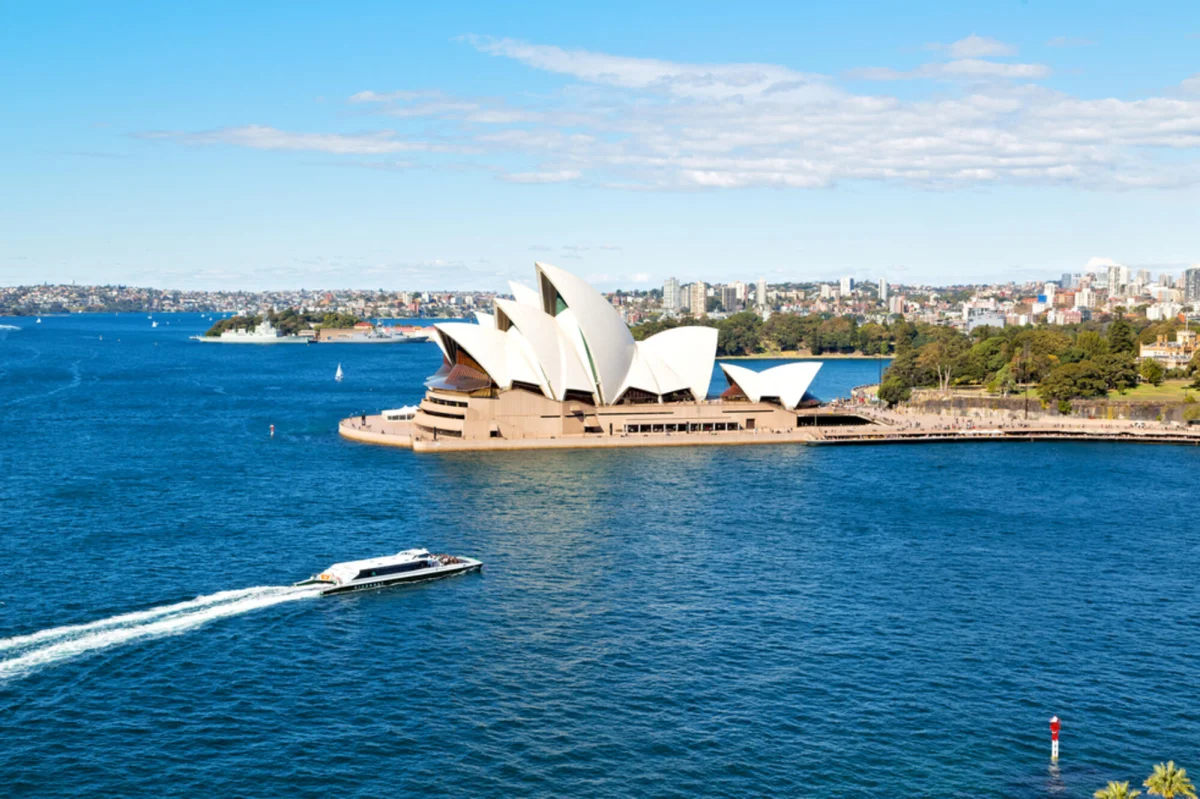
Australia lives by a mirror-image calendar: while Russia is gripped by January frosts, Sydney is at 26°C and the beaches are full. But "summer" here is a flexible concept, and the best time to visit different parts of the country varies by as much as six months.
Picture it: it's New Year's Eve, you're standing on the waterfront with fireworks behind you and the ocean in front, the air is 25°C, and the water is so warm you could wade in and never come out. This isn't a fantasy; it's an ordinary New Year in Sydney.
While half the people on the other side of the planet are huddled by their radiators, Australians are firing up the barbecue in shorts. The seasonal difference is the main thing to understand about Australia before you buy a ticket.
Why Everything Is Upside Down
The mechanism is simple: Australia lies in the Southern Hemisphere. When the Northern Hemisphere is tilted away from the Sun (our winter), the Southern Hemisphere is tilted towards it, and vice versa.
So December, January and February are summer in Australia, while June, July and August are winter.
But Australia is the sixth-largest country in the world, and the "season" depends on exactly where you are. The distance from tropical Darwin in the north to cool Hobart in the south is about 3,700–3,800 km as the crow flies, further than from Moscow to Krasnoyarsk.
Three Climate Zones, Three Different "Seasons"
Broadly speaking, Australia can be divided into three climate belts, each with its own best time to visit.
The tropical north (Darwin, Cairns and the Great Barrier Reef) runs not on "summer and winter" but on "dry season and wet season." From November to April it's the wet season: monsoon downpours, muggy heat of up to 33–34°C, tropical cyclones and venomous Irukandji jellyfish off the coast.
From May to October it's the dry season: warm days (30–32°C), cool nights (19–20°C), minimal rain and the best visibility for diving.
The temperate south (Sydney, Melbourne, Adelaide and Hobart) has the classic change of four seasons, only in mirror image. Summer is December to February, autumn March to May, winter June to August and spring September to November. In winter, Melbourne sees 7–14°C: not freezing, but not beach weather either.
The arid centre (Uluru, Alice Springs and the Outback) is desert with an extreme climate. In summer (December to February), daytime temperatures climb to 40°C and above, and walking among the red rocks is simply dangerous to your health. The best time is May to September: comfortable days of 20–25°C, with nights that can drop to 5°C.
Temperatures by City: The Numbers
According to long-term data from the Australian Bureau of Meteorology (BOM):
Sydney is the most popular city with tourists. In January (high summer), it's 26°C by day and 19°C at night. In July (winter), it's 16–17°C by day and 8°C at night. Annual rainfall is around 1,200 mm, but it's spread fairly evenly.
Melbourne is the "four seasons in one day" city. In February (the warmest month), it's 26.5°C by day. In July, it's 14°C by day and 5.5°C at night. It gets noticeably less rain than Sydney, 500–650 mm a year depending on the weather station, but Melbourne's famous changeability means you always need an umbrella.
Brisbane and the Gold Coast are subtropical. In January it's 29°C by day; in winter (July), 21°C by day and 9°C at night. You can swim on the Gold Coast almost all year round, but it's most comfortable from November to April.
Cairns is the gateway to the Great Barrier Reef. It's tropical: 31–32°C in summer, 26°C in winter. Winter is the best time here: dry, warm and jellyfish-free.
Darwin is truly tropical. The hottest month is October, at 33.5°C by day. But even in "winter" (July), night-time temperatures don't drop below 19°C. The difference between summer and winter isn't the temperature but the rain: most of its annual 1,800-plus mm falls from November to March.
Hobart (Tasmania) is the coolest major city. In January it's 22°C by day; in July, 12°C by day and 5°C at night. Summer here is like a good day in St Petersburg.
What About the Ocean? When to Swim
The water temperature depends as much on the coast as on the season.
Sydney (Bondi Beach): the water warms to 23–24°C from January to March and cools to 17–18°C in July and August. The comfortable swimming season runs from December to April. The rest of the year is for the hardy: Australians swim year-round, but after Russia's Black Sea, 17°C will feel bracing.
Cairns and the Great Barrier Reef: a tropical sea, at 23–24°C even in winter (July and August) and 29–30°C in summer. You can swim at any time, but November to April is the season for dangerous jellyfish (box jellyfish and Irukandji). At that time, people swim only in netted enclosures and in stinger suits (protective suits).
The Gold Coast: the water is warmer than in Sydney, at 22–27°C from November to April and around 20–21°C in winter. It has one of the longest swimming seasons on the east coast.
The Great Barrier Reef: When to Go
The reef is one of the main reasons to fly to Australia, and it has a calendar of its own.
- The best time for diving and snorkelling is June to October (the dry season): clear water, no jellyfish and comfortable temperatures of 23–26°C. That's our summer and autumn, which makes it easy to fit in with a holiday.
- Humpback whales migrate past the reef from June to October, and you may spot them right in the middle of a dive.
- Coral spawning, a unique event when the reef "blooms," takes place in November and December, but by then the jellyfish season and the rains are starting.
- Turtles lay their eggs from November to March, and the first hatchlings emerge in January.
The conclusion is simple: for the reef, go in the dry season, which means our summer and autumn months.
Bushfire Season: What You Need to Know
Australia is a land of bushfires, and they're not an abstract threat. In the southern states (New South Wales, Victoria, South Australia and Tasmania), fire season peaks from December to February, during the Australian summer, when it's dry and hot.
The catastrophic fires of 2019–2020 (the so-called Black Summer) were exceptional in scale, but in general smoke and the smell of burning in the suburbs of Sydney and Melbourne in January and February are not unusual.
You can keep track of the situation through the Fires Near Me app (for New South Wales) and the websites of the state fire services.
For visitors, this means that if you're travelling to the southern states between December and February, you should keep an eye on warnings and have a back-up plan in case a national park is closed because of the fire danger.
When and Where: A Month-by-Month Cheat Sheet
Our autumn (September to November) = the Australian spring. A great time for Sydney and Melbourne: warm (20–24°C), gardens in bloom and fewer tourists than in summer. In Perth, Kings Park hosts its wildflower festival in September. On the reef, these are the last weeks of perfect diving.
Our winter (December to February) = the Australian summer. Peak season on the southern and eastern coasts: Sydney, Melbourne, the Gold Coast and Tasmania. Beaches, surfing and long days. But also heat, crowds and high prices. In the tropical north, it's the wet season: downpours, cyclones and jellyfish. Better to stay away from the Outback.
Our spring (March to May) = the Australian autumn. Perhaps the most balanced time for a trip: Sydney and Melbourne are still warm (20–25°C), the water at Bondi stays at 21–23°C, fire season is over and prices are lower. In the north, the dry season is beginning, so you can head to Cairns and Darwin.
Our summer (June to August) = the Australian winter. It's cool in Sydney (14–17°C) and chilly in Melbourne (10–14°C). But in the tropical north, the weather is perfect: dry, warm and jellyfish-free. It's the best time for the Great Barrier Reef and Kakadu. In the Outback, it's comfortable by day and cold at night.
For Russian Travellers: Logistics
Russians need a visa for Australia: a Visitor visa (subclass 600). The fee is AUD 250 (about $160) from July 1, 2026. There are no fixed processing times: in practice it takes anywhere from a few weeks to about three months, so it's best to apply two to three months before your trip.
The fee can be paid by foreign bank card only: Russian bank cards generally don't go through. Giving biometrics at a visa centre costs extra.
There are no direct flights from Russia to Australia. You'll have to change planes, most often in Abu Dhabi (Etihad), Dubai (Emirates), Doha (Qatar Airways) or Kuala Lumpur. The total journey time is 18 to 24 hours, depending on the connection. The distance from Moscow to Sydney is about 14,500 km as the crow flies.
The cost of flights depends on the season and the airline: in the peak period (December and January), tickets are noticeably more expensive than in spring or autumn. Being flexible with your dates can save you a considerable sum.
What to Keep in Mind Before You Go
- The sun in Australia is fierce. Because of the relatively low latitudes, the very clean air and the fact that the Earth is closer to the Sun during the southern summer, the UV index here is among the highest in the world. You can burn in 15–20 minutes, even on a cloudy day. SPF 50+ sunscreen, a hat and sunglasses aren't a whim but a necessity.
- The distances are huge. From Sydney to Melbourne is 880 km (an hour and twenty minutes by plane, nine hours by car). From Sydney to Cairns is 2,400 km by road. Plan your route with domestic flights in mind.
- Traffic drives on the left, so if you're planning to hire a car, you'll need to get used to it.
- Tap water is safe to drink. It's one of the perks people forget to mention.
There's no universal "season" in Australia: the country is too big. But that's exactly what makes it interesting: whatever month you arrive, the weather will be perfect somewhere on the continent. You just need to know where.