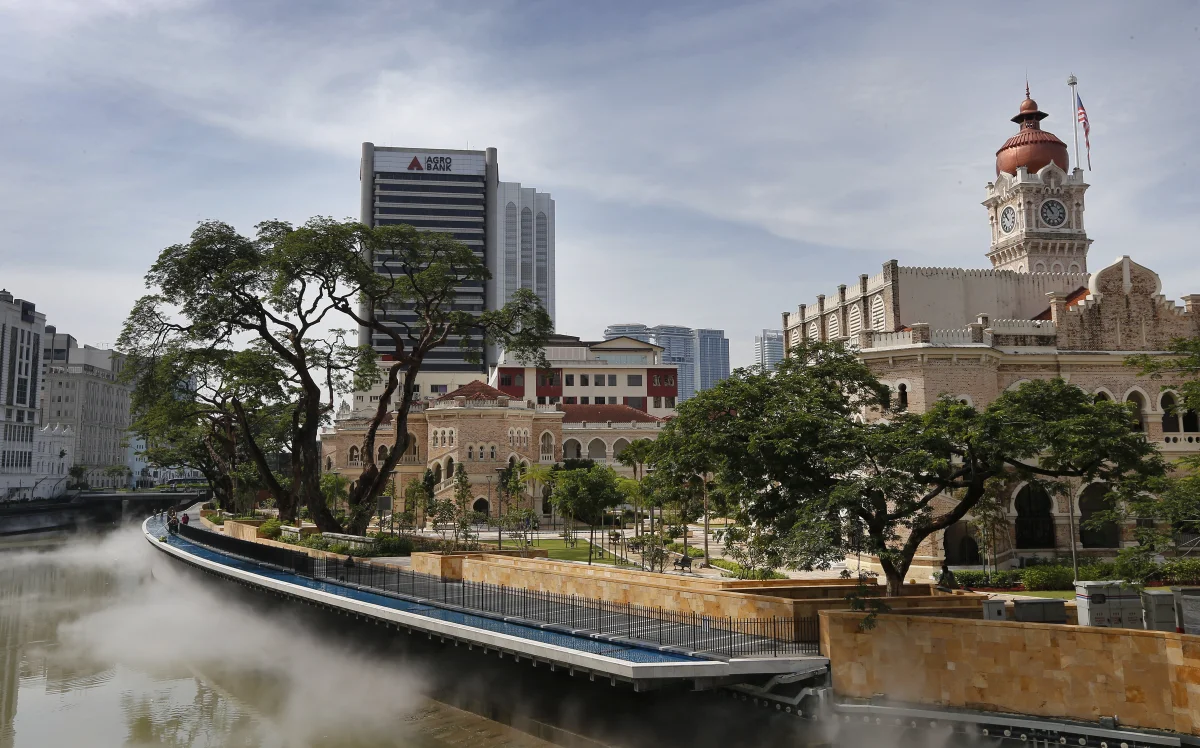
Kuala Lumpur sits almost on the equator and gets nearly three thousand millimetres of rain a year. Rain here isn't a seasonal phenomenon but part of the daily schedule. But some months are easier to cope with than others.
A typical day in Kuala Lumpur goes like this: a clear morning, clouds building up by lunchtime, a torrential downpour with thunder and lightning at around 3pm, and by six or seven in the evening it's all over: wet tarmac, steaming air and clear skies again. And so it goes almost all year round.
There are no completely dry months here, but the difference between "a downpour every other day" and "a wall of water every evening, plus rain at night" is fundamental. That's what decides when to go.
The Tropics Without Winter: What It Means in Practice
Kuala Lumpur lies at 3° north, almost on the equator. Its climate is tropical equatorial (Af in the Köppen classification: tropical rainforest). That means there's no familiar change of seasons: the temperature barely changes, and instead of "winter" and "summer" there are wetter and relatively less wet periods.
Daytime temperatures hover around 32–34°C all year round, and night-time temperatures around 23–25°C. The difference between the "coolest" and the hottest month is about one degree. To someone from central Russia, all twelve months here will feel equally hot.
Humidity is a constant 70–90%. That's what creates the "steam room" feeling, especially after rain, when the tarmac and concrete start releasing the heat they've stored up.
How Much Rain There Really Is
Annual rainfall in Kuala Lumpur is around 2,800–2,850 mm (data from the weather station at Sultan Abdul Aziz Shah Airport, 1991–2020 norms). By comparison, Moscow gets about 700 mm and Sochi about 1,500 mm. In other words, four times as much as the Russian capital.
There are around 160–167 rainy days (with at least 1 mm of rain) a year. That means almost every other day brings rain. But the figure is misleading: most of the rain falls in short, intense downpours rather than long spells of drizzle. A typical tropical downpour lasts 30–90 minutes, and the sky clears afterwards.
Two Monsoons and Two Gaps Between Them
Malaysia's climate is governed by monsoons, and Kuala Lumpur, on the west coast of the peninsula, feels the influence of both, though in different ways.
-
The southwest monsoon (late May to September) is a relatively dry period for Kuala Lumpur. The wind blows from the Indian Ocean, but Malaysia's west coast is shielded from it by the island of Sumatra, which takes most of the moisture. There is some rain, but it's less frequent and shorter.
-
The northeast monsoon (November to March) is Malaysia's main rainy season. The wind from the South China Sea brings moisture, and the east coast gets truly drenched. The western part of the peninsula, where Kuala Lumpur stands, is partly sheltered by the Titiwangsa Mountains, which run down the middle of the peninsula, but the rain picks up here too, especially in November and December.
-
The inter-monsoon transitions (April–May and October–November) are periods when the wind changes direction, the atmosphere is unstable and thunderstorm activity peaks. These are the weeks that bring the heaviest downpours and bouts of flooding.
Rainfall Month by Month: Where's the Window?
According to weather station data (1991–2020 norms), rainfall is distributed roughly as follows:
- January: 227 mm, 13–14 rainy days
- February: 193 mm, 11–12 days, one of the driest months
- March: 270 mm, 14–15 days
- April: 302 mm, 15–17 days, one of the wettest
- May: 230 mm, 13–14 days
- June: 146–152 mm, 10 days, the driest month of the year
- July: 165 mm, 11 days
- August: 174 mm, 11 days
- September: 220 mm, 12–13 days
- October: 284 mm, 16 days
- November: around 350–360 mm, 18–20 days, the wettest month
- December: 281 mm, 16–17 days
The difference between the driest month (June, at around 150 mm) and the wettest (November, at around 360 mm) is almost two and a half times. But even in June it rains every third day, and "dry" is a very relative term.
When to Go
The best months are June, July and August, and, with some caveats, January and February.
From June to August, the southwest monsoon brings Kuala Lumpur its calmest weather: the least rain, 10–11 rainy days a month, and short, predictable downpours (in the afternoon). There are around six to seven hours of sunshine a day, which is a good figure for the tropics.
January and February are also relatively dry: rainfall is moderate, and the downpours don't drag on as they do in November. But this is peak tourist season: hotel prices are higher, and the queues for the viewing platforms are longer.
March to May is a transition period. April is one of the wettest months, but if you go in early March, you may catch the tail end of the drier spell.
October and November are the worst time to go. It rains not only during the day but also at night, and the downpours are heavier and longer. November has 18–20 rainy days, meaning it rains practically every day. December is wet too, but it usually gets a little drier towards the end of the month.
Haze: An Unexpected Downside of the Dry Season
From June to September, technically the best months, there's a catch: haze from forest and peat fires on the Indonesian islands of Sumatra and Kalimantan. When the wind blows towards Malaysia, the smoke blankets Kuala Lumpur for days or even weeks.
In 2026, for example, the haze arrived in late summer and lingered until at least the end of October. The Air Pollutant Index (API) at the Cheras station in Kuala Lumpur rose to 172 at the end of September, and to 166 for the city as a whole: that's in the "unhealthy" category (101–200).
Even at the end of October, several stations in and around Kuala Lumpur were still showing "unhealthy" levels. Rain brings only temporary relief if smoke keeps drifting in from Indonesia.
Haze doesn't strike every year with the same intensity: some seasons have almost none, while others, such as 2015, 2019 and 2026, see it linger for months. You can keep track of forecasts on the MetMalaysia website and check the Air Pollutant Index on the portal of Malaysia's Department of Environment.
"Sumatras": Morning Storms Out of Nowhere
Another feature of Malaysia's west coast is the so-called "Sumatras" (Sumatra squalls). These are squall lines that form over the Strait of Malacca at night and slam into the coast in the early morning, usually around dawn.
Unlike the usual afternoon downpours, Sumatras are frontal storms: sudden winds, a wall of rain and sometimes hail.
They're most common during the southwest monsoon, roughly from May to August or September, and can cause flash floods in low-lying parts of the city.
Floods Are Normal, Not a Disaster
Kuala Lumpur lies in a valley, and the city's name means "muddy confluence": this is where the Gombak and Klang rivers meet. In heavy downpours, the water rises quickly.
The city is used to it. Beneath the centre runs the SMART Tunnel (Stormwater Management and Road Tunnel), a unique piece of engineering that normally works as a road tunnel but switches to draining floodwater during downpours.
But it doesn't solve the problem completely: the Masjid Jamek, Jalan Pudu and Wangsa Maju areas flood several times a year.
For visitors, this means one thing: in the rainy months, avoid staying in low-lying areas along the Klang River, and in a heavy downpour it's better to wait it out indoors rather than trying to cross a flooded street.
What to Do When It's Pouring
Kuala Lumpur is a city built for rain. It has a huge network of covered walkways and shopping centres, linked to each other and to the metro. You can walk several kilometres without stepping outside.
A few ideas for a rainy day:
- The Petronas Towers and the Skybridge: it's best to book tickets in advance, but if it's pouring outside, the observation deck may be closed because of poor visibility
- The Islamic Arts Museum: one of the best collections in Southeast Asia, in a building that's worth a visit in itself
- Aquaria KLCC: right next to the park by the Petronas Towers
- Petrosains: an interactive science museum, good for families with children
- Shopping centres: Pavilion, Suria KLCC and Mid Valley Megamall are, in scale and variety, more like cities within the city
But Batu Caves in the rain is a questionable idea: the 272 steps up to the entrance get slippery, and the monkeys by the staircase get bolder when the crowds thin out.
For Russian Travellers: Logistics
Malaysia is one of the few Asian destinations with visa-free entry for Russians: up to 30 days without a visa. All you need is a passport (valid for at least six months) and a completed online MDAC form (Malaysia Digital Arrival Card, free of charge). It's worth double-checking the entry rules before you travel.
There are no direct flights from Moscow to Kuala Lumpur yet. Talks on direct air links are under way: in autumn 2026, Malaysia's tourism minister discussed direct flights with Aeroflot and Red Wings, including an option with a connection in Haikou.
The Malaysian low-cost carrier AirAsia has announced plans to fly to Moscow, but from Bangkok. For now, you have to travel with a connection, most often via Doha, Istanbul, Dubai, Abu Dhabi or Chinese cities. The journey takes 12 to 18 hours, depending on the connection.
Even so, the flow of Russian tourists to Malaysia is growing: around 140,000 Russians visited the country in 2025, a record. For 2026, declared the year of the Visit Malaysia 2026 campaign, industry experts forecast growth of 20%, but in fact Russian arrivals rose by 4.3% in January–August 2026 (to around 98,500).