Armenia welcomes visitors all year round, but each season has its own character. Summer scorches the valleys and beckons with cool air in the mountains, while autumn turns out, unexpectedly, to be the time when the country shows itself at its best.
You land in Yerevan in July, step out of the airport, and the first thing you feel is a dry heat of nearly 40°C. By midday the tarmac is melting, Republic Square empties, and the only escape is air conditioning or the mountains, which you still have to get to.
Yerevan in late September is a completely different story: 25°C, soft light, markets piled high with grapes and pomegranates, and you can sit out on a veranda until late in the evening. That's when you start to understand why locals say that the real Armenia is autumnal.
How the Climate Works
Armenia is a mountainous country: more than 90% of its territory lies above 1,000 metres. That means that on the same day it can be 35°C in Yerevan and 22°C in Dilijan, while at Lake Sevan you'll actually need a jacket.
The climate is sharply continental: hot, dry summers and cold winters. There isn't much rain overall, from 200 to 800 mm a year depending on altitude and region. Most of it falls in spring and early summer, while the second half of summer and autumn are the driest months.
In Yerevan, the average temperature is −3°C in January and around 24–26°C in July. But daytime highs in summer regularly reach 30–33°C, and 37–38°C during heatwaves. Annual rainfall is only around 300–350 mm, and in July and August rain is a rarity, with one or two rainy days a month.
The temperature drops by about 0.6°C for every 100 metres of altitude. So the mountain towns of Tsaghkadzor, Dilijan and Jermuk have a literally different climate from the Ararat Valley.
Spring: April and May
Spring in Armenia is short and changeable. March still feels wintry, with sleet, wind and sub-zero nights in the mountains. But April is already pleasant: Yerevan sees 15–21°C by day, everything is in bloom, and the apricot orchards of the Ararat Valley are wrapped in a pink and white cloud.
May is one of the best months for a first trip. It's warm (21–27°C in Yerevan) and green, and the mountains still have snowy caps: postcard views of Mount Ararat are especially striking against the flowering valleys. Garni, Geghard, Khor Virap and Noravank, all the main sights, are accessible and comfortable to explore.
The downside is thunderstorms. April and May are the wettest months in Yerevan, and in the mountain areas (Dilijan, Lori and Tavush) the downpours are even more frequent. An umbrella and a jacket are essential.
Summer: Scorching Below, Cool Up Above
June to August means two parallel summers in one country.
In Yerevan and the Ararat Valley, it's a real furnace. July and August are the peak, with daytime temperatures of 30–38°C, almost no rain (7–10 mm a month) and low humidity. Walking around the city in the middle of the day is an ordeal, and most Yerevan residents shift their activities to the evening: restaurants and cafés come alive after nine, and strolls on the Cascade are only pleasant after sunset.
In the mountains, it's a different matter entirely. In Dilijan, Tsaghkadzor, Jermuk and on the shores of Sevan, it's 20–26°C, with green forests, clean air and night-time cool that has you reaching for a jumper.
Lake Sevan is the main summer draw. The swimming season here is short: the water only warms to a comfortable 18–22°C in the second half of July and August. The lake lies at 1,900 metres, and even on a hot day, after a breeze, the water feels distinctly fresh. But the landscape, turquoise water set against treeless mountains, is like nothing else in the region.
Why Autumn Is the Main Season
And now to the reason it's worth rearranging your calendar.
September: Warm Without the Heat
In Yerevan it's 25–31°C by day, and at night you can finally sleep with the window open and no air conditioning. There's almost no rain, usually one to three rainy days a month. The days are still long, the sun is gentler, and the city comes alive at any time of day, not just in the evening.
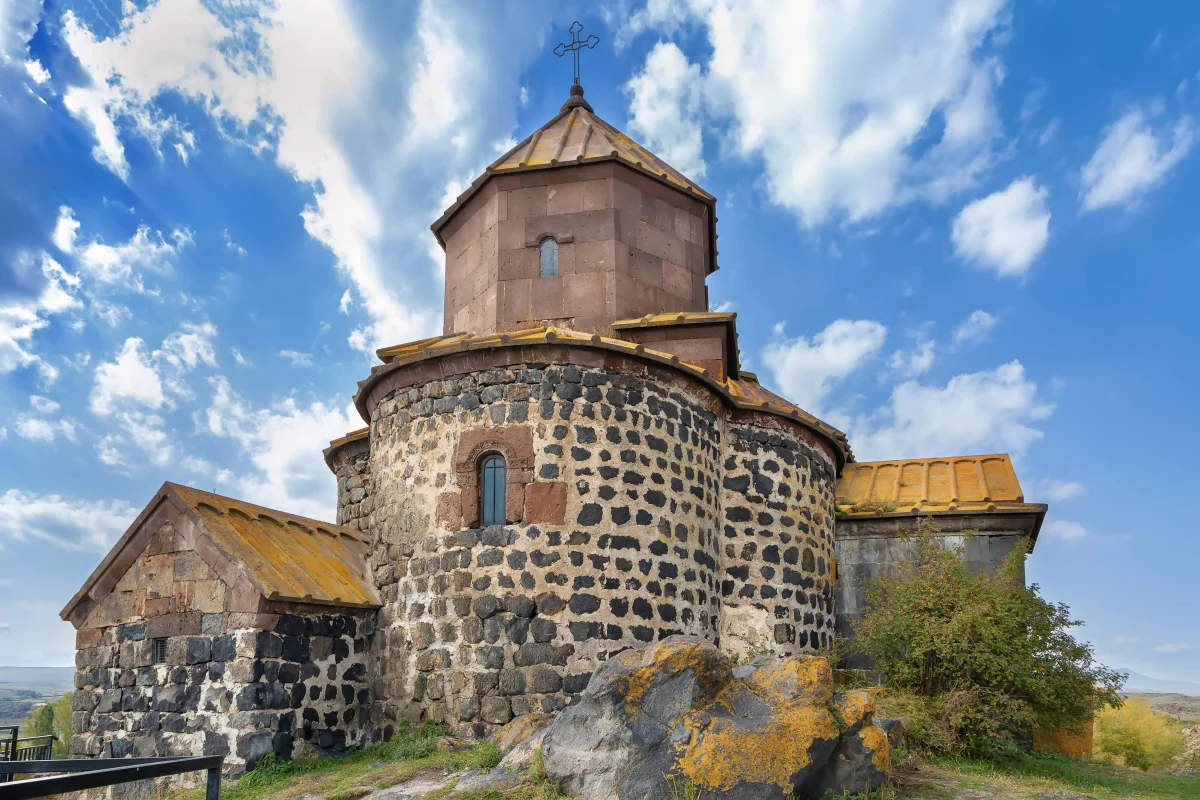
For sightseeing, September is ideal. The churches and fortresses aren't baking like a frying pan, as they are in July. The road to Noravank through its red gorge, the ride up to Tatev on the Wings of Tatev cable car, the hairpin bends up to the Selim Pass: in September you can enjoy all of this rather than just survive it.
September is also when the grape harvest begins, and Armenia turns into one big winery.
October: Gold, Wine and Pomegranates
October is the month when Armenia changes colour. Yerevan is still warm: 16–24°C at the start of the month, and around 16°C by day towards the end. You'll need a jacket in the evenings, but the days are comfortable.
The highlight is Dilijan National Park in its autumn colours. A nature reserve was established here back in 1958, and it became a national park in 2002. The park covers more than 240 km² of mountain forest (about 338 km², according to Armenia's Environment Ministry): oak on the southern slopes, beech on the northern ones, and subalpine groves above 1,900 metres.
In mid-October (around the 15th to the 20th, depending on the weather and altitude), the foliage reaches its peak: yellow, orange and burgundy against the mountain ridges and the medieval monasteries of Haghartsin and Goshavank. Lake Parz, at 1,400 metres, looks as if it were painted specially for a magazine cover at this time of year.
October is also the peak for food. The markets are full of grapes, pomegranates, persimmons, walnuts and the freshest cheeses. On the first Saturday of October, the village of Areni (in Vayots Dzor province) hosts its annual Wine Festival: tastings, homemade wines, national cuisine, music and traditional grape stomping.
And in mid-October, usually on the second weekend of the month, Yerevan celebrates its birthday with the Erebuni-Yerevan festival: concerts, festivities and a city programme running late into the evening. In 2026, it was celebrated over two days for the first time, on October 9 and 10.
The Vayots Dzor region is the heart of Armenian winemaking. It was here, in the Areni-1 cave, that the world's oldest known winery, more than 6,000 years old, was discovered. The local indigenous Areni grape (red, with a distinctive tartness and berry aroma) is the country's calling card. In autumn, the wineries are open to visitors, and after the harvest you can catch the most interesting part: seeing grapes turn into wine.
November: Too Late?
Not quite. In Yerevan it's 8–14°C by day; the evenings are cool, but the city is still great for walking.
For museums, restaurants and the book cafés on Abovyan Street, the weather hardly matters. In the mountains, though, it's already cold: frosts are possible in Dilijan, and the first snow falls on the passes. The tourist season at the nature spots is effectively over.
On the other hand, November is the budget time: prices for accommodation and flights fall, and the crowds disperse.
Winter: Skiing and Spas
Winter in Armenia means first and foremost Tsaghkadzor, a ski resort an hour's drive from Yerevan. The season runs from mid-December to the end of March, with the most reliable snow in January and February. The resort is compact and the runs are designed for beginners and intermediates, but its proximity and prices make it attractive for Russians.
Jermuk is a spa resort with mineral water and mountain air. It's open all year round but is especially cosy in winter: hot springs, snow-covered mountains and silence.
In winter, Yerevan is quiet and atmospheric. Armenians celebrate the New Year holidays in style: the city is decorated and the restaurants are full. Daytime temperatures are 0–5°C, with frost at night. Snow does fall in Yerevan, but it doesn't last long.
Getting There From Russia
Armenia is one of the easiest destinations for Russian travellers. You don't need a visa. You can even enter on a Russian internal passport, but only if you fly in directly, via Zvartnots (Yerevan) or Shirak (Gyumri) airports.
If you're travelling overland through Georgia, you'll need an international passport. You can stay in the country without a visa for up to 180 days a year (in total across all trips).
Direct flights to Yerevan operate from Moscow, St Petersburg, Sochi and a number of other cities. Carriers include Aeroflot, Rossiya, Utair, FlyOne Armenia and others. The flight from Moscow takes about three to three and a half hours. Since June 2026, Aeroflot has been flying from St Petersburg three times a week on an Airbus A320, in addition to the Rossiya and FlyOne Armenia services.
The time difference with Moscow is +1 hour.
What to Keep in Mind on the Ground
Currency — the Armenian dram. Russian Mir cards work in Armenia only at VTB Armenia ATMs and terminals: other banks and the national payment system, ArCa, have not accepted them since March 2024. Visa and Mastercard cards issued by Russian banks don't work. So it's best to carry cash to exchange.
Clothing — the key rule is layers. Even in September, it can be 10°C in the mountains in the morning and 28°C in Yerevan by midday. Sturdy shoes for mountain trails and a light jacket for the evening are the minimum.
Getting around — for trips outside Yerevan, the most convenient option is to hire a car. But the mountain roads require care: hairpin bends, passes and autumn fog. In the areas bordering Azerbaijan (the Ijevan–Noyemberyan stretch), it's advisable to check the situation before setting off.
The ideal length for a first trip is five to seven days. It's easiest to base yourself in Yerevan and make day trips: Garni and Geghard, Khor Virap, Sevan, Dilijan and Noravank can each be done in a day.
Which Month to Choose
-
May — for a first visit, with blossom, snowy peaks and comfortable temperatures. But there may be rain.
-
June — warm, but not yet scorching. Good for the mountains and sightseeing, but Sevan is still too cold for swimming.
-
July–August — for Sevan and the mountain resorts. Too hot in Yerevan for walking around.
-
September — the best month. Warm without the heat, dry, the grape harvest and long evenings on verandas.
-
October — golden autumn, Dilijan in full colour, the Areni wine festival and Yerevan's birthday. A little cooler, but still comfortable.
-
November — affordable and intimate, but the nature routes are already closing.
-
December–February — skiing in Tsaghkadzor, spas in Jermuk and Yerevan at New Year.
Armenia doesn't demand the "right" month: it works in any season. But if you want to see the country at its best, when the light is soft, the air smells of grapes and the mountains change colour every day, aim for September or the first half of October. That's when Armenia isn't just beautiful but truly generous.