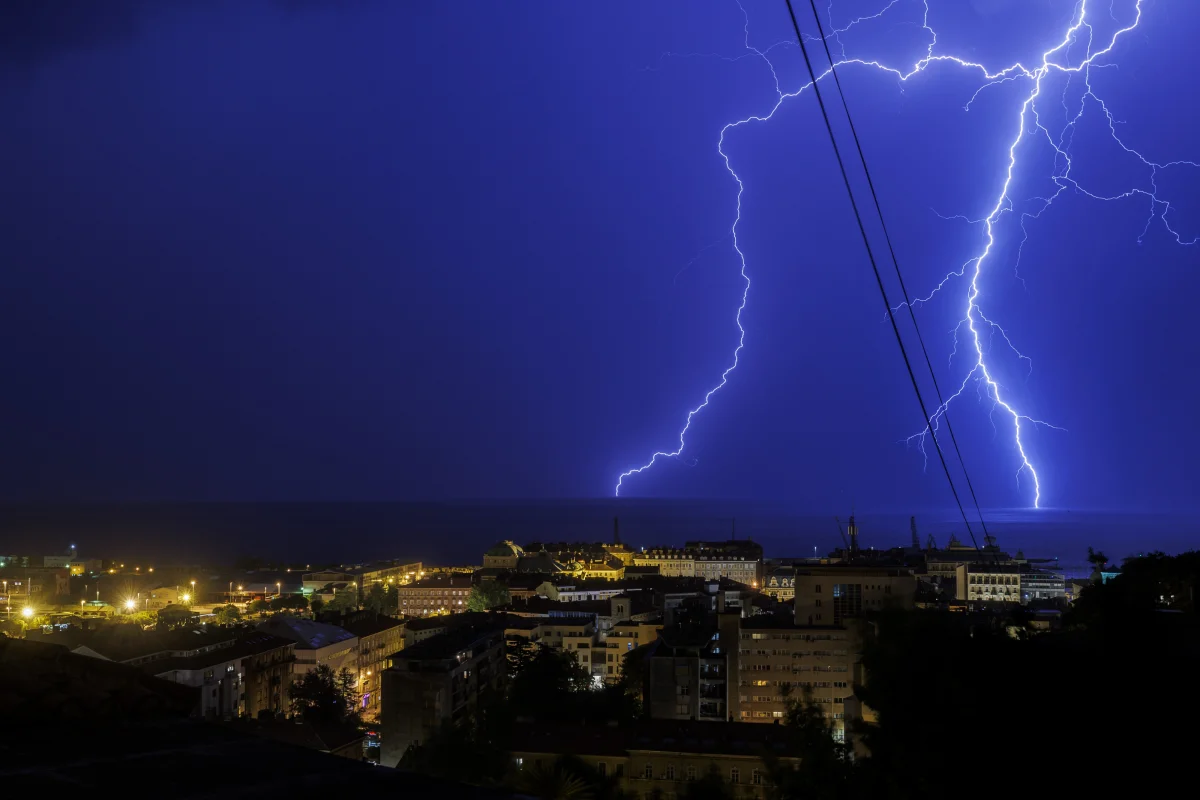
Lightning kills thousands of people around the world every year. Most of them weren't standing under a tree or holding an umbrella: they simply started looking for shelter too late, or didn't know what to do in the first seconds after the flash.
Thunderstorms creep up fast. One moment you're grilling kebabs at the dacha, walking across a field or swimming in a lake; the next, the sky darkens, the wind shifts and there's a dull rumble in the distance. Between "it'll probably pass us by" and a strike a hundred metres away, less than a minute can go by. And at that moment, everything depends on whether you know three or four simple rules, or whether you're acting on guesswork.
Why Lightning Is More Dangerous Than It Seems
Lightning is an electrical discharge with a channel temperature of around 30,000°C (five times hotter than the surface of the Sun). It lasts thousandths of a second, but that's enough to stop the heart, damage the nervous system or cause severe burns.
Estimates of how many people lightning kills around the world each year range from 3,000–6,000 to 24,000. Yet lightning strikes are fatal in only about 10% of cases: nine out of ten people struck survive, especially if they get help quickly. The problem is that the heart and breathing stop instantly, and without resuscitation in the first few minutes, the chances fade.
Russia has no accurate national statistics: the data has to be pieced together from reports by the Emergencies Ministry (MChS) and the media. Expert estimates usually put the number of people struck by lightning at several dozen a year, but the real figures may differ considerably. Most cases occur between May and August, the peak of thunderstorm activity.
How to Tell a Storm Is Close
There's a simple rule: when you see a flash, count the seconds until the thunder. Every three seconds equals one kilometre. Sound travels at about 340 m/s, while light arrives almost instantly. So:
-
3 seconds between flash and thunder = the lightning is 1 km away
-
6 seconds = 2 km
-
10 seconds = just over 3 km
If the gap is less than ten seconds, you're in real danger. But don't wait for that moment: if you can hear thunder at all, you're already close enough to be struck.
There's also the more conservative "30–30 rule": if less than 30 seconds pass between the flash and the thunder, take shelter immediately. Don't leave it until another 30 minutes have passed since the last lightning. Lightning can strike up to 16 km away from a storm, sometimes when the sky overhead is almost clear.
The Biggest Myth: A Tree Will Protect You
This is the most dangerous mistake people make in a thunderstorm. You must never shelter under a tree. A tree is a tall object that attracts the discharge. But a direct strike isn't the only danger.
When lightning hits a trunk, some of the current can jump to a person standing nearby. This is called a side flash, and it most often strikes people who have taken shelter under a tree from the rain. And most of the energy spreads through the ground around the point of impact, a mechanism linked to step voltage.
According to the US National Weather Service, it's this current spreading through the ground that causes the most lightning deaths and injuries, because it affects a much larger area than a direct strike.
A lone tree in a field is the worst shelter there is. But even in a forest, you shouldn't huddle against the trunks. There's a popular notion that lightning more often strikes oak, poplar, willow and ash and less often spruce, fir and lime, but there's little solid scientific evidence behind it, so don't rely on it.
What to Do in an Open Field
Open ground without a single building is the most alarming situation. You may end up being the tallest object around.
The main rule is not to waste time. If there's a solid building or a car with a metal body within reach, run to it as soon as you hear thunder. Running doesn't increase the risk in itself, but delay does: many lightning victims died precisely because they started looking for shelter too late.
Don't waste time taking off metal objects: they don't "attract" lightning in themselves (what matters is an object's height, shape and isolation, not what it's made of). If you have a long way to go to reach shelter, it's best not to hold long metal objects such as trekking poles or an umbrella above your head.
If there's no shelter nearby at all, all you can do is minimise the risk: get off high ground, and keep away from lone trees, poles and water. In the past, people in this situation were advised to adopt the lightning crouch: squatting down with feet together and head tucked towards the knees.
Today, weather services warn that this position offers no significant protection and shouldn't create a false sense of security. It's only a last resort when there's no shelter at all.
Don't lie down on the ground: that creates more points of contact with the surface and makes it easier for current to pass through your body.
What to Do in a Forest
It's important to understand that there's no safe place outdoors in a thunderstorm. A forest is the lesser evil compared with an open field, but it isn't a shelter. If you can get to a building or a car, that's always better.
If you have no choice, the main thing is not to be near the tallest tree.
Look for an area of low trees of roughly the same height and stay among them without huddling against the trunks, keeping at least two metres from the nearest one.
What to Do Near Water
A lake or river during a thunderstorm is an extremely dangerous place. Water conducts electricity, and a swimmer's head sticks up above the surface as the only tall object.
If a storm catches you on a lake or river, get out onto the shore immediately. If you're in a boat and far from shore, put on a life jacket and sit in the middle, as low as possible, without touching any metal parts.
Once on shore, move away from the water by at least a few dozen metres. A strike in the water near the shore can injure someone standing close to the edge.
A Car Is One of the Best Shelters
A car with a metal body offers excellent protection. The current runs over the outer surface of the body and into the ground. It works not because of the rubber tyres (that's a myth) but because of the Faraday cage effect: a continuous metal shell keeps the current from getting inside.
What to do: stop, close the windows, and avoid touching the metal parts of the interior, the steering wheel and the door handles. It's best to switch off the engine. Wait out the storm without getting out.
This doesn't apply to convertibles, motorbikes, bicycles or scooters, which have no enclosed metal body.
What to Do Indoors
A house is the safest shelter, but even indoors there are a few things to bear in mind. Most indoor lightning injuries happen through wiring, pipes and metal surfaces that lead outside.
During a thunderstorm, don't stand by windows or open doors. It's best to move away from the walls, by at least a metre.
Specific advice:
-
Don't use corded devices, such as a landline phone or a computer plugged into the mains
-
Don't shower, take a bath or wash the dishes: water in the pipes conducts electricity
-
Unplug appliances in advance, before the storm begins. Don't pull plugs out during a storm: at that moment you could get a shock through the cable
A mobile phone, however, is safe: it runs on a battery and isn't connected by wires to the outside network (unless it's on charge). This is confirmed by both MSD Manuals and MChS advice.
First Aid: Above All, Don't Be Afraid to Touch
One of the most persistent myths is that "you mustn't touch someone who's been struck by lightning, or you'll get a shock." That's not true. The human body doesn't store an electrical charge, and it's completely safe to touch the victim.
What to do in the first few seconds:
-
Check for breathing and a pulse. The most common cause of death from lightning is cardiac arrest. If there's no pulse, start cardiopulmonary resuscitation (CPR) immediately, and if there's an automated external defibrillator nearby, use it.
-
Call an ambulance. Even if the person has come round, they need medical attention: they may have heart rhythm problems, nerve damage or burns.
-
Don't move the person unless you have to: only if the storm is still going and you both need to take cover.
With prompt resuscitation, the outlook is good. Patients who go into cardiac arrest after a lightning strike often make a full recovery if CPR is successful.
Why Lightning Strikes "Out of Nowhere"
A discharge can reach up to 16 km from a thundercloud: these are known as "bolts from the blue." The sky above you is clear and there's no rain, but there's a storm cloud somewhere on the horizon. That's enough.
That's why the 30-minute rule after the last thunder isn't overcaution but a well-founded precaution. A storm cell can still produce a discharge when it seems as if everything is over.
In Short: What to Remember
-
If you hear thunder, head for shelter straight away. Less than ten seconds between flash and thunder means you're in the strike zone.
-
The best shelters: a solid building or a car with a metal body. Run to them without wasting time.
-
The worst places: under a lone tree, in the water, on open high ground.
-
If there's no shelter at all, get off high ground and away from tall objects. Crouching is only a last resort and doesn't guarantee protection. Don't lie down.
-
Don't wait for the rain: lightning runs ahead of the downpour and can strike under a clear sky.
-
Unplug appliances before the storm, not during it.
-
You can and should touch the victim: start CPR if there's no pulse.
-
After the last thunder, wait another 30 minutes.
Lightning is one of the few natural hazards you can protect yourself against without any special equipment. All you need is to know the rules and not ignore the first rumbles. Three seconds between the flash and the thunder isn't a cue to photograph the sky, but a signal to act.