By day, on a jeep safari in Egypt, you want nothing more than to hide from the sun, yet by evening, around the campfire in a Bedouin village, tourists are wrapping themselves in blankets. Why does the desert cool down so quickly after sunset, and is it true that it can get 40 degrees colder there in a single night?
Many people come back from desert trips with the same impression: hot by day, cold at night. The T-shirt that felt far too warm at lunchtime is no help after sunset, and by morning you want to burrow deeper into your sleeping bag.
There are plenty of exaggerations about this effect, up to and including "+40 by day, frost at night". Below, we look at where these swings come from, how big they really are, and at what time of year the desert genuinely greets the dawn with temperatures close to zero.
How Cold Does It Get at Night?
According to NASA and Live Science, temperatures in the Sahara can drop after sunset from an average of +38 °C during the day to −4 °C at night. Weather stations paint a more modest picture.
In the Algerian oasis of In Salah, in the very heart of the Sahara, the average daytime high in July is +44.6 °C and the night-time low +30.2 °C. In January, it's about +20.6 °C by day and +7.2 °C at night. So the usual daily swing there is 14–15 degrees, and a summer night at +30 °C is hardly going to feel cool.
Long-term observations from a neighbouring part of the Sahara show the same thing. July days there average about +43 °C and nights about +26 °C. January days average about +18 °C and nights about +3 °C.
So +40 by day and around zero by morning usually belong to different seasons, not the same 24 hours. Hot days and warm nights come in summer. Near-zero dawns come in winter, when daytime temperatures are +18…+20 °C. Even so, the swing really is huge: imagine a +18 °C day dropping to +3 °C by dawn.
Why Does the Air Cool So Quickly?
The main reason is dry air. Water vapour is the planet's most important greenhouse gas. At night, it acts like an invisible blanket: it absorbs the heat escaping from the ground and sends some of it back down.
In the Sahara and other arid deserts, humidity can be close to zero. There's no blanket, and the heat built up during the day escapes freely into space. That's why the temperature keeps falling all night long, right up until dawn.
The second reason is clear skies.
Clouds work the same way as water vapour: by day they block the sun, and at night they stop heat escaping. Deserts have almost no clouds, so the sun heats at full strength during the day and nothing stands in the way of cooling at night. Hence the biggest day-night differences in the world.
What Does Sand Have to Do With It?
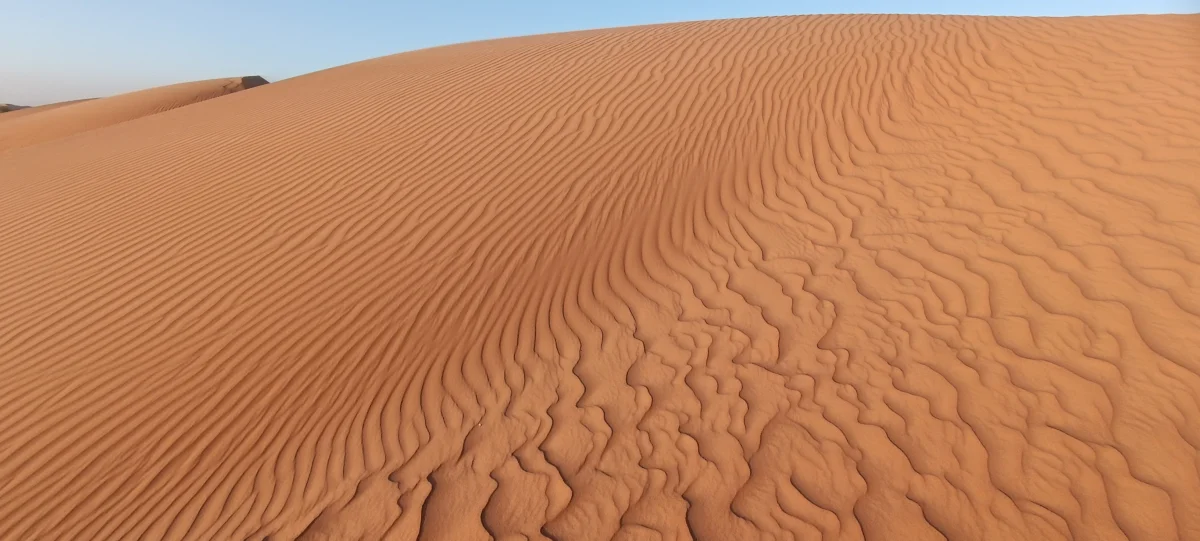
Sand amplifies the effect. It heats up quickly and gives off heat just as quickly. By day, the surface gets much hotter than the air: in the Sahara the ground temperature is often above 70 °C, and in the Karakum Desert sand heats up to 80 °C. The hot surface in turn heats the lowest layer of air.
At night, sand, unlike water or damp soil, holds almost no store of heat. It cools quickly, and the air near the ground cools with it. But sand alone isn't enough: a seaside beach on a summer evening is sandy too, and you don't need a down jacket there. Humidity is what decides it.
The deserts of the Persian Gulf show this clearly. In the UAE and Kuwait, the air is more humid than in the depths of the Sahara, so nights there aren't as cold: the moist air holds on to some of the heat from the ground.
Rather Like Our Spring
The same mechanism is familiar in Russia too. Roman Vilfand, scientific director of the Hydrometeorological Centre of Russia, has explained sharp day-night swings in Moscow by the clarity of the air and the lack of snow. Speaking about the sun's rays at the end of winter, he said:
"Of course, their power now isn't what it is in summer, but energy is still building up, and the air is absolutely transparent."
By day, the air is warmed by the ground and the walls of buildings, and at night, under clear skies, it cools just as quickly. In the desert, this happens every day and far more intensely.
Does Russia Have Deserts?
It does, although they're small. The best known is the Black Lands (Chyornye Zemli) in Kalmykia, the driest region in European Russia. There's little rainfall, strong winds and sharp temperature swings: in summer the air heats up to +45 °C, while in winter it can drop to −35 °C. In the 1990s, the area of desert was cut from 600,000 to 240,000 hectares, but the desert is still advancing.
In Dagestan stands the Sarykum dune, where White Sun of the Desert, the cult 1970 Soviet film, was shot. The dune even has its own microclimate.
Russia's most unusual desert is the Chara Sands in Zabaykalsky Krai. This is more than 4,000 hectares of shifting dunes in Kodar National Park, and a few kilometres away lies a large ice field that doesn't melt even in summer. Hot sand next to ice is a vivid example of how differently surfaces heat up and cool down.
How to Dress So You Don't Freeze
-
Pack warm clothes even for a hot country
Egypt in winter is the classic example: daytime temperatures are usually around +22 °C, but at night it can drop to +8 °C. For an evening safari, a night in the White Desert or a climb up Mount Sinai to see the sunrise, you'll need a fleece or a light down jacket, a hat and closed shoes.
Summer nights in the Sahara are warm, and the coldest dawns come between December and February. If you're planning a hike to Russia's dunes, take a sleeping bag rated for lower temperatures than you expect.
-
Dress in layers
The temperature drop comes fast: the air starts to cool as soon as the sun goes down. A T-shirt, a sweatshirt and a windbreaker on top are the most practical, since you can take them off and put them back on as the temperature changes.
-
Don't judge by the daytime heat
If it was +30 °C in the sun during the day, the sky is cloudless and the air is dry, the night is almost certain to be cool. Cloudy or humid weather, on the other hand, softens the swing.