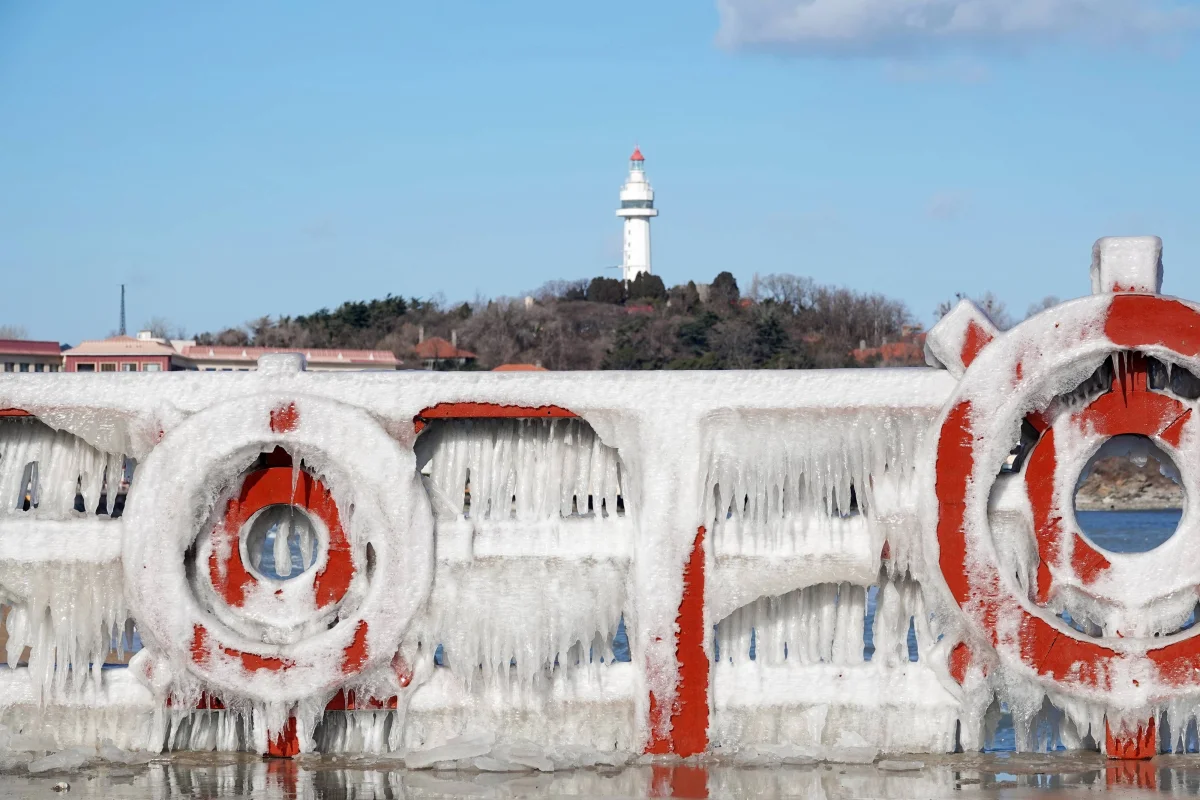
A garden pond freezes with the first frosts, yet the Black Sea doesn't ice over even in a hard cold snap. The Gulf of Finland, meanwhile, freezes every winter, and in February 2026 icebreakers were clearing a path through it for tankers.
In February 2026, the Gulf of Finland froze over as it hadn't in more than a decade. In places the ice was up to 40 cm thick. Ships without an ice class were only allowed into the ports of Primorsk and Vysotsk behind icebreakers, and the nuclear-powered icebreaker Sibir was brought over from the Arctic to the Baltic.
The water in the gulf is salty, yet ice forms on it almost as easily as on a river. The Black Sea, on the other hand, usually stays open even in severe winters. Here's a look at the temperature at which salt water freezes, and why some seas ice over while others don't.
Why Salt Stops Water Freezing
Fresh water freezes at 0 °C. In salt water, the dissolved salts get in the way of water molecules lining up into the crystal lattice of ice, so extra cold is needed for it to freeze. The more salt there is, the lower the temperature at which ice starts to form.
Ordinary ocean water, with a salinity of about 35 grams of salt per litre, freezes at around −1.9 °C. This is the standard figure for the open ocean.
At What Temperature Do Russia's Seas Freeze?
Salinity varies widely between Russia's seas, and so does the freezing point. Oceanographic formulas give roughly the following:
-
Gulf of Finland: a salinity of just a few grams per litre, so the water is almost fresh. It freezes at around −0.3 °C.
-
Sea of Azov: about 12 grams per litre, freezing at roughly −0.7 °C.
-
Black Sea: about 18 grams per litre at the surface, freezing at roughly −1 °C.
-
White Sea: salinity in its open waters of about 26 grams per litre, with a freezing point of around −1.4 °C.
-
Sea of Okhotsk: about 33 grams per litre, so it freezes almost like the ocean, at around −1.8 °C.
A difference of one and a half to two degrees doesn't sound like much, but it isn't the only thing that matters. Salinity also changes the way a sea cools.
The Real Secret: Water Density
Fresh water has a peculiarity: it's at its heaviest at +4 °C. In autumn, as a lake cools, water from the surface sinks until the entire body of water has cooled to +4 °C. After that, the top layer gets lighter as it cools further, stays on top and quickly freezes. That's why rivers and lakes ice over even when the water at depth is much warmer than zero.
Salt water is different. The more salt it contains, the lower the temperature at which it reaches its maximum density. Once salinity exceeds 24.7 grams per litre, the water keeps getting heavier right down to its freezing point.
Cooled surface water constantly sinks, and warmer water rises to take its place. Ice can only appear once the whole mixed layer has cooled to freezing point.
Hence a simple rule: the saltier and deeper the sea, the longer it holds out against ice. Oceanographers at the University of Gothenburg stress that what matters for ice formation is the difference in salinity with depth.
"The difference in salinity between the surface water and the deeper water is an important factor in ice formation," oceanographer Fabien Roquet has noted.
If rivers freshen the top layer, it becomes a light "lid" that doesn't mix with the water below, and the sea freezes faster beneath it.
Why the Gulf of Finland and the Sea of Azov Freeze, but the Black Sea Doesn't
The Gulf of Finland is almost fresh, diluted by the Neva and other rivers. Its salinity is well below the 24.7 threshold, so the water behaves almost like a lake. In a cold winter, the gulf ices over completely.
The Sea of Azov isn't very salty either, and it's also the shallowest sea in Russia, no more than 13.5 metres deep. Shallow water cools quickly, and ice forms here almost every winter, especially in the Taganrog Bay.
In hard frosts, the ice floes break up, get pushed ashore and pile up into ridges up to 3–4 metres high. In winter 2025, ridges like these appeared right on Taganrog's central beach.
The Black Sea is saltier than the Sea of Azov and also very deep, at more than two kilometres. That enormous body of water stores the summer's heat, and winters on the coast are mild. So the sea as a whole doesn't freeze. Only the shallow bays and estuaries in the north-west ice over, and even then only in especially cold winters.
What Else Keeps a Sea From Freezing
-
Waves and wind. As long as the sea is choppy, the ice crystals that form are broken up and mixed back into the water. Stable ice forms in bays, gulfs and along the shore, where the water is calmer.
-
Currents. Warm currents bring heat from far away. The Barents Sea, for example, doesn't freeze in its southern and western parts even in winter, thanks to warm Atlantic waters.
-
How long the frost lasts. Cooling the whole body of water takes not one cold night but weeks of sustained frost. That's why ice usually appears on the sea noticeably later than on rivers and lakes in the same region.
Why Sea Ice Is Almost Fresh
When seawater freezes, the ice crystals "squeeze out" the salt. It stays in the water, which becomes even saltier and heavier beneath the ice. The ice itself ends up far less salty than the sea, and over time the remaining salt drains out of it, so old ice becomes almost fresh.
Young sea ice, though, is riddled with tiny channels of salty brine. That makes it weaker than river ice of the same thickness, which is worth remembering if you plan to walk out onto it in winter.
If You're Heading Out Onto Sea Ice
-
Don't go by the guidelines for rivers and lakes. Salt ice is weaker than freshwater ice, so the usual "safe" thickness in centimetres doesn't apply here.
-
Watch the wind. On the sea, ice can break away from the shore within hours, especially in an offshore wind. If a floe with anglers on it starts drifting away, every minute counts.
-
Keep away from river mouths, headlands and open patches of water. Currents wear the ice away from below, and there it can be much thinner than it looks.
-
Check MChS warnings. Every winter, Russia's Emergencies Ministry issues them for the Gulf of Finland, the Sea of Azov and the coast of Sakhalin, where anglers regularly have to be rescued from drifting ice floes.