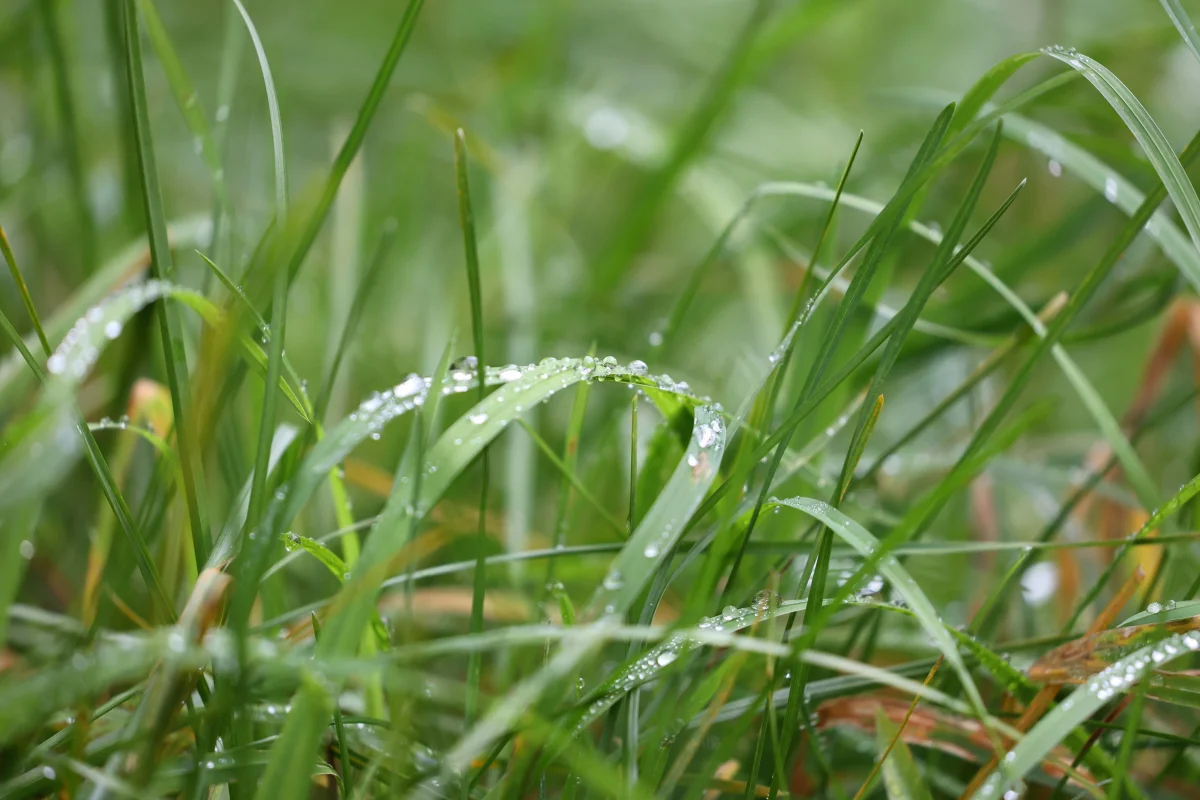
Yesterday you walked across the lawn in trainers and your feet stayed dry; today, on the same lawn, you're soaked to the ankles. The weather seems much the same, but dew doesn't form every night.
Dacha owners know this well from mowing in the morning. On some days you can cut the grass straight after breakfast, while on others you have to wait until lunchtime for it to dry. Wet grass clumps together and clogs the mower, and the droplets linger for ages on the car, on the garden bench and on any washing left out on the line.
It might seem that damp and fog are to blame, but it's more complicated than that. Heavy dew most often comes after clear, still nights, while in overcast, windy weather there's hardly any. To understand why, you need to get to grips with one concept: the dew point.
What Is the Dew Point?
There's always water vapour in the air, even though we can't see it. The colder the air, the less vapour it can hold.
The dew point is the temperature to which air has to be cooled for the vapour in it to start turning into droplets of water.
When the air near the ground cools to the dew point, its relative humidity reaches 100%. The excess vapour settles on grass, leaves, car roofs and railings. If this happens below zero, frost forms instead of droplets.
At What Humidity Does Dew Form?
The answer may surprise you: dew doesn't need the air's humidity to be 100%. Weather stations measure humidity at a height of 2 metres, but dew forms on grass, which at night is much colder than that air. The grass can cool to the dew point while the air at eye level is still warmer.
This is clearly illustrated by the "hidden" ground frosts that agricultural meteorologists study. That's the term for nights when the soil surface cools below zero while the air at a height of 2 metres stays above it. It's the same with dew: the weather station by your house may show humidity below 100%, yet the grass is already wet.
Scientists who studied dew in meadows and forests found that how often it forms in meadows depends almost directly on the night-time humidity: dew appeared on anywhere from 15% to 95% of nights, depending on how humid the air was.
Dew lasted longest, for 6–15 hours, at a humidity of about 96% and in almost total calm, with the wind blowing at about 0.5 m/s.
Why Is a Clear Night the Key Condition?
During the day, the ground and grass are warmed by the sun, and at night they give that heat back. If the sky is cloudy, the clouds send some of that heat back to the ground, and the grass cools slowly. On a clear night, the heat escapes freely into space, so the grass cools faster and further than the air above it.
Roman Vilfand, scientific director of the Hydrometeorological Centre of Russia, explained similar morning fogs in the Moscow region like this:
"I call these cooling fogs. They form on cloudless nights, when the earth's surface cools quickly, the air temperature falls and the moisture condenses."
Dew is the same process, except that the moisture settles not in the air but directly on cold surfaces.
What Does the Wind Have to Do With It?
A strong wind gets in the way of dew. It mixes the air and brings warmer, drier air down to the ground from above, so the grass doesn't have time to cool to the dew point. After a windy night, the lawn is almost always dry in the morning.
But dead calm isn't ideal either. With no movement at all, the air next to the grass quickly gives up its moisture, and no fresh moisture arrives. Dew forms best in a light breeze you can barely feel.
There's an upper limit too: if humidity reaches 100% throughout the whole layer of air, instead of dew fog forms. Like cloud, fog stops the grass from cooling, so less dew forms.
Why Doesn't Dew Form Everywhere?
Even within a single garden, one spot can be wet and another dry. Here's what makes the difference:
-
Grass and leaves. Thin blades of grass get little heat from the soil, cool quickly and are exposed to the sky. They also have a huge surface area for droplets to collect on. That's why the lawn gets wet first.
-
Paving, tarmac and stone. These store heat during the day and stay warmer than the grass for a long time at night, so the path next to a wet lawn is often dry.
-
Car roofs, railings and bridges. Thin metal isn't warmed by the ground and cools quickly under a clear sky, so a car that has spent the night outside is often covered in droplets in the morning.
-
Hollows and places near water. Cold air drains into hollows at night, and it's more humid near rivers and lakes. Dew forms earlier there and lasts longer.
-
Under trees. The canopy shields the grass from the sky, much as clouds do, so dew under a tree is usually lighter than on an open lawn.
Can You Predict the Weather From Dew?
The best-known saying is "heavy dew in the morning means a clear day". The physics behind it is clear: dew forms on a calm, cloudless night, and that kind of weather usually comes with a stable anticyclone. So a dewy morning is often followed by a sunny day.
The opposite saying, "no dew means rain", is less reliable. Dry grass in the morning tells you only that the night was cloudy or windy. That may mean bad weather is on the way, or it may simply have been a windy but dry night.
Roman Vilfand generally advises against trusting folk signs as a forecast: in his words, there are no reliable folk signs that could replace a weather forecast. Dew tells you more about what the past night was like than about what tomorrow will bring.
When Does Dew Turn Into Frost?
In central Russia, dew is especially noticeable in late summer and early autumn, when the nights are getting longer and cooler but the days are still warm. The longer the night, the more time the grass has to cool to the dew point, so a September morning after a clear night often leaves the lawn wet for a long time.
Then comes the point when the grass cools below zero, and frost forms on it instead of droplets. In Moscow, the first frosts come on average in early September, and in the Moscow region in the second half of the month.
You can clearly see that the surface cools more than the air. On September 8, 2026, Yevgeny Tishkovets, a leading specialist at the Fobos weather centre, warned that it would be around +3…+5 °C in Moscow overnight, but added:
"Ground frosts in places, for the first time."
In other words, the air at head height is still above zero, but the grass is already turning white with frost. In northern and Siberian regions this usually happens earlier, and in the south of the country noticeably later.
How to Put This to Use
- Plan your mowing and garden work
After a clear, still night, it's better to mow closer to lunchtime, once the dew has dried: wet grass clumps together and cuts poorly. After a cloudy or windy night, you can start in the morning.
- Don't leave washing and cushions outside
In clear, windless weather, anything left out overnight in the garden or on the balcony may be damp by morning. It's best to bring textiles and outdoor cushions indoors.
- On a hike, dress for the night that's just passed
If the night was clear, a path through tall grass will soak your shoes and trousers within minutes. Waterproof footwear helps, or you can set off a little later, once the sun has dried the grass.
- Look at the sky in the evening
A cloudless sunset, a light wind and air that's still damp after rain all but guarantee wet grass in the morning. If clouds or wind arrive by nightfall, the lawn will most likely be dry in the morning.