What types of volcanoes there are
Volcanologists describe a volcano as a geological formation that arose from the outpouring of lava and its subsequent solidification. Active volcanoes, like inactive ones, have a specific structure.
This is the crater, located at the summit and consisting of a kind of depression through which magma escapes. Below the crater lies the magma chamber, where the magma accumulates. And when too much accumulates, active volcanoes expel the excess to the surface. The crater and the magma chamber are connected by the vent, the channel through which the active volcanoes of the earth pour out their magma. This is not a single channel, however; vents sometimes branch. That is why volcanoes erupt not only through one central crater, but also through smaller, lateral ones.
Active volcanoes are located for the most part in areas where a specific geological setting prevails – in the zones of mid-ocean ridges and on active continental sections situated not in the centre but along the edges.
Volcanoes are divided into active and extinct. Today there are around 900 active volcanoes in the world. And that is only on land. The final number of underwater active volcanoes is unknown.
Volcanoes are also divided into further subcategories, according to the type of eruption and the flow of lava.
- Linear volcanoes are characterized by fissures across their entire surface and the presence of lateral craters. That is, large active volcanoes of the linear type look as though they have been doused in lava. This is because the dangerous contents reach the surface through the volcano's numerous fissures.
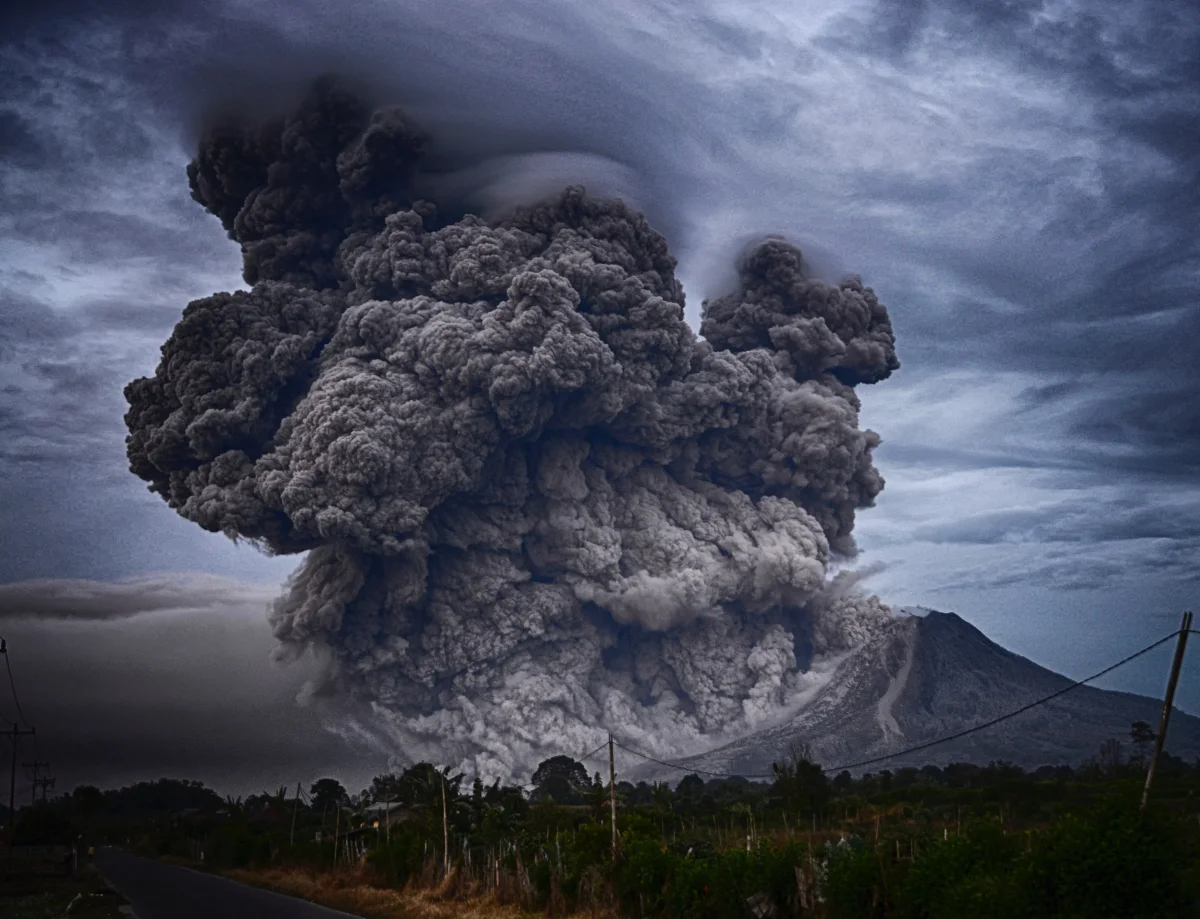
- The central-type volcano is the phenomenon we more often associate with an eruption. The eruption itself takes place from the central upper crater.
%20(1).jpg)
The appearance of volcanoes depends on the composition of the magma inside them. As it solidifies, magma takes on fanciful shapes. According to the composition of the magma, five types of volcanoes are distinguished:
- Shield volcanoes – the product of repeated eruptions of basaltic lava.
- Cinder cone volcanoes – these are the most common active volcanoes on earth, the familiar sight to the human eye.
- Stratovolcanoes erupt not only lava but also pyroclastic material — a mixture of hot gas, ash and hot rocks. The combination of lava and pyroclastic material forms the layers.
- Dome volcanoes are among the dangerous ones. The magma contains granite, which makes it very heavy. The magma cannot rise to the crater and solidifies in the vent. For years the magma accumulates there together with gases. Which, in the end, press so strongly on the plug that it bursts out with force along with the accumulated magma and sulphurous gases.
- Complex volcanoes are a combination of the above.
To understand which volcanoes are active and which are not, volcanologists especially study the territory of South and Central America, the Hawaiian and Aleutian Islands. The largest areas of volcanic activity are also considered to be the Japanese Islands, Java, Melanesia, the Kuril Islands, Kamchatka, the northwestern part of the USA, Alaska and Iceland.

The largest active volcano in the world is Llullaillaco, located on the border of Chile and Argentina. Its height is 6,739 metres, falling a hundred metres short of the highest volcano in the world, the volcano Ojos del Salado, located in the Chilean Andes. Ojos del Salado, at a height of 6,887 metres, is considered extinct. However, the last eruption of Llullaillaco also dates back to 1877 and the volcano itself causes scientists no concern. So the highest active volcano has long been dormant. And we hope it will continue its serene slumber.
To understand which volcanoes are active, there is no need to guess. Lately the news has often spoken of eruptions. Last year, for instance, a dozen volcanoes awoke, throwing columns of ash and molten magma to a great height.
For example, the last eruption of Shiveluch on the Kamchatka Peninsula was recorded on 23 November last year. The volcano was so hot that it glowed even in the dark, and above it volcanologists recorded a field of abnormal thermal activity. This means that an eruption is bound to happen – magnitude-five earthquakes off the coast of Kamchatka clearly prove it.
It is impossible to be prepared for the awakening of a long-dormant volcano. So people have to adapt to living in constant fear. Though it does not really work out with the fear: despite appeals from the Emergencies Ministry not to approach the volcano closer than 15 kilometres, tourists still go to admire the terrifying spectacle in the hope of capturing striking footage.

There are not just a handful of such volcanoes; there is a great multitude of them. Today there are more than several hundred volcanoes that pose a danger to humanity. Just imagine the global catastrophes and tragedies that the eruption of even one dormant volcano would cause.
Today we will tell you about five well-known active volcanoes that continue to instil fear in people.
An active volcano in Indonesia – Krakatoa (height 813 metres)

This enormous volcano is located in Indonesia and does not have the best reputation. In 1883, the eruption of Krakatoa destroyed hundreds of settlements and shrouded the planet in darkness. Because of the colossal eruption, tsunamis began in the depths of the world's oceans.
That said, Krakatoa last displayed its might in 2012, but it did not lead to serious consequences.
Operation «Winter Tan»: more than 70 beaches to open in the Krasnodar Territory from December
A volcano in Italy – Vesuvius (height 1,281 metres)

This famous volcano is in Italy. The very volcano that destroyed Pompeii. In recent decades the volcano has been quietly and peacefully sleeping, and it showed activity only in 1944. There was much destruction, but fortunately there were fewer casualties than might have been expected – 27 people died. People fell victim to their own homes, whose roofs collapsed under the weight of volcanic ash.
The most ancient volcano on the Hawaiian Islands – Kilauea (height 1,243 metres)

The volcano with the hard-to-pronounce name is located on the Hawaiian Islands. Scientists classify Kilauea as one of the ancient and most dangerous volcanoes on the planet. The volcano last awoke in the not-so-distant 1983 and, rumour has it, is once again ready to display its power. And Hawaii is shaken regularly as it is.
An active volcano in Mexico – Popocatepetl (height 5,426 metres)

Another volcano is located in sunny Mexico. Popocatepetl is on the list of the highest active volcanoes on Earth. Popocatepetl is a dangerous active volcano, but the Mexicans flatly refuse to acknowledge the possibility of its awakening and have concentrated on the territory around it. Then again, one can understand the residents – the soil around the volcano is well fertilized, and the local population has no choice but to make a living trading from the plantations.
An active volcano in Augustine (height 1,252 metres)

This bold and frightening volcano is located in Alaska. The locals are also keen to settle at the foot of the volcano, but in 2006 a disaster occurred – the awakened volcano wiped an entire settlement off the face of the earth. Augustine is a restless volcano that has repeatedly made itself known, frightening the residents.
Video of the eruption of the Shiveluch volcano in Kamchatka has appeared