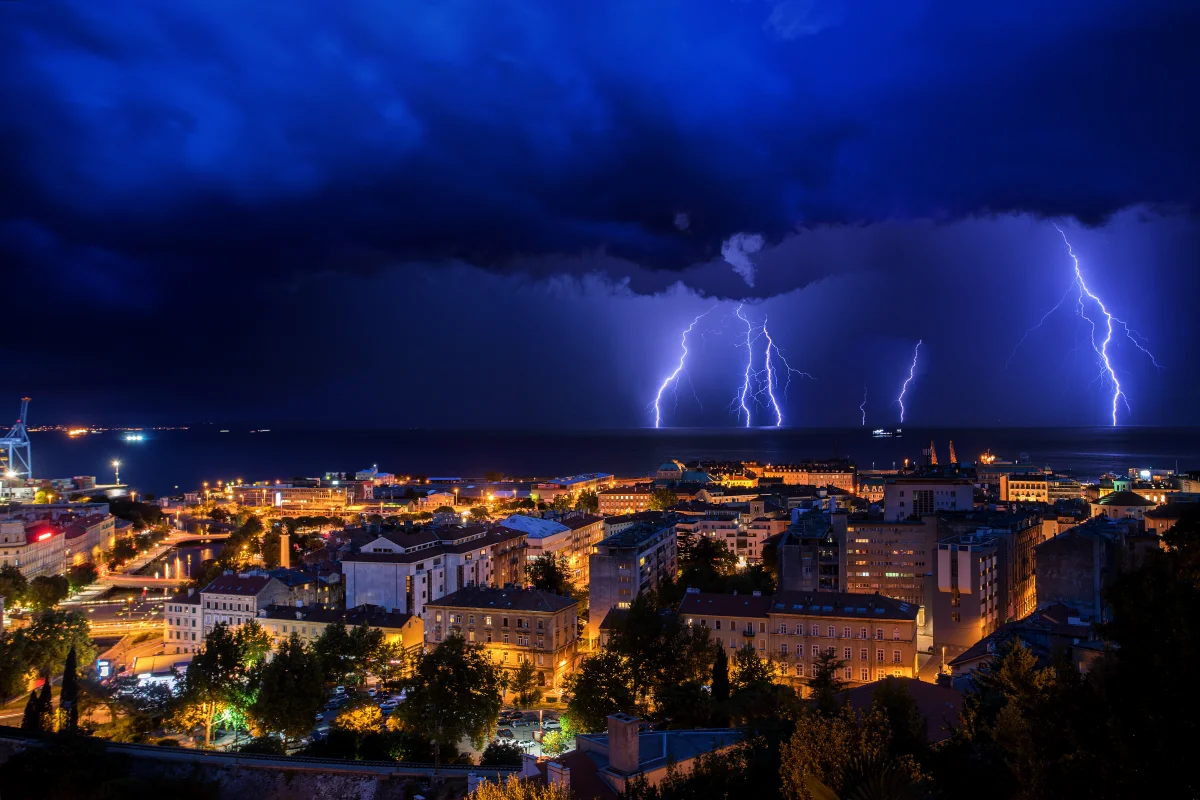
Picture a night where you don't need a flashlight. The sky over a lake flashes so often that the gaps between strikes nearly disappear — one bolt fades, and the next is already burning. The silent flickering on the horizon continues until dawn. And this happens every single night. This isn't fiction. It's a real place on Earth where lightning strikes more often than anywhere else.
At any given moment, roughly 1,800 thunderstorms rage simultaneously across the planet's atmosphere, driving more than 100 lightning strikes into the ground every second. Over a full day, that adds up to more than 8 million discharges. But they're distributed unevenly: some regions rarely see a storm at all (polar latitudes, the open ocean), while others light up almost every day.
So what determines where lightning strikes, why some spots on Earth attract storms while others don't, and where exactly does the absolute record-holder sit?
Why Lightning Doesn't Strike Everywhere Equally
Lightning is an electrical discharge that forms inside a storm cloud, or between a cloud and the ground.
For it to happen, three conditions need to align: warm, moist air rising upward; tall clouds where ice and water particles collide and separate electrical charge; and a sufficient voltage difference for the air itself to break down and conduct current.
All three conditions come together best in the tropics: heat warms the air, moisture evaporates off oceans, rivers, and forests, and powerful convective currents carry that moist air up to 10–15 km, where storm clouds form. That's why the equatorial belt is the planet's primary lightning generator.
But there's a nuance: lightning over land strikes roughly ten times more often than over the ocean. Land heats up faster and more intensely, producing stronger convection. That's why the most lightning-prone spots aren't in the middle of the Pacific — they're wherever tropical heat, humidity, and land (or shallow water) converge in one place.
Catatumbo: The World's Lightning Capital
The undisputed champion sits where the Catatumbo River empties into Lake Maracaibo in northwestern Venezuela. Here, researchers have recorded roughly 250 lightning strikes per square kilometer per year — a record entered into the Guinness Book of World Records. Over a year, up to 1.6 million discharges flash above the Catatumbo estuary. In a single night, that number can reach 20,000.
Catatumbo lightning isn't a typical storm — it's a continuously recurring phenomenon: thunderstorm activity has been observed on as many as 300 nights a year, peaking in May and October. The discharges begin in the evening, around 7 p.m., and continue until 4 or 5 a.m.
Remarkably, the thunder isn't audible from a distance — the lightning is visible from 400 km away, but the sound never reaches that far. That's exactly why Caribbean sailors used the glow as a navigation beacon for centuries, nicknaming it the "Maracaibo Lighthouse."
Catatumbo lightning is even depicted on the coat of arms and flag of Venezuela's Zulia state — that's how deeply the phenomenon shapes the region's identity.
Why Catatumbo, Specifically
The mechanism behind it is a unique geographic combination that doesn't repeat anywhere else on the planet.
- A trapping lake
Maracaibo is South America's largest lake, spanning 13,000 km². During the day, its surface heats up, water evaporates, and a thick layer of warm, moist air builds up above it.
- Mountains that funnel the airflow
The lake basin is ringed on three sides by spurs of the Andes reaching 3,000–5,000 meters. Warm trade winds off the Caribbean get funneled into this basin and collide with cold air descending from the mountains. Warm air surges upward, cold air pushes downward — a near-perfect convection engine.
- Methane
Swamps and mangroves at the Catatumbo estuary release methane, which rises toward the clouds. Scientists believe the methane contributes to ionizing the air and amplifies electrical activity. Catatumbo lightning is, in fact, the single largest generator of tropospheric ozone on Earth.
All three factors — warm water, a mountain funnel, and methane — work together to form a self-sustaining cycle: storms form each evening in exactly the same spot, with a precision that even meteorologists find striking.
Central Africa: A Belt of Nonstop Storms
If Catatumbo is the champion for lightning density at a single point, the Congo River Basin is the champion for sheer area of storm activity. Of the 500 most "lightning-dense" spots on the planet, identified through NASA satellite observations, 283 are in Africa — more than half.
The Congo Basin is a vast tropical lowland blanketed in rainforest. The mechanism is the same: moist air, intense evaporation, powerful convection. Storms erupt here nearly every day, especially in the afternoon, when heating peaks.
Lake Victoria in East Africa is another hotspot. The world's largest tropical lake generates its own storms: by day, the shorelines heat up, breezes carry moist air out over the water, and by evening, powerful storm cells form above the lake.
Lightning over Victoria is one of the leading causes of death for local fishermen — storms strike suddenly, and the wooden boats offer little protection.
Indonesia: Storms 322 Days a Year
The city of Bogor on the island of Java, Indonesia, has long been considered the stormiest city on Earth — thunderstorms are observed there up to 322 days a year. It thunders over the city on nearly every day of the calendar, save for a few weeks at the height of the dry season.
The reason is location: Bogor sits at the foot of volcanoes, 260 meters above sea level, within an equatorial climate zone that holds steady at 77–86°F (25–30°C) with humidity above 80%. The mountains trap moist air rolling in off the Indian Ocean, and convection kicks off every afternoon like clockwork.
Indonesia as a whole is one of the most storm-prone countries on the planet. An archipelago of 17,000 islands sitting on the equator, ringed by warm oceans and dotted with volcanoes — every condition for constant thunderstorms is present.
Uganda and Kenya: Lightning as a Natural Disaster
The town of Tororo in southeastern Uganda sees 251 thunderstorm days a year. Southwestern Kenya sees up to 210 days with lightning. In these areas, storms aren't a spectacle — they're a problem: lightning strikes kill up to 100 people annually in Kenya, along with livestock losses and property damage.
East Africa is a zone where moist air off the Indian Ocean collides with the highlands of the Rift Valley. The result is intense storm activity that, for local residents, is a daily risk factor, not a tourist attraction.
What About Russia?
Russia isn't tropical, and its storm activity runs far below equatorial levels. But even here, there are local hotspots.
The Black Sea coast of the Caucasus is Russia's stormiest region. Sochi and the area around Krasnaya Polyana see up to 50–60 thunderstorm days a year. The mechanism is familiar: a warm sea, moist air, and mountains that push air masses upward. Summer storms in Sochi are intense but brief: downpour, thunder, lightning — and an hour later, sun again.
The Medveditskaya Ridge in the Volga region (Volgograd Oblast) is a place wrapped in legend. A stretch of low hills in the middle of the steppe that, according to locals and researchers, seem to attract lightning more often than the surrounding terrain. Trees split by strikes and scorched trunks are a common sight there.
There's no definitive scientific explanation yet for the elevated storm activity in this specific location — one hypothesis points to underground rock formations with high electrical conductivity.
Central Russia averages 20–30 thunderstorm days a year, Siberia sees 15–20, and the Arctic fewer than 5. For comparison, equatorial zones see 150–250 days.
Lightning and Global Warming
Climatologists project that as global temperatures rise, the frequency of lightning worldwide will increase. Calculations suggest that a 1°C rise in average temperature drives roughly a 12% increase in lightning frequency. By 2100, the total number of strikes could climb by 50%.
The logic is simple: the warmer the atmosphere, the more moisture it holds, and the more powerful the convective processes become. More convection means more storms, and more storms mean more lightning. That translates not just into more dramatic skies, but also more wildfires (lightning is the leading natural cause), more infrastructure damage, and more fatalities from strikes.
Lightning by the Numbers
- The temperature inside a lightning channel reaches up to 54,000°F (30,000°C) — five times hotter than the surface of the sun.
- A discharge can run 2 to 20 km in length, sometimes longer.
- Speed reaches up to 124,000 mph for the stepped leader, and up to 60,000 miles per second for the return stroke.
- Current can hit 200,000 amperes (a household outlet carries 10–16 amps).
- Duration is a fraction of a second, but in that instant, the discharge releases enough energy to power a light bulb for months.
- The odds of being struck by lightning in a given year are roughly 1 in 1,000,000.
Can You Actually See the Catatumbo Lightning?
Yes — and it's one of the few places on Earth where you can watch lightning as an actual tourist attraction. Night boat tours across Lake Maracaibo are run out of the city of Mérida or villages along the lake's southwestern shore.
The best time to go is May through November, when storm activity peaks. The excursion works like this: you head out onto the lake by boat in the evening, then spend the next several hours watching a silent light storm unfold across the horizon.
Getting there from Russia isn't simple: there are no direct flights to Venezuela, the country is navigating an economic and political crisis, and infrastructure is limited. But for those who do make the trip, the spectacle is the kind that reshapes what you thought the atmosphere was capable of.
That said, you don't need to travel to the other side of the planet to watch lightning. A summer storm over the Black Sea — bolts striking the water on the horizon, thunder arriving a few seconds late — is its own can't-look-away spectacle. The only difference is scale: in Sochi, it happens on about fifty evenings a year. Over Catatumbo, it happens on three hundred.