Friday evening, Moscow, traffic. You want to get out of the city for the weekend, traveling light. No foreign passport required. No flight required. All you need is a car (or a "Lastochka" train), two free days, and the realization that within 300 kilometers of the Kremlin lies enough to see that most Muscovites haven't experienced half of it in their entire lives.
Central Russia isn't the part of the country that ends up in "most beautiful places" roundups. There are no mountains, no sea, no volcanoes.
But there are kremlins that are six hundred years old, rivers lined with monasteries and manor estates, small towns where time slows to walking pace, and landscapes that shift so completely from season to season that the same place in winter and in summer feels like two different trips.
Kolomna: Two Hours from Moscow, a Different World
115 km from Moscow, 1.5–2 hours by car or 2.5 hours by commuter train from Kazansky Station. Over the past decade, Kolomna has transformed from an unremarkable Moscow-region district center into a model of small-scale Russian tourism.
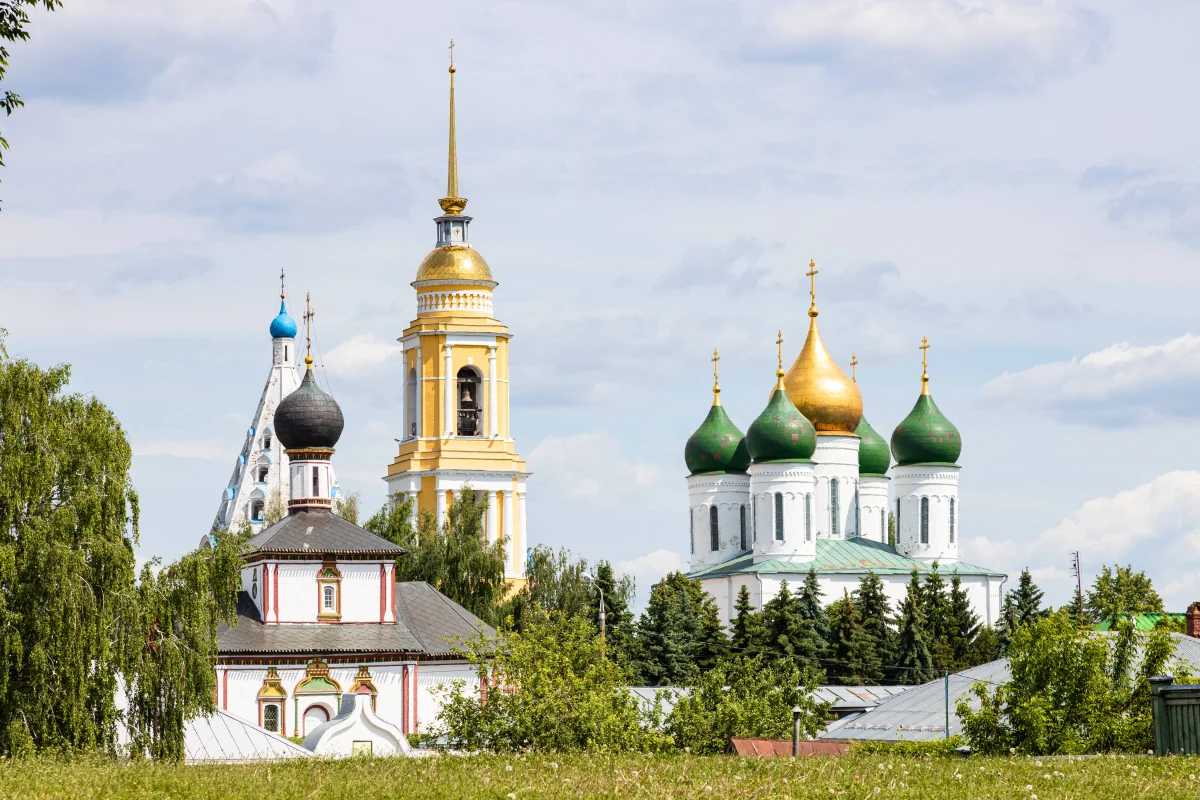
Kolomna Kremlin is one of the most beautiful in Russia: red brick walls dating to the 16th century, seven surviving towers, and inside — not museum emptiness, but a living residential neighborhood with wooden houses, front gardens, and cats sitting on fences. You can wander the kremlin for hours, and every side street leads somewhere new.
But the main reason people come to Kolomna is food. The Pastila Museum (real Kolomna pastila, made to 19th-century recipes), the Kalach Museum (with tastings straight from the oven), and the Kolomna mead distillery. These aren't exhibits behind glass — they're working production sites where baking, brewing, and pouring happen right in front of you. For lunch, try the café "Lazhechnikov's Yard" or the restaurant attached to the museum. Leaving Kolomna hungry is not really possible.
Best time to visit: May–September for walking; December–January for Christmas Kolomna, with its markets and mulled wine.
Suzdal: A Town That Stopped in the 18th Century
220 km from Moscow, 3.5 hours by car, or by train to Vladimir (1 hour 40 minutes on the Lastochka) followed by a 40-minute bus ride. Suzdal has not a single multi-story building — nothing taller than two floors, a restriction written directly into the town's master plan. The effect is that you feel like you've been transported back 200 years.
Within just 9 square kilometers sit more than 200 architectural landmarks, including 5 monasteries and an 11th-century kremlin. The trading arcades on the central square, the Convent of the Intercession on the banks of the Kamenka River, and the open-air Museum of Wooden Architecture are all within walking distance of each other.
Suzdal changes personality with the seasons. In summer: green meadows, a river, horses grazing against a backdrop of whitestone walls. In winter: postcard Russia — snow on the domes, smoke curling from chimneys, sleds and a banya. In autumn: golden birches and empty streets. In spring: muddy roads and the quietest period of the year — ideal for anyone who values silence.
Stay overnight. Suzdal at sunset and Suzdal at dawn are essentially two different towns, and both are worth seeing.
Tula: Weapons, Gingerbread, and a Park You Wouldn't Expect
185 km from Moscow, 2.5 hours by car or 2 hours on the Lastochka from Moskovsky Station. For a long time, Tula was a town people drove through on their way to Yasnaya Polyana, never stopping. That changed once the embankment along the Upa River was turned into a modern park, the kremlin was restored, and the Weapons Museum moved into a building shaped like a helmet.
The Tula Kremlin dates to the 16th century — compact, well-kept, home to a cathedral, a garden, and trading arcades selling local souvenirs. The Weapons Museum spans two buildings — the old one inside the kremlin and a new one on the embankment — with interactive exhibits engaging enough for kids. The Gingerbread Museum is a must-stop: it explains exactly what sets Tula gingerbread apart from every other kind, with samples to prove it.
Yasnaya Polyana, Tolstoy's estate, sits 14 km outside Tula. The house where War and Peace and Anna Karenina were written has been preserved almost exactly as Tolstoy left it. The surrounding park covers 400 hectares, and walking it properly takes at least two hours.
Best time to visit: May–June (the park in bloom, the embankment coming to life) and September (golden Yasnaya Polyana).
Yaroslavl: Capital of the Golden Ring
270 km from Moscow, 3 hours by car or 3.5 hours by train. Yaroslavl is the largest city on the Golden Ring, and its historic center is entirely inscribed on the UNESCO World Heritage list.
The Strelka, where the Volga and Kotorosl rivers meet, is one of the best viewpoints in central Russia. From here you can see the full sweep of the embankment, the Assumption Cathedral, and the whitestone walls of the Transfiguration Monastery.
The Volga embankment — long, well-maintained, lined with lindens — makes for the perfect walking route.
Yaroslavl doesn't shy away from its size: theaters, restaurants, contemporary museums (including a private Museum of Enamel Art and the "My Favorite Teddy Bear" Museum), and a full, living city life. This isn't an open-air museum — it's an active regional capital with a thousand years of history behind it.
Best time to visit: June–July (white nights, river cruises) and golden autumn — September–October.
Plyos: Silence on the Volga
370 km from Moscow, 4.5 hours by car. A bit far for a day trip, but ideal for a weekend with an overnight stay. Plyos is a tiny town perched on a high bank of the Volga, immortalized by the painter Levitan — this is where he painted Above Eternal Peace and dozens of other landscapes.
The population is around 1,800. Two streets, wooden houses, a church on a hill, and the sweeping expanse of the Volga. Levitan's house-museum is small and intimate, with a view of the very river he painted. Mount Levitan is a 10-minute climb — and at the top, a landscape that hasn't changed since the 19th century.
Plyos is a place people visit not for sights, but for a feeling. There's no entertainment here, no rush, no crowds — just the river, the sky, and quiet. In winter: steam rising off the Volga and snow up to your knees. In summer: sunsets that stretch on for an hour. In autumn: hills dressed in gold.
Book your accommodation early — options are limited, and Plyos's popularity keeps growing. Try the smoked bream on the embankment — a local specialty.
Kaluga and Nikola-Lenivets: Space and Art
190 km from Moscow, 2.5 hours by car, 3 hours by commuter train. Kaluga is Tsiolkovsky's city, and its Museum of Cosmonautics History ranks among the best science and technology museums in the country. The new wing, opened in 2021, is enormous and modern, packed with full-scale rocket models, interactive exhibits, and a planetarium.
But the real discovery here is Nikola-Lenivets, an art park 80 km from Kaluga. Spread across 650 hectares of meadow and forest are giant art installations: wooden structures as tall as a five-story building, sculptures made of hay and metal, bridges leading nowhere. Every year during Maslenitsa, one grand structure is ceremonially burned — a tradition that draws thousands of spectators.
Nikola-Lenivets is a place where the weather becomes part of the art. Fog rolling over the meadows, frost on the wooden sculptures, summer thunderstorms, golden autumn light — each season reshapes how the objects are perceived.
It's worth visiting any time of year, but a stock of warm clothing in winter and rubber boots in spring are essential — the roads here are unpaved dirt tracks, with no asphalt in sight.
Pereslavl-Zalessky: A Lake and Peter the Great's Little Boat
140 km from Moscow, 2 hours by car. A small town on the shore of Lake Pleshcheyevo, one of the largest and most beautiful lakes in central Russia. This is where a young Peter the Great built his "toy flotilla," and the sole surviving vessel — the Fortuna — is preserved in a museum on the shore.
Pereslavl has six monasteries, each with its own history, and the Blue Stone on the lakeshore — a pagan boulder that, according to legend, slowly moves on its own. Nikitsky Monastery dates to the 12th century, with massive white walls and profound quiet. Goritsky Monastery houses a museum with a collection of icon painting.
Lake Pleshcheyevo is a national park. In summer: swimming (the water warms to 72–75°F / 22–24°C by August), kitesurfing (the lake is shallow and windy — ideal conditions), and fishing. In winter: ice fishing and views of the snow-covered lake from Alexandrova Hill.
Best time to visit: July–August for the lake, May and September for walking the town.
Nizhny Novgorod: A Metropolis on the Volga
420 km from Moscow, 4 hours by car or 3.5 hours on the Lastochka. It pushes the limits of a weekend trip, but Nizhny is worth stretching it to two or three days.
The kremlin, perched on a high bank of the Volga, has 13 towers and walls running a kilometer long, enclosing a well-kept park and views over the confluence of the Oka and Volga rivers that will take your breath away. Bolshaya Pokrovskaya is a pedestrian street lined with 19th-century architecture, cafés, and street musicians. The Strelka — where the two rivers meet — was renovated for the city's 800th anniversary in 2021: a new embankment, a park, and the Alexander Nevsky Cathedral.
Nizhny is a city of contrasts: merchant mansions sit alongside constructivist buildings, wooden districts alongside modern quarters. The cable car crossing the Volga to the satellite town of Bor takes 12 minutes and offers one of the best urban cable-car rides in the country.
Best time to visit: May–June and September. Winter is beautiful but windy and cold (5 to –4°F / –15 to –20°C along the embankment with wind off the Volga).
Which Season Suits Which Trip
Central Russia offers four entirely different trips depending on the time of year.
Winter (December–February)
Suzdal, Rostov Veliky, Pereslavl — snow-covered kremlins and monasteries, empty streets, hot tea in old-style taverns. Kolomna runs Christmas programs and winter markets. Temperatures range from 23°F to 5°F (–5 to –15°C), with short days — but the sunny ones show off winter Russia at its best.
Spring (April–May)
Nature wakes up, but tourists are still scarce. May is the best month for road trips: dry roads, fresh greenery, long daylight hours, half-empty hotels. The downside is mud season on unpaved roads (Nikola-Lenivets, country lanes leading to remote monasteries).
Summer (June–August)
Long days, green landscapes, swimming in lakes (Pleshcheyevo, Seliger, Valdai). Temperatures run 72–82°F (22–28°C), sometimes higher. The downside: mosquitoes outside the city and Friday-evening traffic jams leaving Moscow.
Autumn (September–October)
Golden autumn in central Russia is one of the most beautiful phenomena in Russian nature. Plyos, Yasnaya Polyana, Suzdal, and the linden-lined Yaroslavl embankments all look better in October than at any other time. The air is clear, the light is soft, and the tourists are few.
Practical Notes
- Traffic leaving the city. Friday evening is the worst time to start a trip — the Yaroslavskoye, Simferopolskoye, and Novorizhskoye highways can back up for 2–3 hours just to clear the region. Leave before 2 p.m., or set out Saturday morning instead.
- Gas stations and food. Along the main highways (M-7, M-5, M-2, M-11), stations appear every 30–40 km, usually with an attached café. On secondary roads, they're sparser — fill up ahead of time.
- Accommodation. Small towns like Suzdal, Plyos, and Pereslavl have limited options — book 2–3 weeks ahead, especially for summer and golden-autumn trips.
Central Russia doesn't demand heroics — no long-haul flights, no complicated visas, no extreme preparation. Get in a car or on a Lastochka train, and within a couple of hours you're standing in a town where the kremlin is older than Columbus, a river flows past whitestone walls, and a museum bakes kalach in front of you using a two-centuries-old recipe.
Sometimes the best trip isn't to the other side of the world — it's to the other side of the region.