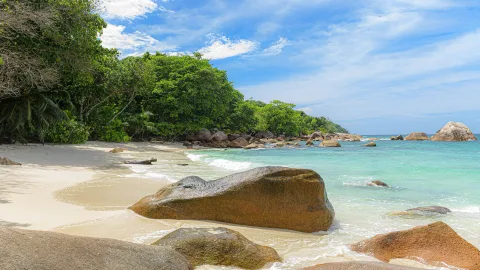
Mid-September, Gagra. The beach that a month ago had no room to spread a towel out has suddenly opened up. It's 81°F outside, and the market has mandarins, figs, and persimmons that weren't there in August. An Abkhaz vendor pours you a glass of homemade wine and says: "Right now — this is the good time. Summer's fine too, but now is better." And he's right.
Gagra is the closest resort town in Abkhazia to Russia, and one of the warmest spots on the entire Black Sea coast. The town is squeezed between mountains and sea: the Gagra Range, rising up to 3,300 meters, presses right up to the water's edge and shields the coastline from cold northern winds.
The result is a humid subtropical climate, mild winters, a long summer, and a swimming season that runs from late May to mid-October. But between "you can technically swim" and "this is ideal," the difference comes down to a few degrees of water temperature — and a few thousand fewer tourists.
Why Gagra Is Warmer Than Sochi
Gagra sits just 25 kilometers from the Russian border along the Psou River and is considered the warmest spot on the Abkhazian coast.
The reason is geography: a mountain range wraps around the bay in a half-ring, forming a natural barrier against cold air. Northern winds can't reach the valley, and warm air heated by the sea gets trapped between the mountains.
Gagra's average annual temperature sits at around 63°F (17°C) — a degree or two higher than central Sochi. In winter, temperatures rarely dip below 41–46°F (5–8°C), and snow on the coast is almost unheard of. Thanks to the sheltered bay, the sea in Gagra warms up slightly earlier than the neighboring Sochi coast, and cools down slightly later.
Month by Month: What to Expect
May: Waking Up
Air at 68–75°F (20–24°C), water at 63–66°F (17–19°C). Swimming is technically possible, but the water still bites — most people wade in knee-deep and call it a day. Nature, though, is at its best in May: everything blooms, the mountains are green, and the air smells of jasmine and magnolia. Tourists are scarce, prices are low, and excursions run without lines.
May is a great month if your main goal isn't the beach but sightseeing and getting to know Abkhazia. Lake Ritsa, New Athos Cave, and the Pitsunda temple are all accessible without the crowds.
June: The Season Opens
Air at 75–81°F (24–27°C), water reaching 72–73°F (22–23°C) by month's end. Early June is still calm: beaches are open, hotels half-empty. By the second half of the month, tourist traffic picks up — though nowhere near July's crush.
June is one of the best months for combining swimming with sightseeing. The heat isn't exhausting yet, the water's already comfortable, and the mountains still look fresh and green. Rain does happen, but briefly — a typical half-hour subtropical downpour, followed by sun again.
July: Heat and Crowds
Air at 82–90°F (28–32°C), water at 77–79°F (25–26°C). This is peak season: beaches packed shoulder to shoulder, lines at cafés, traffic jams on the road to Lake Ritsa. The heat, combined with 70–80% humidity, feels heavy — the kind of air you could cut with a knife.
The sea in July is at its most comfortable for long swims: warm, calm, clear (barring recent storms). But by 10 a.m. there's nowhere left to lay a towel, and by midday the sun is intense enough that being on the shore without cover becomes genuinely risky.
July is worth picking if crowds, heat, and higher (by Abkhazian standards) prices don't bother you. It's not ideal for families with young kids — the humidity, lines, and packed beaches aren't exactly a recipe for a relaxed family trip.
August: Even Hotter, Even Busier
Air at 84–91°F (29–33°C), water at 79–82°F (26–28°C) — the year's peak. August is both the hottest and busiest month. Every Russian school holiday, every family, every budget converges here. The long pebble beach of Old Gagra can still absorb the crowds, but the compact beaches of New Gagra are packed solid.
Humidity in August can climb to 85%, and the only relief is the sea or air conditioning. Evenings bring no real cooldown either: nighttime temperatures stay at 72–75°F (22–24°C), making sleep uncomfortable without a fan.
On the upside: fruit season. August marks the start of figs, peaches, and grapes — everything at the markets is fresh and cheap.
September: Velvet Season — and the Best Time to Go
Air at 77–82°F (25–28°C), water at 75–79°F (24–26°C). The heat retreats, humidity drops, and breathing gets noticeably easier. The kids are back in school, the beaches have emptied out, and prices are dropping.
September is the month locals and experienced travelers consider the best for Gagra. The sea is still warm — heated all summer, it holds its temperature until mid-October — the sun is gentler, and tans come out more even. Evenings are warm and long: you can eat dinner on an open veranda until 10 p.m. without needing a sweater.
Excursions become a genuine pleasure in September: no traffic on the road to Lake Ritsa, no lines at New Athos Cave, and the mountains start turning yellow. The markets are at their best: mandarins, persimmons, pomegranates, feijoa, and homemade wine from the fresh harvest.
October: A Last Chance to Swim
Air at 66–73°F (19–23°C), water at 70–73°F (21–23°C) in the first half of the month, dropping to 66–68°F (19–20°C) by the end. Swimming season is technically still on, but it depends on the year: some Octobers stay warm enough to swim through the entire month, others turn cold and rainy right at the start.
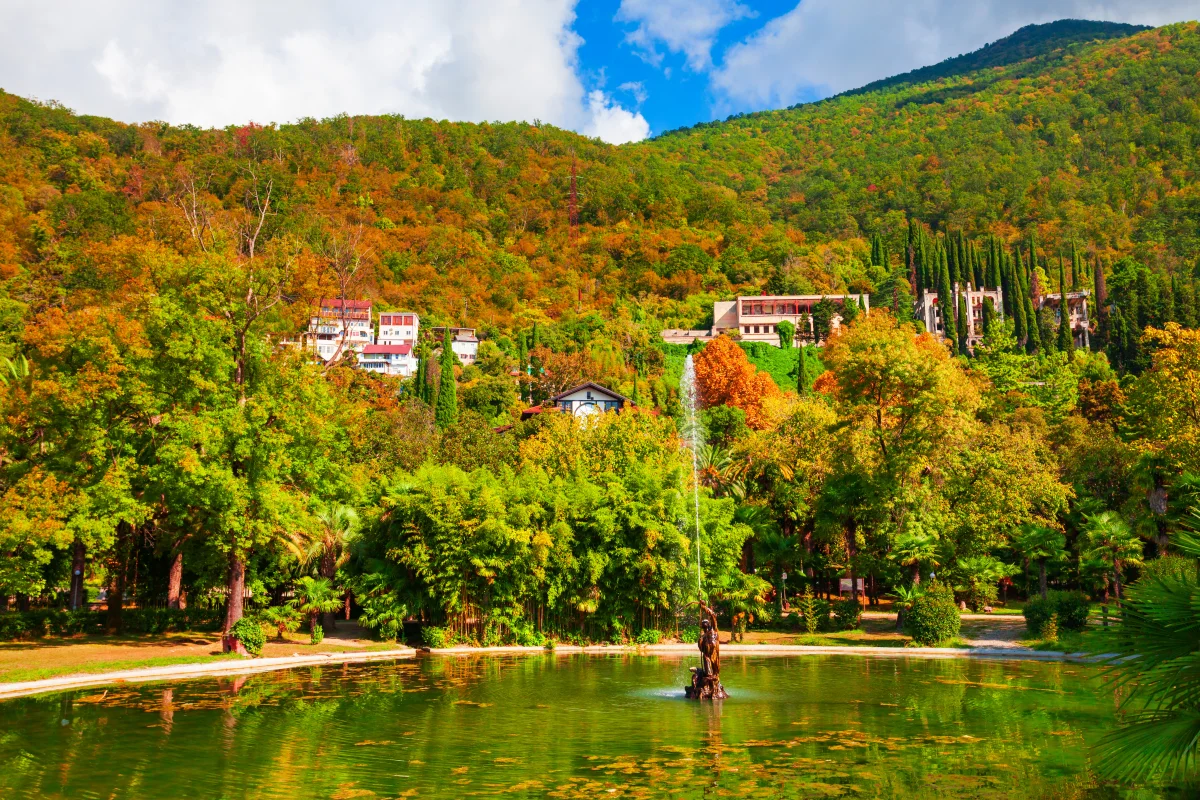
October suits travelers who value quiet and color. Subtropical autumn is vivid: palm trees stay green while the deciduous trees on the mountain slopes turn yellow and orange. Tourist numbers hit their lowest, and prices are the cheapest of the season.
The downside: rain picks up. Autumn is Abkhazia's rainiest stretch — October alone sees around 120–150 mm of precipitation, more than any single summer month. Rain can settle in for a day or two at a time, and on those days, the beach is a write-off.
November–April: Not Beach Weather
Winter and early spring in Gagra are mild by Russian standards (46–59°F / 8–15°C), but unsuitable for swimming: the sea cools to 50–57°F (10–14°C), rain is frequent, and cloud cover is heavy. There's no snow, but the dampness is felt more than the cold.
That said, winter in Gagra isn't entirely a dead season. Subtropical greenery stays year-round, mandarins ripen in December–January, and on clear days you can stroll the promenade in just a shirt. For travelers who want peace, fresh air, and low prices, winter works fine. For a beach trip, it doesn't.
Old Gagra vs. New Gagra
The town splits into two districts with distinct personalities.
Old Gagra is the historic quarter at the foot of the mountain: a colonnade, the Gagripsh restaurant, Abaata fortress, and the overgrown park once belonging to Prince Oldenburgsky. The beach is wide and pebbled, with clean water. There are fewer tourists here (the infrastructure is more modest), but the atmosphere is different — subtropical thickets, ruins, and quiet. Accommodation is mostly private guesthouses.
New Gagra is the modern district — shops, a market, cafés, hotels, and the main flow of visitors. The beach is also pebbled, but the infrastructure is better: loungers, umbrellas, water activities. It's noisier here, but more convenient, with everything within walking distance.
For velvet-season travel, Old Gagra is the more atmospheric pick — quiet, empty beaches, that sense of a lost-in-time resort. For families with kids, or anyone who values solid infrastructure, New Gagra is the better fit.
What to See When the Sea Needs a Break
On a rainy day, or once you've had enough sun, Abkhazia offers plenty to explore.
Lake Ritsa — a mountain lake at 950 meters, ringed by cliffs and fir forest. The drive from Gagra runs about 40 km through the Bzyb River gorge — hairpin turns, waterfalls, and the Blue Lake along the way. Plan for a full-day excursion.
In summer it's hot, and the water sits at 50–54°F (10–12°C) — not worth swimming in. In autumn, the air turns crystal clear, with mountains reflecting perfectly in the water. In winter, the road can close entirely.
New Athos Cave is one of the largest in the world: 11 chambers, an underground railway, stalactites and stalagmites. The temperature inside stays at a constant 57°F (14°C) year-round, so a jacket is a must, even in summer.
New Athos itself offers a monastery, an artificial waterfall, Swan Lake, and the Anakopia Fortress up on the mountain (a 20-minute climb, with a view of the coast from the top).
Pitsunda boasts a relict pine grove and one of the cleanest beaches on the coast. It's 25 km from Gagra, about half an hour by shared van.
Getting There and What to Know
Russian citizens can enter Abkhazia using their internal passport (a foreign passport works too). The border crossing is on foot, across the Psou River: you leave your car on the Russian side (or drive across if it's registered locally). Wait times in season run from 30 minutes to 2–3 hours on weekends in July–August; in September, the crossing is noticeably faster.
From Sochi (Adler Airport) to the border is a 10-minute taxi ride. From the border to Gagra is another 20 minutes. Transfers can be booked ahead or arranged on the spot. Within Abkhazia, options include shared vans, taxis, and rental cars — it's best to rent on the Russian side, since options are more limited within Abkhazia itself.
Abkhazia's currency is the Russian ruble. Cards aren't accepted everywhere, so cash is essential. ATMs exist but aren't on every corner. Prices run lower than in Sochi: a café meal costs 400–700 rubles, and private-sector lodging starts at 1,500 rubles a room during the season.
Russian mobile carriers work in Abkhazia via roaming, but calls and data get expensive. It's better to buy a local SIM card (Aquafon or A-Mobile) at the border — starting around 300 rubles with a data package included.
Abkhazia isn't Turkey, and it isn't Sochi. Chain hotels are scarce, service can be unpredictable, roads beyond the coast are rough, and abandoned Soviet-era buildings sit next to well-kept guesthouses. It's part of the local character — but it's worth being prepared for it.