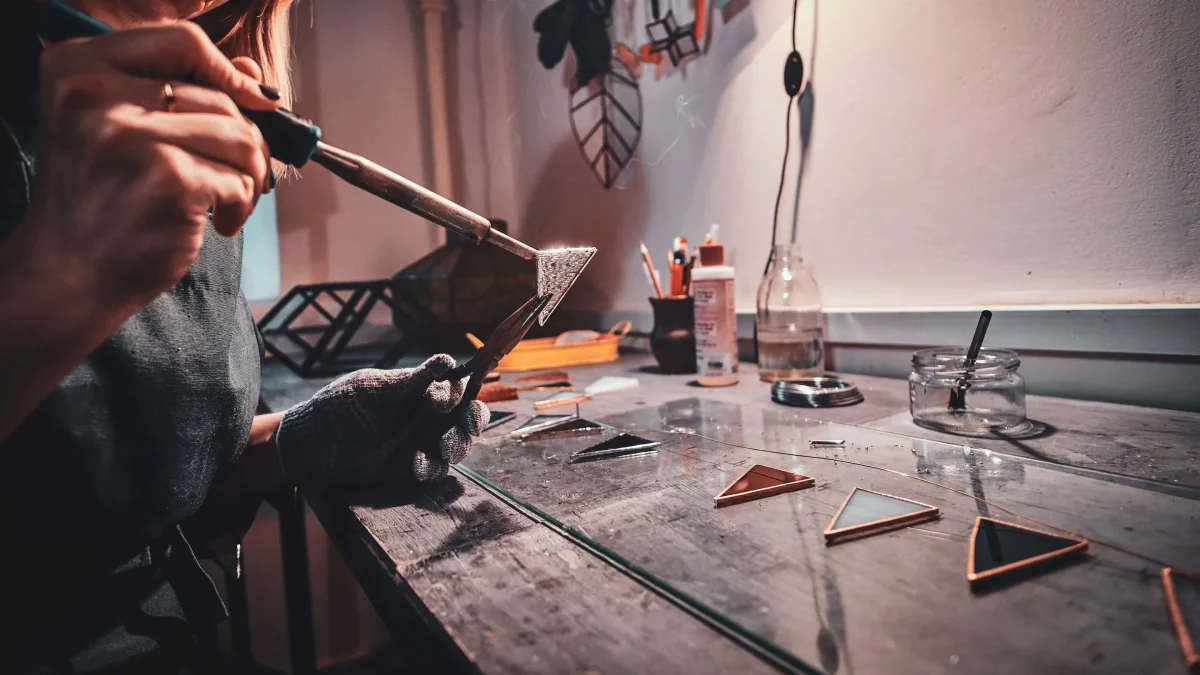
Has a vase broken? Don’t rush to throw away the fragments. We offer a few ideas on how to creatively use the shards of ceramic and glass vases, pots, and plates and breathe new life into them.
Safety measures
You need to remember that glass is a material that can cause injury. That is why it is very important to take special care when working with it. For some ideas, you may need to additionally crush the shards. Take care to protect your hands – with gloves, and your eyes – with special goggles.
When crushing, you also need to use water. This is done so that the glass dust does not scatter and get onto the skin, into the eyes, or into the respiratory tract. Before making your new masterpieces, the broken pieces of glass need to be treated – to get rid of the sharp edges.
Stained glass from glass shards
First prepare a sketch of what you want to see on your stained glass. A suitable design can be found on the internet. Attach the sketch with tape to a whole pane of glass on the reverse side. Then degrease the surface of the glass with ammonia. Transfer the design onto the glass with a suitable paint or a black marker. Cover the glass with a thin layer of silicate glue and lay the broken pieces of glass on top of it. Wait some time for the design to set. And afterwards – cover the finished stained glass with a thick layer of glue.

Candle holders
For this decor element, both glass and ceramics will work. You can try gluing the shards onto the candle holder itself, if the thickness of its elements allows. For this, use superglue.
But there is another original solution. You can make holes in some parts of the candle holder, and then, using threads passed through the little holes, hang the shards. On the other hand, with a piece of cord you can tie the pieces of glass or ceramic right around the holder. As for the candles, you can leave them in the recesses or place them in cups, small pots, or other containers fixed in advance to the candle holder.

Mailbox
A mailbox will be a great addition to the look of your plot. If the mailbox is made of wood, then first it needs to be cleaned of paint with acetone. After this, it is recommended to go over it with sandpaper.
On convex surfaces it is more difficult to work with glass. Therefore, pieces of ceramic are better suited for a mailbox. The shards of a vase or cup can be glued onto the mailbox haphazardly – and this will look rather harmonious and interesting.

Tabletop
Again, the most important thing is to prepare the surface. For this it naturally needs to be cleaned of dust and degreased. You can lay out the shards either randomly or in the shape of an intended design. If the broken vase was ceramic, then you can cut the broken pieces with a tile cutter to give the shards straight edges.
You can lay out the shards either almost flush together, or with a small gap. If you wish, the gaps between the large pieces can be filled with smaller shards. Also, before laying, you should apply a special glue to each piece. And at the end, the gaps between the pieces need to be filled with grout.

Garden paths
First you need to prepare the base for the future path: remove the top layer of soil and tamp down the bottom. All that remains is to pour a five-centimeter layer of sand – and you can begin laying the tiles. Mix a cement mortar and pour it under the spot where you will lay the shards. Along the edges of the path it is better to lay pieces with relatively even edges. Once all the pieces are laid out, you need to fill the gaps between the resulting tiles with cement mortar – and the path is ready.
You can use both ceramic and glass. From the latter, for example, you can make gravel. For this, the shards, together with water, gravel, and sand, need to be placed in a concrete mixer. This way the edges of the glass pieces will be smoothed and ideally will resemble small stones. The paths can also be cemented, by setting the glass or ceramic shards directly into the layer of cement. Here your imagination will come into play again: the broken pieces can be laid out in a particular pattern or design, or simply «scattered» however you like.