When the famous writer met Alexander Selkirk, who had lived alone on the uninhabited island of Más a Tierra for almost five years, he immediately realized that he was talking to a real buccaneer – that is, a pirate.
Before his adventures, the Scotsman had been a sea pirate, nimble, clever, and reckless, who mercilessly sank Spanish caravels – and boldly boarded them. And Daniel Defoe had to do a great deal of «smoothing over» of the image of Robinson Crusoe so that he would come out not bloodthirsty and negative, as in real life. The writer even changed his character’s «place of residence» and sent him to the Caribbean. So that in the future no one could accuse Defoe of wholly borrowing the extraordinary life story of Alexander Selkirk.
He ran away from home to become a pirate

Selkirk was born in 1676 in a small Scottish village. His father, a shoemaker and tanner, would mercilessly beat his sons when drunk. Alexander got his fair share too. And one day the hot-tempered youth could take no more and showed his temper. First he fought brutally with his brothers, and then he nearly killed his father.
Alexander would leave his family home forever and take up the buccaneer’s trade. He advanced quickly in the service. With his quick wit, foul temper, and habit of throwing punches without the slightest provocation, Alexander Selkirk instantly became one of the «gang» in the company of notorious murderers and robbers. He was not afraid of quarrels even with the captain of the pirate ship, who sometimes simply plugged his ears so as not to hear Selkirk’s choice profanity.
He became a well-known pirate
Soon he was entrusted with the most delicate matters, requiring not only certain knowledge but also the ability to profit from the undertaking. Aboard the ship «Cinque Ports», badly battered by the Spanish, Alexander Selkirk became the assistant of Captain Stradling. And Selkirk soon, in his characteristic manner, got into an argument about the necessary repairs to the vessel. Otherwise it would sink at the very first encounter with the Spanish. But here he met his match. Stradling may even have considered hanging the insufferable Scotsman from the yardarm.
But Selkirk’s reputation as a well-known pirate forced the captain to take the most primitive decision. Alexander was put ashore on the island of Más a Tierra. By the way, the «Cinque Ports» did indeed go to the bottom, and only a small part of the buccaneers were saved.
In exile on the island

It should be noted that Más a Tierra was considered uninhabited only nominally. On this patch of land a certain Indian had lived for three years, in all likelihood becoming the prototype for Friday in Daniel Defoe’s work. Here on the deserted shore 9 sailors were once left behind for their addiction to cards. At one point there were even attempts to set up fur seal hunting on the island.
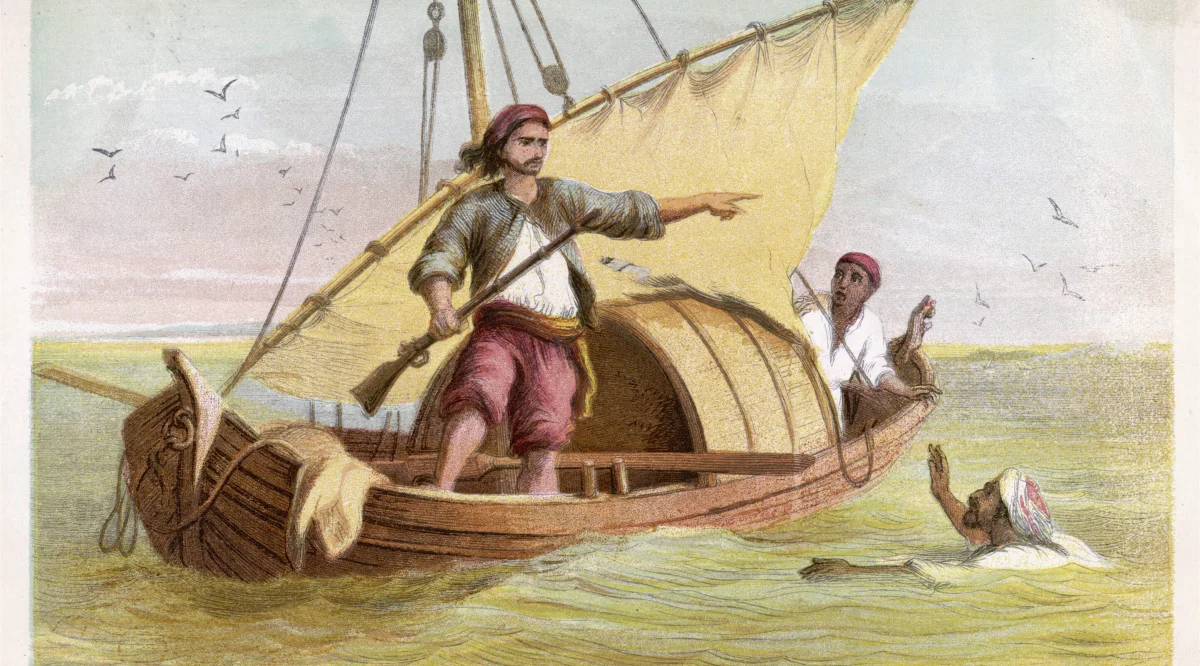
The unruly Scotsman was taken to the shore and left with a boat, a musket, some clothing, a kettle, and a Bible. Alexander Selkirk would later admit that on his very first night on the island he wanted to shoot himself. But the thirst for life made the buccaneer hide the musket away. On Más a Tierra he would discover, to his great joy, a great many goats and wild cats.
There turned out to be plenty of fresh water on the island. When the gunpowder ran out and the musket became useless, Selkirk would hunt goats with a homemade knife. Although he soon grew very tired of this chasing about. Alexander tamed some of the animals, and now roasted meat would be on his daily menu. The wild cats, which Selkirk gradually began to feed, made the fight against the hordes of rats easier. In the loud-mouthed Scotsman a talent for building unexpectedly emerged. And the two huts he erected would later arouse legitimate envy in his rescuers.
Rescue
On February 1, 1709, English sailors spotted the pirate-hermit on the island of Más a Tierra in the Pacific Ocean. Alexander Selkirk would return to Britain practically with the rank of a hero. He would be showered with royal favor and receive as a gift 800 pounds sterling – a very substantial sum for those times. However, a peaceful, quiet life was not to the former buccaneer’s liking. And Alexander Selkirk would once again return to his beloved «trade». On one of his voyages he would fall ill with yellow fever and find his rest in the ocean waters off Guinea.
A tourist was running late for a low-cost flight – and arrived at the airport by helicopter