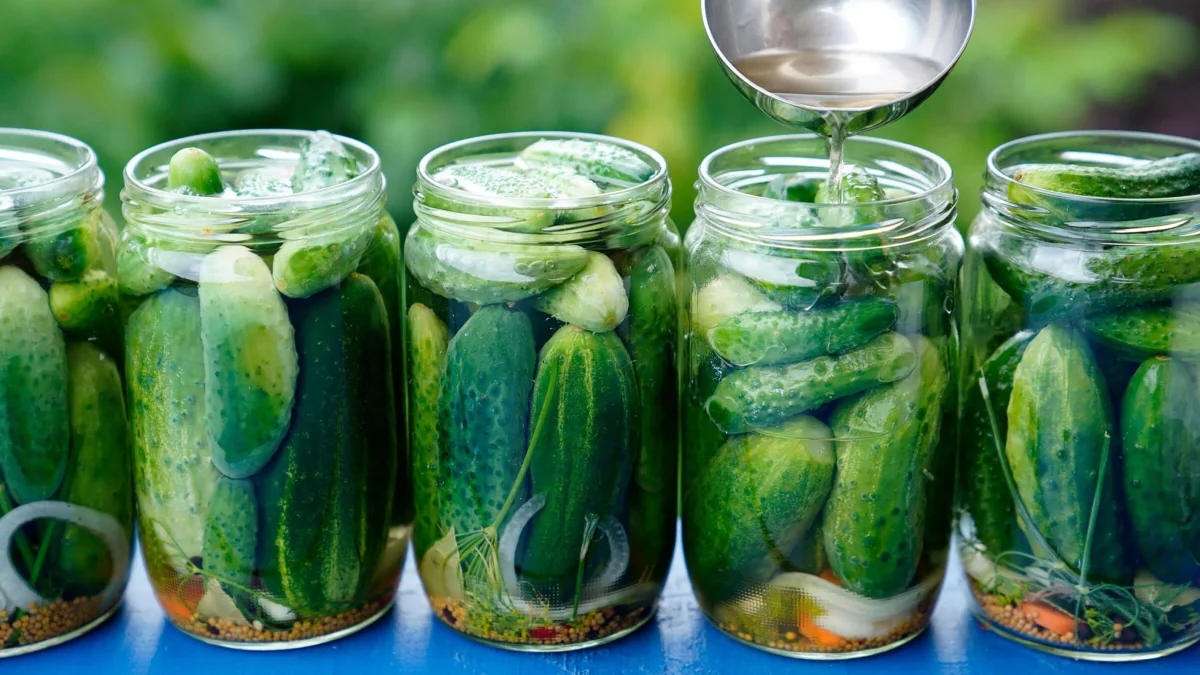
To make perfect crunchy salted or pickled cucumbers, they have to be chosen correctly – practically one to one. And everything depends not only on the size of the vegetable (though that, too, is an important detail), but also on its firmness.
How to choose cucumbers for pickling
Experienced gardeners claim that you can tell just by looking whether a vegetable is suitable for canning. First, what sets pickling varieties apart from the rest is the presence of small dark spines on the skin – such cucumbers are called prickly. These vegetables have very thin skin, which allows the brine to penetrate right inside. However, if the tips of the spines have turned white, then these cucumbers cannot be used for salting and canning.

Second, to the touch, cucumbers for pickling are very firm and hard. But even such varieties can lose their good looks because of improper care or watering. If a cucumber is a bit soft or limp – then it is better to use it in a salad. It is no good for pickling. One such cucumber can ruin all of the cook's efforts – it will start to ferment, and the jar lid will fly off.
Note that for vinegar-free pickling medium-sized vegetables are suitable, while for marinating – tiny gherkins. The cucumber's color should be rich, the skin green, without yellowing or dark spots.
By the way, gardeners warn that pickling varieties of cucumbers turn yellow very quickly. That is why you should not put off harvesting and the subsequent canning.
You cannot salt smooth cucumbers – they will turn to mush because of their thin skin and lack of spines. Overgrown large vegetables are not suitable either. They will simply turn out tasteless. They can be saved if you peel off the coarse yellow skin, slice them and can them in tomato juice – the cucumbers come out resembling zucchini.
The very best cucumber varieties for pickling

These cucumbers are prized for their small, compact size, and the salted vegetables come out very crunchy:
- «Altai»;
- «Anulka F1»;
- «Beregovoy»;
- «Bochkovoy Zasolochny F1»;
- «Bettina F1»;
- «Voronezhsky»;
- «Velikolepny F»;
- «Vyaznikovsky»;
- «Vesyolye Rebyata»;
- «Vodoley»;
- «Vodogray»;
- «German»;
- «Dolomit F1»;
- «Zhuravlyonok»;
- «Zozulya»;
- «Kurazh F1»;
- «Karnak F1»;
- «Kustovoy»;
- «Muromsky»;
- «Mamenkin Lyubimchik F1»;
- «Nezhinsky»;
- «Nosovsky»;
- «Primadonna»;
- «Rodnichok»;
- «Solovey F1»
- «Khrustyashchy»;
- «Champion»;
- «Era»;
- «Etap».
And the tiniest cucumbers, which are quick and easy to marinate – are «Liliput», «Parizhsky Kornishon», «Fillipok F1», «Detsky F1».

By the way
For pickling, use ordinary finely ground table salt without any additives, including iodine.
Before canning, the cucumbers need to be soaked in water for several hours.
If you plan to make lightly salted cucumbers that the whole family will eat within a week, then you can cut off the tips of the vegetables. That way they soak up the brine faster. But if you are canning them for the long term, then you should not do this, otherwise the cucumbers will soften and turn into a loose mush.
To protect the jar from «exploding», put a horseradish leaf in it. It kills all bacteria and gives the cucumbers a piquant flavor.
A harvest to envy: the best tomato varieties for the greenhouse