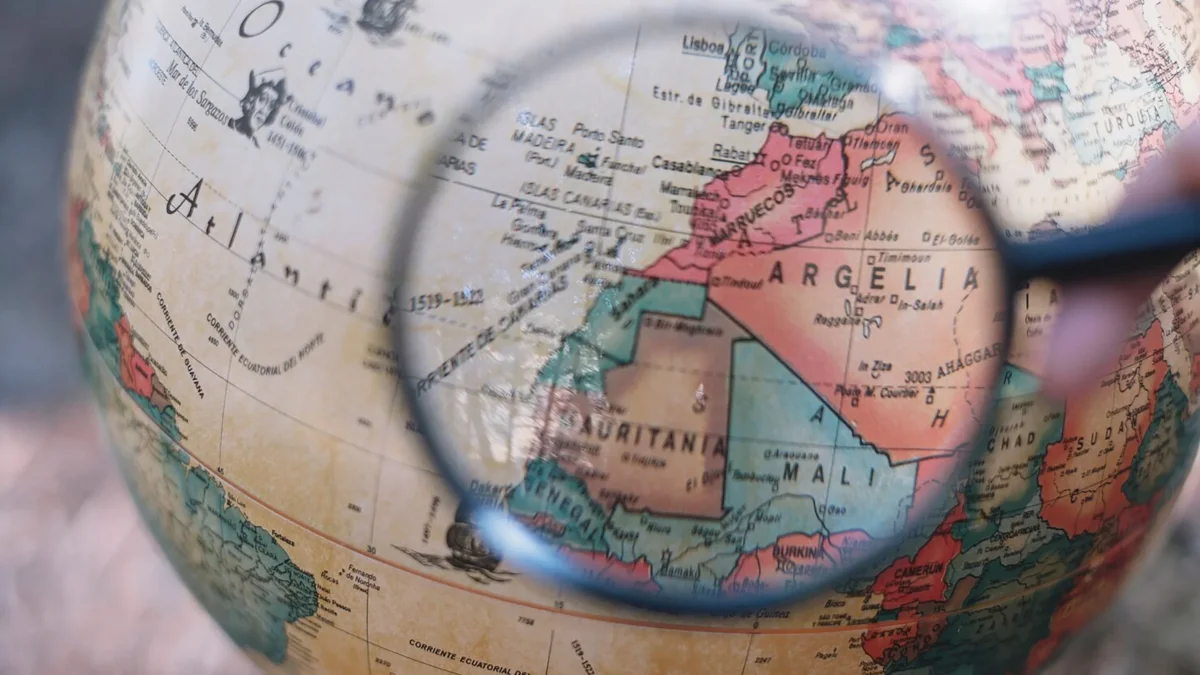
We are used to thinking of the world map as a horizontal projection with Africa at the center, Eurasia and Oceania to the right, and North and South America to the left. But what if this perception of the world is living out its final days?
There is another version of the map – the Chinese one. On it, the center of the world is quite predictably China, as one of the world's greatest powers, and in the opinion of the Chinese themselves – the greatest. America is split into two parts: the northern one sits at the top of the map, the southern one, accordingly, at the bottom.
The Arctic and Antarctic are no longer at the poles, but dangle somewhere in the upper and lower thirds. The oddities do not end there. The map is vertical.

Of course, it is far from certain that such a vision of the world is China's official position. However, it is known that this state is very sensitive about how its borders are depicted. But the fact that the Middle Kingdom strives to dominate the world is no secret to anyone either.
In addition, this map is built with global warming in mind. According to experts, by 2050, or even earlier, the Arctic will be sufficiently free of ice to open the Transpolar Passage, that is, it will make navigation across the North Pole possible. In that case the distance between Europe and Asia will be significantly reduced, and there will be no restrictions on ship tonnage either – since they will no longer need to pass through shallow waters and locks.
Experts at BigThink say that no country in the world other than China thinks strategically about navigation across the Arctic. And they already have a map – taking into account what the world will be like after the Transpolar Passage opens.
By the way
Specialists believe that there is no difference in exactly how a map is centered. Any flat image is a convention. It is impossible to transfer a map from a globe to a two-dimensional surface without distortion. But from a political point of view there is a difference, of course – reputational, at the very least.