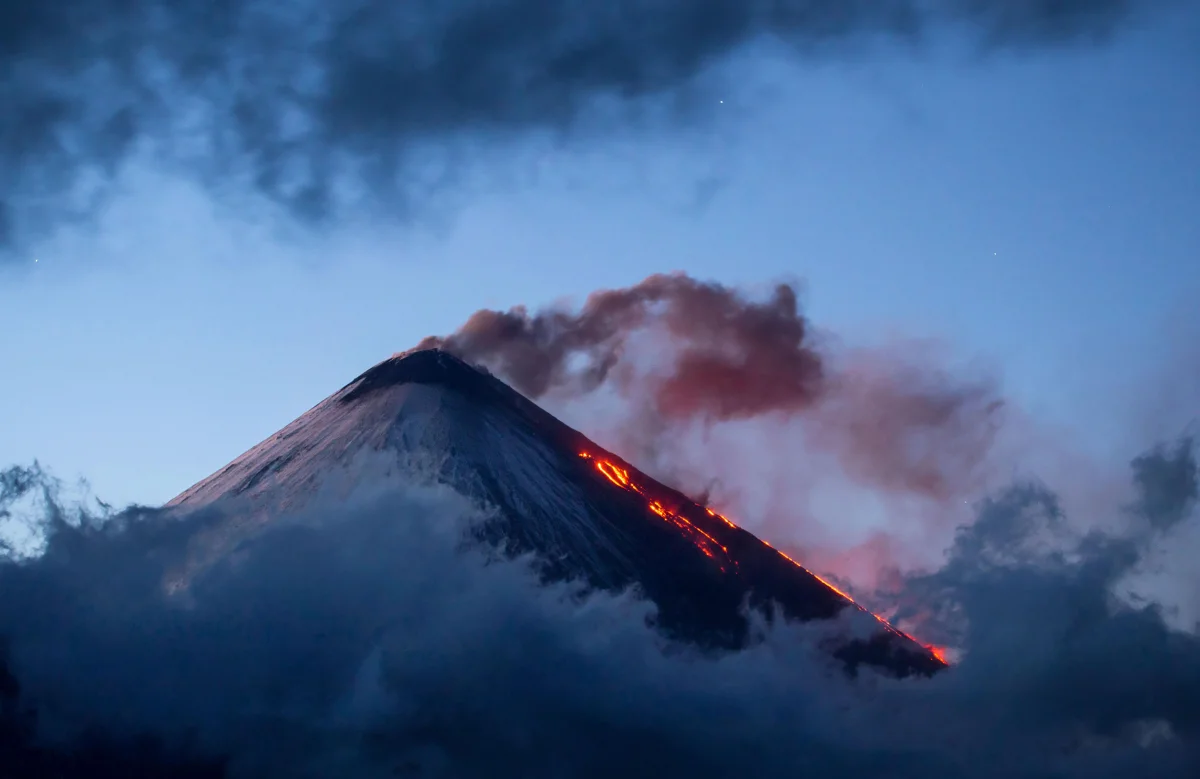
In June 2026, Indonesia's Semeru and Lewotobi volcanoes produced 11 eruptions within a matter of days. A year earlier, seven volcanoes on Kamchatka erupted simultaneously — something that hadn't happened in nearly 300 years. The vast majority of these hotspots are concentrated along a single belt.
According to the U.S. Geological Survey, Earth is home to roughly 1,350 potentially active volcanoes, not counting submarine ones. At any given moment, several dozen are in a state of eruption or heightened activity. But their distribution across the planet is extremely uneven.
The Pacific Ring of Fire: 75% of All Volcanoes
The overwhelming majority of active volcanoes lie along the Pacific Ring of Fire — an arc stretching 40,000 kilometers around the Pacific Ocean. Here, oceanic plates dive beneath continental ones, rock melts, and magma pushes toward the surface.
The ring passes through New Zealand, Indonesia, the Philippines, Japan, Kamchatka, Alaska, the Cascade Range, Mexico, and the Andes. This zone accounts for roughly 75% of all active volcanoes and 90% of the planet's earthquakes.
Indonesia: The Undisputed Leader
No country on Earth rivals Indonesia in the number of active volcanoes. It has roughly 130 — more than any other nation. The archipelago of 17,000 islands sits at the junction of three tectonic plates, and underground activity never stops.
In the past year alone:
- Semeru (Java) — five eruptions in a brief stretch during June 2026. Pyroclastic flows — a mixture of superheated gas, ash, and rock — raced down the slopes for several kilometers.
- Lewotobi (Flores) — no fewer than six eruptions during the same period. Residents of nearby villages were evacuated.
- Dukono (Halmahera) — an eruption in 2025 killed two foreign tourists and one local resident; around 20 people were trapped on the slope.
- Merapi (Java) — one of the most dangerous volcanoes in the world. In January 2025, pyroclastic flows traveled two kilometers; in autumn, another powerful ash ejection followed.
Indonesians live with volcanoes literally: millions of people reside on the slopes and at the bases of active volcanoes. The fertile volcanic soil feeds them — but it also kills.
Kamchatka: Russia's Record Holder
Kamchatka is one of the most volcanically active regions on the planet: roughly 300 volcanoes, 29 of them active. In the summer of 2025, the peninsula experienced a series of events that scientists called historic.
On July 29, 2025, an earthquake of magnitude 8.8 struck off the Kamchatka coast — the strongest in the world since 2011. What followed was what the Russian Academy of Sciences' Institute of Volcanology and Seismology dubbed a "parade of eruptions": seven volcanoes came to life at once. Nothing like it had been recorded here in nearly 300 years.
Shiveluch — the most active of Kamchatka's giants. In 2026, ash emissions occur virtually daily. Yuri Demyanchuk, head of the volcano station in the settlement of Klyuchi, notes that the volcano is erupting "according to its characteristic pattern" — powerfully, but predictably.
Klyuchevskaya Sopka, Bezymianny, Karymsky — the list of Kamchatka volcanoes under constant monitoring is long. They pose a special threat to aviation: ash clouds rise to cruising altitude and can disable jet engines.
Which Volcanoes Are Causing the Greatest Concern Right Now
Not all dangerous volcanoes are the ones currently erupting. Some have been silent for decades but are sending signals that unsettle scientists.
- Campi Flegrei (Italy)
A supervolcano beneath Naples — not a mountain, but a giant caldera 13 kilometers in diameter, inside which 360,000 people live. Since 2023, the region has been shaken by earthquake swarms and the ground surface is rising — signs of growing magma pressure. The last major eruption was in 1538, but the catastrophic one came 39,000 years ago.
According to researchers at Kobe University, the magma reservoir responsible for the most powerful eruption of the Holocene has begun refilling.
- Vesuvius (Italy)
Last eruption: 1944. The volcano is active, and seismic activity is recorded continuously. In the potential impact zone: three million residents of the Naples metropolitan area.
- Aira Caldera (Japan)
The active volcano Sakurajima inside the caldera erupts regularly — hundreds of small emissions per year. But what concerns scientists isn't Sakurajima itself — it's the caldera: its last super-eruption 29,000 years ago blanketed all of southern Japan in ash.
- Mount Fuji (Japan)
Last eruption: 1707. A potential repeat, according to NHK estimates, could cause severe disruptions to the power grid and paralyze the Tokyo region — home to 38 million people.
- Yellowstone (USA)
The supervolcano that documentary films love to dramatize. In spring 2026, all monitored indicators were at normal danger levels. The last super-eruption was 640,000 years ago.
Scientists rate the probability of a repeat in the coming centuries as extremely low.
Why Eruptions Can't Be Predicted
Unlike weather, volcanology has no reliable forecasting models. Scientists detect precursors — earthquake swarms, ground uplift, changes in gas composition — but translating them into a specific eruption date is impossible. A volcano can "rumble" for decades and never blow. Or it can stay silent and erupt without warning.
Monitoring is constant: seismic stations, satellites, gas analyzers, GPS sensors tracking ground rise. But of 1,350 potentially active volcanoes, fewer than a third are systematically observed. The rest — especially in Indonesia, Central America, and Africa — could deliver a surprise.
What This Means for Travelers
Volcanoes are not a reason to cancel a trip to Bali, Kamchatka, or Naples. But a few things are worth knowing:
- Check the status. Volcanological agencies publish color-coded danger levels: green, yellow, orange, red. Before traveling to a volcanically active region — look it up.
- Don't ignore evacuations. If local authorities call an evacuation — comply. A pyroclastic flow moves at speeds up to 700 km/h and temperatures of +400°C. You cannot outrun it.
- Have insurance. A volcanic eruption is force majeure. Canceled flights, closed airports, hotel evacuations — all of this is covered by a policy with a natural disaster clause.
Volcanoes are a reminder that the Earth's crust is not a monolith but a thin shell over a molten mantle. And the 1,350 points where that shell can crack form a map the planet updates every day.