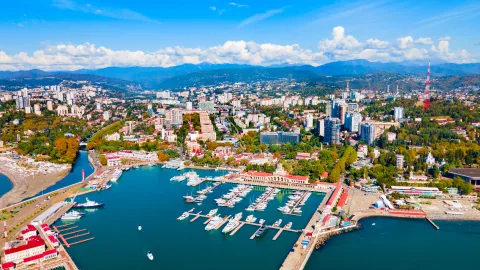
It's been drizzling in Sochi for three days straight, the beach sits empty, and any hope of snorkeling has vanished along with the sky. At that exact same moment, in the Trans-Baikal town of Borzya — where the thermometer easily drops past –22°F in winter — locals are pulling out their sunglasses, since the sky there stays clear almost year-round.
Intuition says the sunniest spot in Russia should be somewhere in the south, near warm water. But actual meteorological data breaks that logic apart: the number of sunshine hours in a year isn't determined by air temperature — it comes down to entirely different factors: humidity, cloud cover, and the character of atmospheric circulation over a given territory.
Why Warm and Sunny Aren't the Same Thing
The duration of sunshine depends on the angle of the sun's rays, the length of daylight, and — most importantly — the amount of cloud cover over an area.
Cloud cover, not latitude or temperature, turns out to be the decisive factor: two places on the same parallel can receive wildly different amounts of sunshine if one sits under dry continental air and the other gets swept by moist weather systems.
This is the key to the Trans-Baikal paradox. Over Eastern Siberia and Transbaikalia, a stable anticyclone dominates most of the year — a high-pressure zone that brings dry, cloudless weather regardless of how cold it gets outside. Frost and clear skies coexist perfectly well there.
Who Tops the Ranking
According to long-term Roshydromet data, Russia's sunniest city consistently turns out to be Borzya, in Zabaykalsky Krai — around 2,870 hours of sunshine a year, despite its sharply continental climate with harsh, freezing winters. This isn't a one-off record from a single season — it's a stable climatic norm for the region.
Ulan-Ude, the capital of Buryatia, comes next at 2,797 hours a year. Its reputation as "Russia's sunny capital" has stuck so firmly that officials have periodically proposed making it official.
Neighboring Chita holds around 2,653 hours, while further east, Khabarovsk breaks into the leaders at 2,449 hours — despite the Far East's monsoon influence, its peak sunshine shifts to March, before the summer fogs roll in.
Rounding out the list: Omsk, where the dry continental climate leaves only two overcast months a year, with roughly 2,200 hours of sun, and Yakutsk, at a similar total but for a different reason: its proximity to the Arctic Circle stretches summer daylight to nearly 20 hours.
What About the Southern Resorts
Sochi, the default stand-in for Russian sunshine, actually loses out in this ranking to the Siberian towns most people would never expect. Long-term observations put the city at around 2,175–2,250 hours of sunshine a year — noticeably below Borzya or Ulan-Ude.
The reason lies in the nature of a subtropical climate itself: mountains shield Sochi from cold winds and trap moist sea air, but that same humidity translates into higher cloud cover and frequent rain, especially in winter.
The resort stays warm almost year-round, but warm isn't the same as sunniest — these are two separate climate characteristics that don't always overlap.
Other Regions in the Top Rankings
Beyond the clear Siberian and Far Eastern leaders, Russia's sunniest territories consistently include:
- Zabaykalsky Krai,
- Tyva,
- Crimea,
- Amur Oblast,
- Astrakhan Oblast,
- Kalmykia,
- Altai,
- Orenburg Oblast,
- Volgograd Oblast.
It's no coincidence that a significant share of Russia's solar power plants are concentrated in these exact regions.
Today, the country's largest is the Arshan Solar Power Plant in Kalmykia, with an installed capacity of 115.6 megawatts — enough to supply electricity to about eight thousand apartments.
But that lead may soon change: in 2026, Amur Oblast plans to begin construction on a 650-megawatt solar plant, expected to cover more than a tenth of the region's projected energy shortfall — clear evidence that the solar potential of Russia's south and east is being put to use more and more actively.
The distinction between a "warm" climate and a "sunny" one isn't just a meteorological footnote. For anyone choosing a destination for the sunbathing itself, rather than the warm sea, the right route might lead somewhere entirely different than the usual southern-resort logic would suggest.