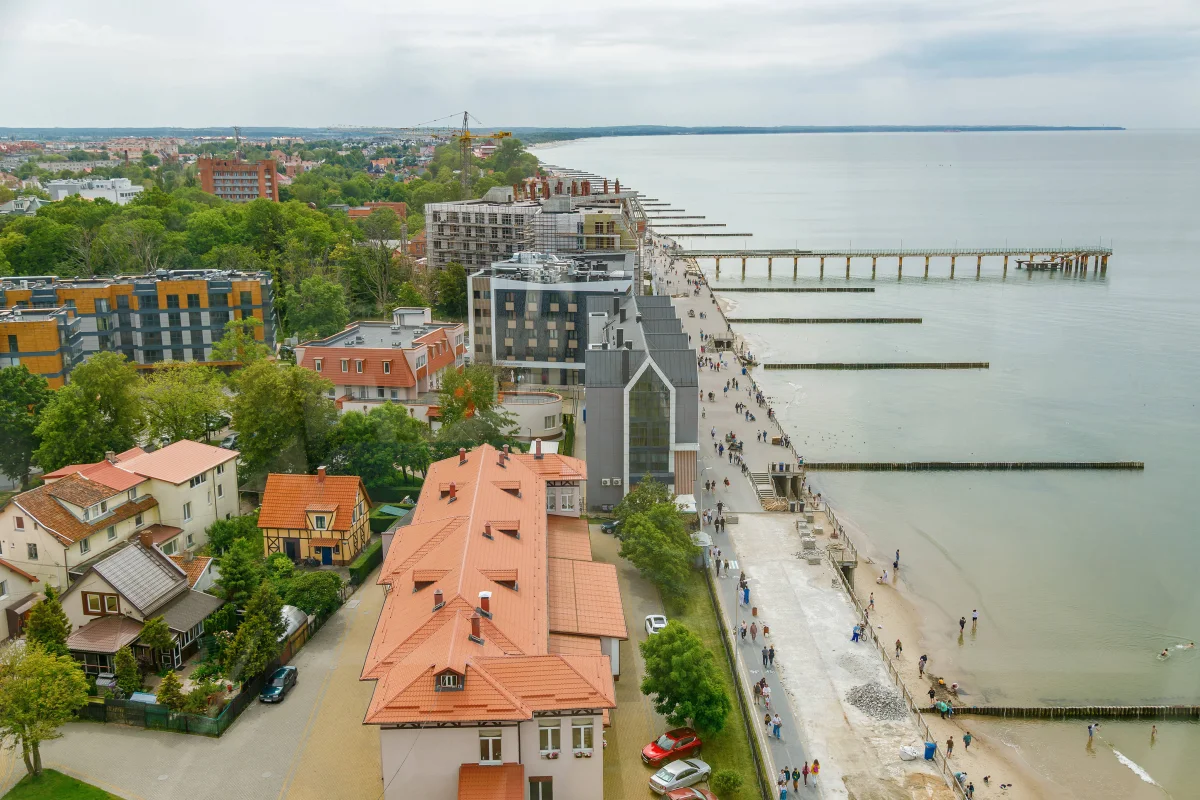
A tourist wades into the water at Zelenogradsk in June, pleased with himself — the sun's out, the beach is nearly empty — and immediately jumps back out: the sea sits at 55–59°F (13–15°C), as if the water refuses to acknowledge that it's supposedly summer. Two months later, in August, that same water will have warmed by nearly ten degrees and turned genuinely swimmable.
The Baltic isn't a sea you can plan around the standard southern template of "it's summer, so swim." Its seasons run on a different logic: the water has its own warming schedule, amber hunting follows the rhythm of storms, and the famous Curonian Spit runs on a calendar tied to migrating birds.
Figuring out when to go for exactly what you want takes a bit more thought than simply picking the warmest month.
When to Go for the Beach and Swimming
If the sea itself is the goal, there's one clear answer: July and August. This comes down to water inertia — the Baltic Sea warms slowly, so even on hot June days, swimming feels more like a cold-water challenge than relaxation.
- June: water sits at 55–59°F (13–15°C) — refreshing, sure, but most people opt to just sunbathe instead.
- July: the water reliably warms to 68–72°F (20–22°C), and the beaches of Zelenogradsk and Svetlogorsk fill up with visitors, thanks to their gentle entry and sandy bottom.
- August: peak swimming season, with water reaching 73–75°F (23–24°C) — the warmest month on the coast.
Differences between resorts matter too: on the Curonian Spit, shallow water warms faster; in the lagoon, temperatures typically run 2–3 degrees warmer than the open sea; while in Baltiysk, the water stays cool even at the height of summer.
Why Locals Call September the Best Month
The Baltic Sea works like a thermos in reverse: it takes a long time to heat up, and just as long to cool down. Because of that, September water still holds around 63–68°F (17–20°C), and air temperatures in the first half of the month climb to 64°F (18°C), all while rainy days run roughly half as frequent as during peak summer.
This is Kaliningrad's velvet season: mild enough for long walks along the dunes and embankments, noticeably fewer tourists than in July, and a different quality of light — warmer, angled lower, and perfect for photographs.
Long-term data puts September's average daytime temperature around 63°F (17.3°C) and nighttime around 48°F (9.1°C), with about 12 rainy days across the month — so a windbreaker and rain jacket belong in the suitcase just as much as a swimsuit.
When the Spit Gets Especially Interesting — Beyond the Beach
The Curonian Spit runs on its own calendar, and the main entry on it isn't weather — it's bird migration. Hundreds of thousands of birds pass each year through this narrow strip of land between the sea and the lagoon, making it one of the largest migratory corridors in Eastern Europe.
The Fringilla ornithological station — the oldest in the world, founded in 1901 — records up to 250,000 birds in a single day during peak migration.
The station operates from late April through early October, with the best observation windows during spring migration in April–May and autumn migration in September–October. In summer, far fewer birds show up in the nets — most have already dispersed to their nesting grounds.
If the plan is to combine a walk through the dunes with actual birdwatching, rather than just photographing the Dancing Forest, aim for mid-May or mid-September — and as a bonus, the spit sees fewer tourists during those windows than at the July peak.
What About Amber Hunting
Here, the logic runs completely opposite to beach planning: the calmer and warmer the water, the lower your odds of finding anything worthwhile. Amber washes ashore after storms — large waves dredge it up from the seabed and dump it onto the sand along with seaweed. Extended storms, lasting 2–3 days with a northwesterly wind, are considered the most productive.
The practical takeaway: the Baltic's main storm seasons are autumn and winter, especially September–November, when weather systems roll through one after another. The best time to search is early morning after an overnight storm — before anyone else has walked the beach, and while the low morning sun highlights pebbles among the gravel and seaweed.
The prime spots are the beaches of Yantarny, home to the world's largest amber deposit, along with Zelenogradsk and the Baltic Spit.
Is It Worth Going in Winter
Winter in Kaliningrad is mild by Russian standards: severe frosts are rare, snow falls but doesn't stick around long, and average January daytime temperatures hover near freezing. Beach season is obviously closed, but winter on the Baltic offers its own distinct spectacle — a stormy sea, icy patterns forming on the promenade after frigid nights, and occasionally an ice shelf extending dozens of meters from the shoreline.
This isn't a trip people plan specifically around, but for anyone already in the city for other reasons, a winter walk along the sea is a genuine experience in its own right — not just a consolation prize for missing summer.
How to Pick a Month for Your Specific Goal
Boiled down to practical terms: for swimming, aim for July–August; for calm walks without crowds and still-warm water, aim for September; for birdwatching on the spit, aim for May or September–October; and for amber hunting, aim for the period right after autumn or winter storms, ideally early in the morning.
The region's weather stays unpredictable in any month — the Baltic is rarely forecastable more than a couple of days out — so even with the "right" season chosen, it's worth keeping a backup plan for rain and wind.