In Kosh-Agach, in the Altai region, rain is an event — not a meteorological one, but a social one: people step outside just to look at it. Over the course of a year, this place gets about as much precipitation as Moscow gets in a single wet November. And this isn't the Sahara — it's right here in Russia.
Ask "what's the driest place in the country," and most people answer quickly: Kalmykia, Astrakhan — somewhere in the south. That answer is half right.
Southern European Russia genuinely is arid, but the absolute record for the lowest precipitation belongs to an entirely different region — the Altai Mountains. And if you measure "dryness" not in millimeters of rainfall but in number of rainy days, the picture flips entirely: the leaders aren't who you'd expect.
Three Ways to Measure Dryness
Before naming a champion, it helps to agree on the yardstick — because "driest" can mean different things, and each approach produces a different answer.
By total precipitation (mm per year) — the classic metric. Fewer millimeters means drier. Here, the leader is Kosh-Agach (Altai Republic), at roughly 100–150 mm a year.
By number of days with precipitation — a different lens entirely. You could get 150 mm from 15 short downpours, or from 90 days of light drizzle. In the first case, you get 350 "dry" days; in the second, 275. The felt sense of aridity is completely different.
By aridity index — the ratio of precipitation to evaporation. If precipitation is low but evaporation is also low (a cold climate), moisture might still be adequate. If precipitation is low and evaporation is high (heat), real drought sets in. By this measure, the leaders are Kalmykia and the Caspian lowlands — the places where water scarcity is felt most acutely.
All three metrics crown different champions. Let's look at each.
Kosh-Agach: The Absolute Minimum for Precipitation
The village of Kosh-Agach, in the Altai Republic, is officially Russia's driest place by average annual precipitation: 100–155 mm. For comparison: Moscow gets around 700 mm, St. Petersburg about 660 mm, Astrakhan roughly 220 mm.
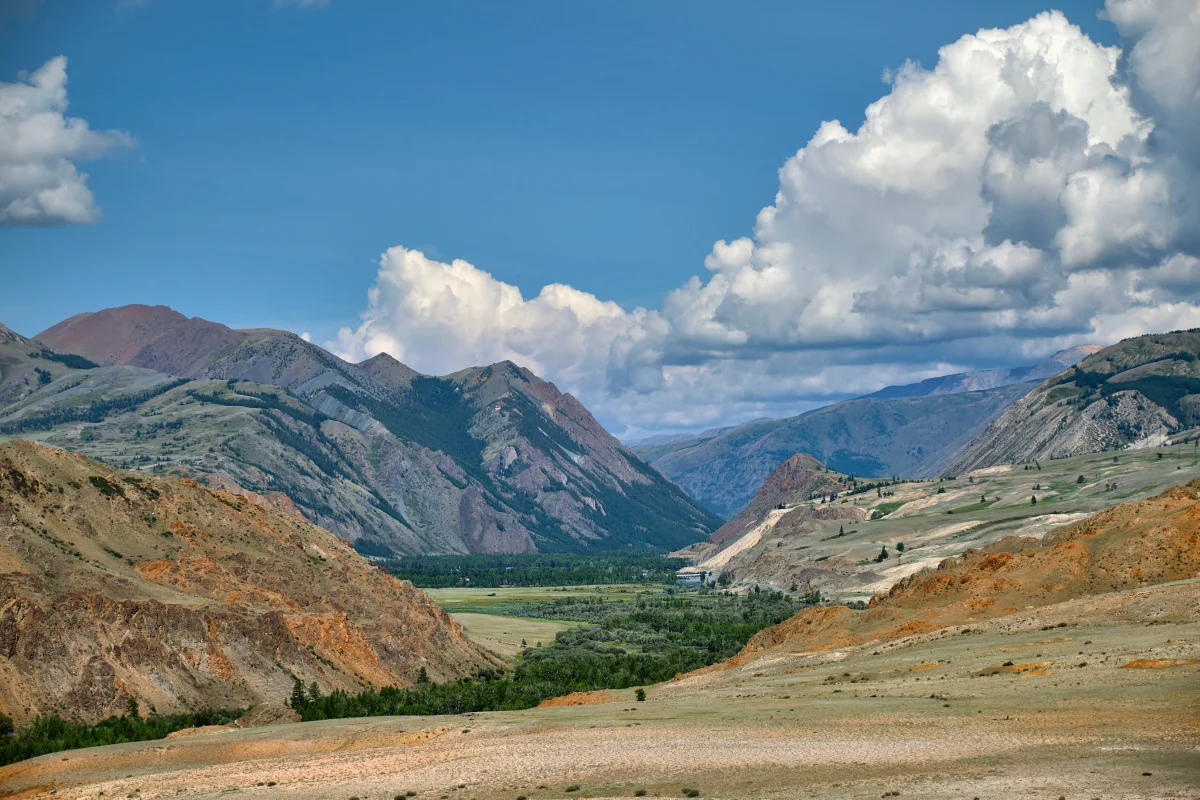
Kosh-Agach sits in the Chuya intermountain basin, at an elevation of 1,760 meters, surrounded by mountain ranges on all sides.
Moist air, wherever it originates, simply can't make it over those mountains. Clouds dump their moisture on the outer slopes, and only already-dried air reaches the basin's interior. This is known as a rain shadow, and it operates at maximum efficiency in Kosh-Agach.
Rainy days per year number no more than 20–30. The other 335–345 days stay dry. The sky is clear enough that a 5-megawatt solar power plant was built here — Kosh-Agach ranks among the sunniest places in Russia by hours of sunlight.
But "dry" doesn't mean "hot" here. Winter temperatures drop to –49 to –58°F (–45 to –50°C), while summer highs reach 86°F. The annual temperature swing runs as high as 80 degrees Celsius (144°F). The landscape is rocky steppe, closer in character to Mongolia: scorched grass, sparse shrubs, and camels — yes, Kosh-Agach is one of the few places in Russia where camels are raised.
The population sits around 4,500, mostly Kazakhs and Altaians. The main livelihood is livestock herding: cows, horses, yaks, camels. Farming without irrigation is impossible — 150 mm isn't enough to grow even potatoes.
The Caspian Lowlands and Kalmykia: The Harshest Drought
If Kosh-Agach holds the record for lowest precipitation, the Caspian Lowland holds the record for moisture deficit. Precipitation here runs somewhat higher (150–200 mm), but evaporation runs 3–4 times higher than rainfall. Every drop that lands on the ground escapes back into the atmosphere faster than it can soak in.
Eastern Kalmykia is the most arid region in southern European Russia. Rainy days number 30–40 a year, with most precipitation falling in spring (March–April).
Summer here is dry and scorching: up to 120 days of hot, dry winds, with soil surface temperatures reaching 140°F (60°C). This is where the Black Lands sit — Europe's only anthropogenic desert.
The Black Lands formed when uncontrolled livestock grazing during the 1970s and 1980s destroyed the vegetation cover. Wind began shifting the exposed soil, and sand dunes formed — a genuine desert. The area of open sand covers roughly 100,000 hectares.
Over recent decades, some of the dunes have been stabilized — shrubs planted, grazing restricted — but 80% of the republic's territory remains vulnerable to desertification.
Astrakhan, the largest city in the Caspian region, gets around 220 mm of precipitation a year. For a city of half a million people sitting in the Volga River delta, that's a paradox: water surrounds it everywhere — rivers, channels, backwaters — yet rain is nearly absent. Rainy days number around 45–50 a year, unevenly distributed: autumn and spring bring slightly more moisture, summer brings almost none.
Volgograd: Dry Steppe With a Million Residents
Volgograd is another city where the precipitation deficit shapes daily life.
Its annual average runs 260–270 mm, with about 50–55 rainy days. Summer is long, hot, and dry — from June through August, rain can vanish for weeks at a time. At 95–104°F, that means dust storms, scorched lawns, and garden plots where the harvest depends on a well, not the sky.
The city stretches 90 kilometers along the Volga, and the river is the only reliable source of moisture for a city of a million people. Without it, Volgograd would sit in the middle of semi-desert — which is, in essence, the reality just outside city limits.
Yakutsk: Dry, But Not Arid
Yakutsk is one of Russia's major cities with the least precipitation: around 240 mm a year — even less than Volgograd. It sees around 60–70 days with rain or snow.
Yet Yakutsk doesn't feel dry. The reason is temperature: at –40°F, moisture in the air doesn't evaporate — it freezes. Snow that falls in October sits on the ground until April, slowly soaking into the soil. In summer, the taiga around the city turns swampy, rivers run full, and humidity stays high. There's no moisture deficit here at all.
This is the key distinction: low precipitation doesn't equal aridity. Yakutsk gets little rain, but its soil stays moist. Kalmykia gets slightly more rain, but its ground cracks from dryness. The difference lies in temperature and evaporation.
What Life Looks Like in Russia's Driest Place
Kosh-Agach has no use for umbrellas — not because they aren't sold, but because there's simply no need for one; over a year, you might reach for one only a handful of times. What it does have is dust: strong wind lifts fine particles off the rocky steppe and clogs everything — windows, clothing, lungs.
Water comes from wells and mountain streams. The nearby Chuya River, fed by glacial melt, stays full even at minimal rainfall — without it, the village wouldn't exist.
Garden plots require irrigation to survive; without it, nothing grows besides wormwood. Locals grow potatoes and cabbage using water channeled from the streams — the short summer allows it, as long as water reaches the soil.
Kalmykia and the Caspian region tell a different story. There are no glacial rivers here; groundwater is salinized, and the only source of fresh water comes from canals and pipelines carrying water from the Volga and Terek rivers. Some settlements still receive drinking water by tanker truck. Without the canal system built during the Soviet era, agriculture in southeastern Kalmykia would be impossible.
Is It Getting Drier
Researchers note that aridification is intensifying across southern Russia — not so much from a drop in precipitation (which has been minimal), but from rising temperatures: the warmer it gets, the more evaporation increases, sharpening the moisture deficit even with the same amount of rain.
Kalmykia is a bellwether. In 2020, the republic endured its worst drought in decades: the agricultural sector suffered massive losses, pastures burned out, and livestock went without feed. One good year now alternates with two or three bad ones — a pattern that, according to forecasts, is only expected to intensify.
Dryness Records: The Cheat Sheet
- Kosh-Agach (Altai): 100–155 mm/year, 20–30 rainy days. Caused by a mountain rain shadow.
- Eastern Kalmykia: 170–210 mm/year, 30–40 days. Driven by distance from the ocean and extreme heat.
- Astrakhan: ~220 mm/year, 45–50 days. Caspian lowland climate.
- Volgograd: ~265 mm/year, 50–55 days. Steppe zone with few passing cyclones.
- Yakutsk: ~240 mm/year, 60–70 days. The Siberian High in winter brings dryness, but not aridity.
Russia's driest place isn't where it's hottest, and it isn't where water is scarcest. Kosh-Agach is a cold high-altitude basin where rain is rare, but a river still flows reliably. Kalmykia is a hot plain where rain falls slightly more often, but water is catastrophically scarce.
Yakutsk gets nearly as little precipitation, yet never experiences drought. Behind a single number — millimeters of rainfall — sit completely different realities, and "driest" turns out to be a term that needs qualifying: dry by the rain gauge, dry by how it feels, or dry by its consequences.