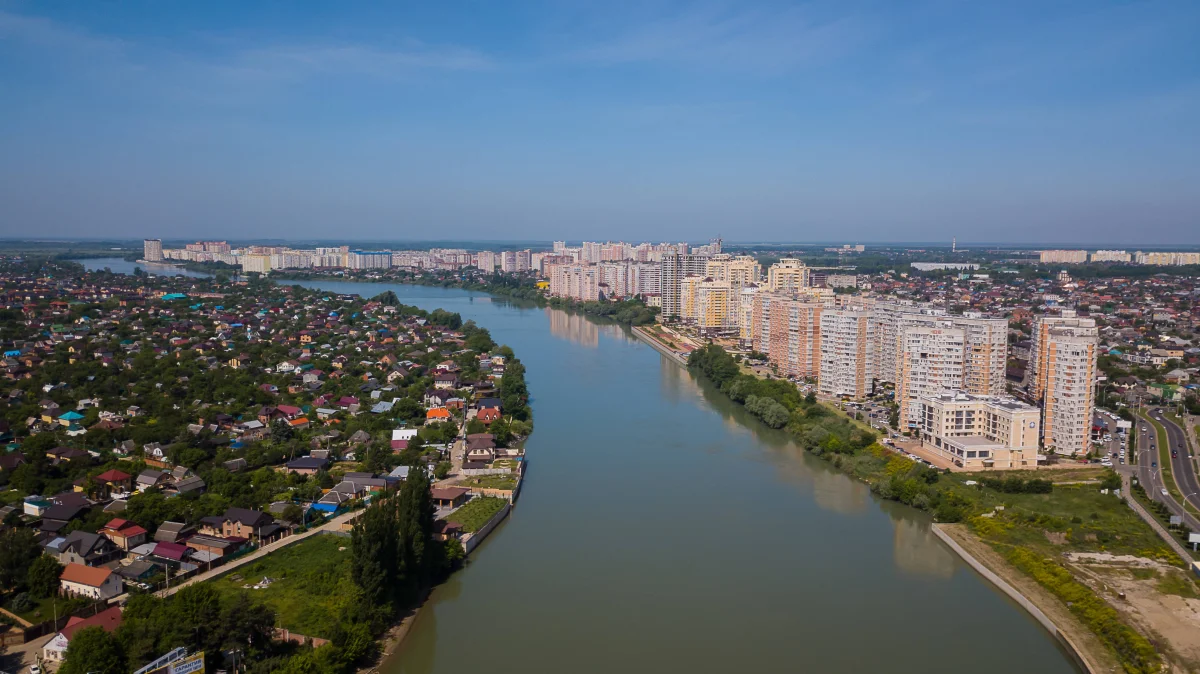
Krasnodar, July, 99°F. A city of over a million people, with no sea in sight. The river sits five minutes from home, complete with a landscaped embankment and a sandy slope down to the water. The water is murky, but warm. "No Swimming" signs stand every hundred meters. Half the people on the shore ignore them. Every year, someone from that half doesn't make it home.
The swimming ban on the Kuban River has been in effect in Krasnodar since the early 2000s — over twenty years. Not a single officially approved beach exists anywhere along the river within city limits. The water fails sanitary standards, the riverbed is unpredictable, and the current is dangerous.
And yet every summer, the same story repeats: heat drives people into the water, and the water takes lives. Let's break down exactly what makes the Kuban dangerous — and why even an experienced swimmer might not make it out.
The Current: Stronger Than It Looks
The Kuban is a mountain river that originates on Mount Elbrus and crosses nearly the entire length of Krasnodar Territory before emptying into the Sea of Azov.
Even in its flatland stretch through Krasnodar, current speed runs 0.5–1.5 m/s — and after water releases from the Krasnodar Reservoir, it can double within a few hours. Someone standing chest-deep in water at that speed has no control over their position — the current simply carries them off.
Galina Koroleva, deputy head of the Emergency Ministry's regional directorate for Krasnodar Territory, has explained that the river's bed drops off sharply in places, forming whirlpools capable of pulling a person underwater. The problem is that these drop-offs are invisible from shore: the Kuban's bottom is murky and silty, and there's no way to tell where a ledge or a shallow ends until you step right onto the edge.
The areas near hydraulic structures — dams, spillways, bridge piers — carry a special danger. Reverse currents and eddies form here, capable of pulling a swimmer underwater. Escaping such a current without outside help is extremely difficult, even for an experienced swimmer.
The Riverbed: Pits, Debris, Snags
The Kuban's riverbed in Krasnodar is uneven and cluttered. The river carries silt, sand, and branches, and along its urban stretches, the bottom is littered with construction debris, rebar, and submerged objects. Catching a foot on a snag, or cutting yourself on metal underwater, is far from rare.
Depth shifts unpredictably: three meters from shore might be knee-deep, while five meters out could drop into a pit 3–4 meters deep. These pits form both naturally (current erosion) and from human activity (old quarries, undercut banks).
After floods and heavy rain, the riverbed shifts entirely — a spot that was safe last year can become a trap this year.
The Water: What's Actually In It
The Kuban within Krasnodar has failed to meet sanitary standards for swimming for more than 15 years. According to Rospotrebnadzor, the problems run along several fronts.
- Microbiology
The water contains E. coli, enterococci, and other pathogens at concentrations far exceeding safe swimming limits. The sources include sewage discharge, storm runoff, and livestock operations upstream.
Ecologist Alexey Korabelnikov, interviewed by the outlet Utyug, said that sample results from Krasnodar's potential beach zones failed to meet sanitary-chemical, microbiological, parasitological, and viral standards — and that swimmers there would "almost certainly pick up rotavirus."
- Chemistry
Steppe rivers feeding into the Kuban carry runoff from agricultural operations — fertilizers, pesticides, farm waste. Industrial facilities operate further upstream. Within Krasnodar itself, storm drains dump into the river — drains that, according to local residents, have illegal connections tapped in by residential complexes.
The visual evidence is simple: bottles, bags, hygiene products, and construction debris float along the shoreline. On hot days, the smell matches.
Swimming in this water risks intestinal infections, skin conditions, and conjunctivitis. For children, whose immune systems are less developed, the risk runs higher.
Why People Swim There Anyway
Krasnodar is a city of over a million, and one of the hottest in Russia — weeks of 95–104°F in summer. Meanwhile, the sea sits 130 to 300 km away, depending on direction. Pools are in short supply for a city this size, with just one water park. The river, meanwhile, sits right in the city center, walkable from home.
Under these conditions, the ban works on paper but not on the ground. People show up with kids, inflatable mattresses, portable grills. Some have swum here for years and say, "nothing's ever happened." Others show up for the first time — and get pulled into a whirlpool or drop into an unseen pit.
According to the Emergency Ministry, dozens of people drown in Krasnodar Territory every year — a significant share of them in rivers and bodies of water never intended for swimming. During heat waves, the reports come in daily.
What About Further Upstream
The Kuban isn't just Krasnodar. The river runs through dozens of towns — from the mountain districts of Karachay-Cherkessia down to the plains of Krasnodar Territory. And the issues differ by stretch.
- In the upper reaches (Karachay-Cherkessia, Adygea), the water is cleaner, but the current is faster and more powerful — a mountain river with a rocky bed, drop-offs, and rapids. Swimming here is physically dangerous: the current can knock you off your feet even in shallow water.
- In the middle stretch (Kropotkin, Ust-Labinsk), the river widens and calms, but pollution increases — runoff from agriculture, sugar refineries, and meat-processing plants. The situation is nominally better than in Krasnodar, but there are still no official beaches.
- In the lower reaches (Slavyansk-na-Kubani and onward toward the sea), the Kuban splits into channels and estuaries. The current weakens, the water turns stagnant and murky — a breeding ground for mosquitoes and microorganisms.
Can This Be Fixed
Meteorologist and geographer Yuri Tkachenko, speaking to AiF-Krasnodar, noted that the problem is systemic. The Kuban is a federally regulated waterway, but oversight of water quality is split across several agencies, with insufficient coordination between them.
Bringing the Kuban's water up to swimming standards would require modernizing wastewater treatment in Krasnodar and upstream towns, eliminating illegal sewer connections, controlling agricultural runoff, and clearing debris from the riverbed.
According to environmental estimates, that would take billions of rubles and years of work.
Until that happens, the situation is a closed loop: the river stays dirty → beaches never open → people swim at their own risk → some drown or get sick → authorities put up more signs.
Where You Can Actually Swim in Krasnodar
If you live in Krasnodar or are visiting, the options are limited but they do exist.
- Pools. Indoor and outdoor, attached to sports complexes and fitness centers. Prices start at 300 rubles per visit. The water's treated, and lifeguards are present.
- Lakes and quarries outside the city. Some carry official recreational status, with equipped beaches. Check the city administration's website before heading out — the list of approved sites gets updated each season.
- The sea. The nearest beaches are Dzhubga (~120 km), Gelendzhik (~185 km), and Arkhipo-Osipovka (~140 km) — 1.5 to 2.5 hours by car without traffic. Not close, but safe and legal.
The Kuban River is beautiful, historically significant, and central to the life of an entire region. But it's not built for swimming. The murky water, so tempting-looking in the heat, hides currents, pits, debris, and pathogens — and no "No Swimming" sign explains that as clearly as it should. Every summer, someone decides the rules don't apply to them. And every summer, luck runs out for a few of them.