Some destinations get visited despite autumn, as travelers chase the last of summer's warmth. Others exist specifically because of autumn — a different light, different colors, a different kind of quiet. September in Russia isn't a compromise season. It's its own distinct destination map.
In summer, everyone heads south, toward the sea. Come autumn, the map flips: the most interesting things start happening in central Russia, the north, the mountains, and around the lakes. Places that were too hot for long walks in summer, too crowded for quiet, or too uniformly green to offer contrast — September puts all of that back in order.
The southern resorts haven't gone anywhere (the sea's still warm there too), but this roundup is about something else: places that wait for autumn to show their best version.
Karelia: Gold on Black Water
Karelia in summer means mosquitoes, white nights, and crowds at Kizhi. Karelia in September means quiet, crimson, and reflections. The forests around its lakes ignite within a matter of days — birches turn yellow, aspens turn red, and the dark water of Karelia's lakes becomes a mirror that doubles every color.
The Ruskeala marble canyon looks brighter in autumn foliage than in summer: turquoise water, white marble, red-and-yellow trees framing it all. The underground boat tour runs through the end of September, and the canyon's evening light show is a spectacle of its own.
Kizhi, the open-air museum of wooden architecture on an island in Lake Onega, sees lines and tour groups every 15 minutes in summer. In September, you can stand in front of the Transfiguration Church completely alone, without a single other voice around. Boat navigation on Lake Onega runs until mid-October.
Valaam, an archipelago on Lake Ladoga with an active monastery, turns into golden forests, stone hermitages, and a calm Ladoga in autumn. Boats from Sortavala run through the end of September.
Temperatures run 50–59°F (10–15°C) during the day, dropping to 37–41°F (3–5°C) at night. A warm jacket, hat, and waterproof shoes are essential. The mosquitoes are gone — and that alone might be the biggest argument for coming now.
Plyos and the Volga: Levitan's Landscapes
Plyos is a tiny town on the Volga that the painter Levitan didn't choose by accident: hills over the river, wooden houses, a church on the hill — and nothing else competing for attention. In September, the landscape he painted a century and a half ago recreates itself exactly: golden birches, a silvery Volga, morning haze over the water.
The population is around 1,800, and September brings few tourists.
Highlights include Levitan's house-museum, Mount Levitan (a 10-minute climb, with a view instantly recognizable to anyone who's seen Above Eternal Peace), and the embankment with its smoked bream. Two or three days is enough to take your time here. It's 370 km from Moscow — best reached by car. Book lodging in advance; options are limited.
The Altai Mountains: Golden Larches
Altai in September is one of the country's defining autumn images. The larches covering the mountain slopes turn yellow all at once, transforming the valleys into a golden sea stretching from horizon to horizon. Against a backdrop of snow-capped peaks and the turquoise Katun River, the scale of it is something a camera can't fully capture.
The Chuysky Tract delivers 700 kilometers of shifting landscape. In September, every turn brings a new palette: birch groves near Biysk, larch forests near the Seminsky Pass, the Martian-looking steppes of the Chuya Valley. National Geographic listed the tract among the world's most beautiful roads — and in autumn, it's easy to see why.
The Multinsky Lakes, a cascade of mountain lakes at the headwaters of the Multa River, require a two- to three-day trek with an overnight camp. September nights bring frost (down to 23°F / –5°C), but the days stay sunny and clear, and without summer's rain, the trails are drier and easier to navigate.
Temperatures run 50–64°F (10–18°C) during the day, colder up in the mountains. Bring a warm sleeping bag if you're camping.
The Caucasus: Elbrus Region and Arkhyz Without the Crowds
The Caucasus in September offers clear air, dry trails, and visibility that simply doesn't exist in summer. The summer haze lifts, and from higher elevations you can see for dozens of kilometers. Elbrus and the surrounding 5,000-meter peaks stand out in sharp detail.
- The Elbrus region
The lifts to Cheget and Elbrus keep running. Above 3,000 meters, snow has already arrived, while below, the golden birch groves of the Baksan Gorge glow. Trekking to Elbrus's base in September comes without summer's heat, without lift lines, without crowds on the trails.
- Arkhyz
This ski resort turns into a trekking hub in summer and fall, with dozens of routes to lakes, waterfalls, and mountain passes. The Sofia Lakes and Sofia Waterfall make up the most popular day route, with minimal crowds in September. At night, the stars come out free of light pollution, and the Arkhyz observatory (BTA, the largest telescope in Eurasia) sits just half an hour away.
- Dombay
The Amanauz Gorge, Alibek Waterfall, and the cable car to the summit of Mussa-Achitara (3,012 m) all glow with autumn color. Valley temperatures run 54–64°F (12–18°C), dropping to near freezing at altitude.
Lake Baikal: The Clearest Water of the Year
Baikal in September offers visibility down to 40 meters — its yearly peak. Summer plankton has died off, the water has cleared, and you can see the lakebed at depths that stay murky all summer. Water temperature sits at 50–57°F (10–14°C) — swimming here is for the hardiest only — with air at 50–61°F (10–16°C).
The Circum-Baikal Railway in autumn colors delivers tunnels, viaducts, cliffs, and golden taiga passing by the window of the excursion train.
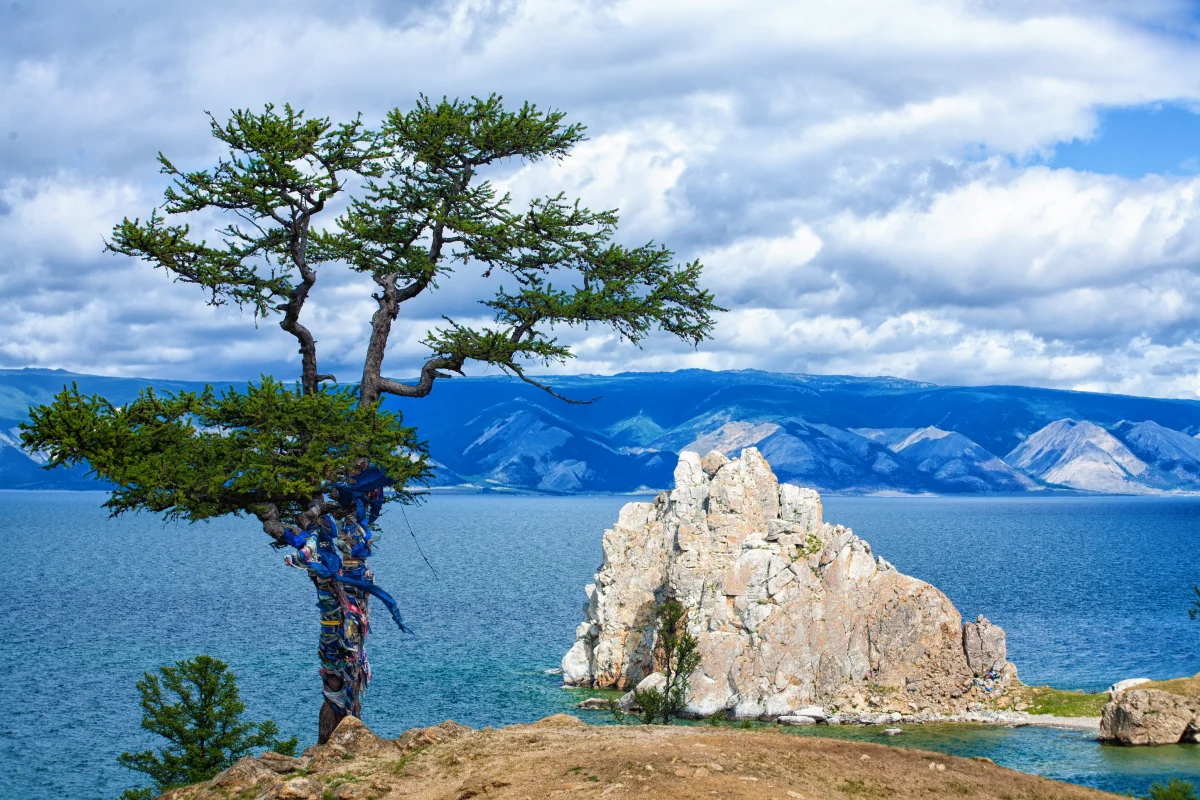
Olkhon Island turns its steppes a burnt orange, Cape Burkhan stands out against a deep blue sky, and cattle wander empty roads. By late September, the ferry crossing to Olkhon may close — check the schedule before you go.
From Irkutsk, it's an hour to Listvyanka, or five hours by car to Olkhon.
Kamchatka: Tundra on Fire
Kamchatka's tundra in September turns crimson, orange, and rust. Dwarf birches, blueberry and lingonberry shrubs, and moss all change color at once, turning the flat expanses around the volcanoes into something resembling abstract painting.
The volcanoes carry their first dusting of snow by this point — the contrast of white against crimson makes for one of Kamchatka's most photographed shots. Bears feed actively along the rivers in September, catching salmon before winter sets in — watching them at Kuril Lake is one of the region's defining experiences.
The hot springs run year-round, and soaking in a 100°F (38°C) thermal pool against a backdrop of snow-dusted peaks and autumn tundra delivers a sensation no tropical resort can match.
The flight from Moscow to Petropavlovsk takes about 8.5 hours, starting at 20,000 rubles one-way. A helicopter trip to the Valley of Geysers starts at 45,000 rubles.
The Russian North: Solovki and Arkhangelsk
The Solovetsky Islands reveal their true character in September: a monastery set against a leaden sea, white walls surrounded by golden birches, wind off the White Sea cutting straight through you. Tourist season is technically winding down, though flights and boats from Kem still run — just with hardly anyone aboard.
Temperatures run 46–54°F (8–12°C), with constant wind. This isn't about comfort — it's about impact: Solovki in September delivers one of the most powerful visual experiences available anywhere in Russia.
Arkhangelsk offers the wooden architecture of the Malye Korely open-air museum in autumn colors, a promenade along the Northern Dvina, and Pomor cuisine (cod, halibut, cloudberries). The flight from Moscow takes 2 hours, with tickets starting at 5,000 rubles.
St. Petersburg and Its Suburbs: Golden Autumn Without Rain (Sometimes)
St. Petersburg in September is a bit of a gamble — but the odds are decent. A proper Indian summer, when it happens, brings 59–68°F (15–20°C), clear skies, and golden parks. When it doesn't, expect clouds, 50°F, and drizzle. Even the overcast version, though, still beats November.
Peterhof without the summer crowds finally lets you take in the fountains and park without jostling for space — the fountains run through mid-October. Pavlovsk is arguably Russia's most beautiful landscape park in its autumn form: 600 hectares of gold. Tsarskoye Selo offers the Lyceum park, the Catherine Palace, and avenues lined with yellowing lindens.
When Each Region Peaks
- First week of September. The south is still in summer mode: Sochi, Crimea, Dagestan offer sea and warmth. Central Russia stays green, with autumn just beginning.
- Second to third week. Golden autumn arrives in central Russia and Karelia: Plyos, Suzdal, and Ruskeala hit their peak. The south settles into velvet season.
- Late September. Peak autumn color shifts to the mountains: Altai, the Caucasus, Kamchatka. In central Russia, leaves start falling. Baikal reaches maximum clarity.
September in Russia isn't one trip — it's twenty different ones, packed into a single month. Golden Karelia and warm Crimea, Kamchatka's crimson tundra and sunlit Arkhyz, quiet Plyos and stormy Solovki.
What they all share is this: every one of them is better than its summer version. Not warmer, not more convenient — better. Because autumn in Russia isn't the end of the season. It's its culmination.