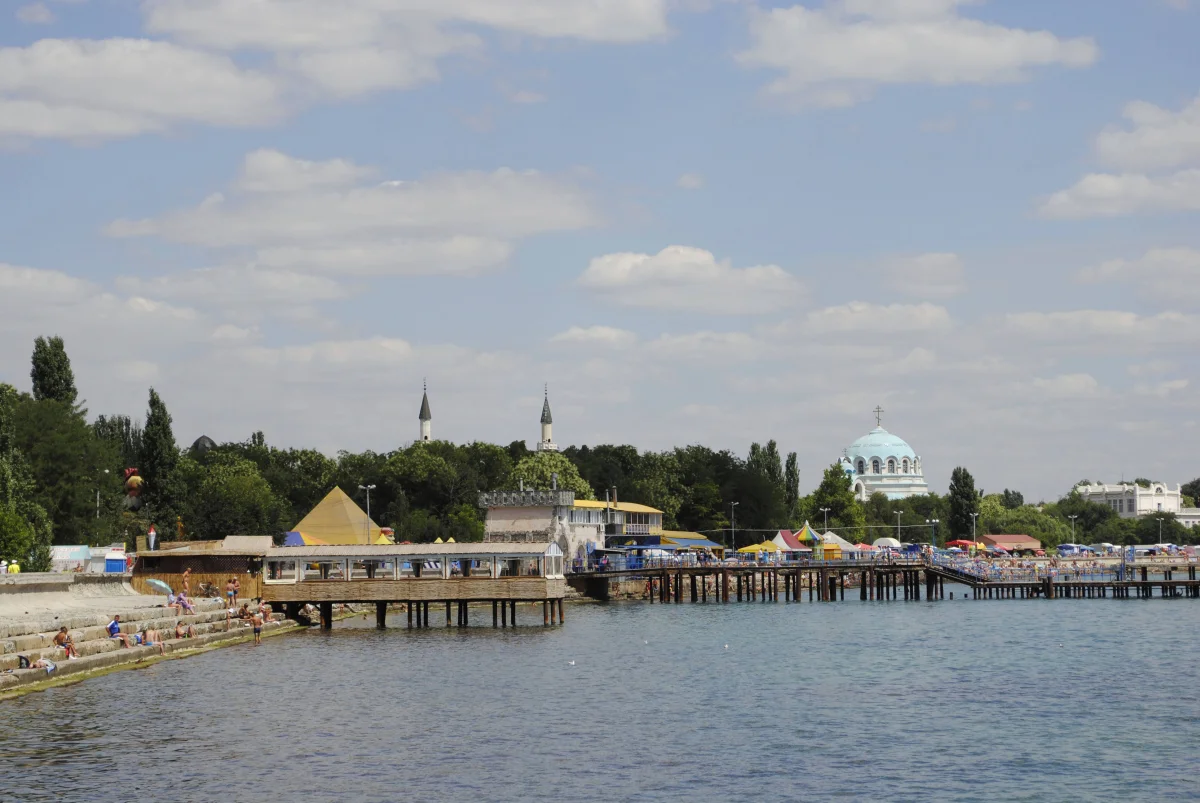
In late May, locals are already sunbathing, but they wade in only knee-deep and hop right back out — the sea's still at 64°F. Three weeks later, those same beaches are unrecognizable: the water hits 72°F, kids splash around for hours, and the real Yevpatoria begins — the one families have been bringing children to for over a hundred years.
Yevpatoria has had a reputation as a children's resort since Soviet times: a shallow sandy bottom, a gentle slope into the water, warm sea, and steppe air rich in salts and iodine. The city sits on the shore of Kalamitsky Bay — a sheltered inlet rarely reached by cold currents, where the water warms earlier and more evenly than on Crimea's southern coast.
But "earlier" doesn't mean "in May": there's a gap of several weeks between the first warm days and genuine swimming season, and for a trip with kids, that gap matters a lot.
Why Yevpatoria Warms Up Faster Than the Southern Coast
Crimea's southern coast — Yalta, Alushta, Gurzuf — sits on a deep, open shoreline. The sea there gets deep right near the shore, so warming happens slowly: a large volume of water needs to heat up.
On top of that, cold currents periodically rise from the depths (upwelling), which can drop the temperature by 5–8 degrees overnight.
Yevpatoria works differently. Kalamitsky Bay is shallow: the seabed slopes very gradually, and even 50–100 meters from shore, the water only reaches an adult's waist. Shallow water heats up in the sun within hours, and there's simply nowhere for cold deep-sea currents to come from. In June, the water in Yevpatoria runs 1–2 degrees warmer than in Yalta, and warming begins earlier overall.
Month by Month: From Cold Sea to Warm
Air temperatures in May run 64–73°F (18–23°C), water at 59–64°F (15–18°C). Sunbathing is already an option — the sun's strong, and there's little wind. Swimming, though, is only for the hardiest — 61°F is not a workable temperature for a child. By late May, water in the shallowest coves can reach 64–68°F (18–20°C), but it's unstable — wind and cloud cover can push it back down. Too early for kids.
The first half of June is transitional: air at 73–81°F (23–27°C), water at 66–70°F (19–21°C). Swimming is possible, but kids can get cold, especially with wind. The second half of the month brings genuine season: water at 70–73°F (21–23°C), with shallow water near shore warming to 75°F (24°C) by midday.
Mid-June is when Yevpatoria officially declares its swimming season open. Crowds are still light, and prices run 20–30% below July's.
For a family trip, June works well from the second half of the month onward — by then the water is reliably warm, and the heat hasn't set in yet, so kids don't overheat on the beach.
Peak season arrives in July: air at 82–91°F (28–33°C), water at 75–79°F (24–26°C). Hot, sunny, essentially no rain. The sea feels like a bathtub, and the shallows run even warmer. Beaches fill up — claim a spot at "Zolotye Peski" ("Golden Sands") before 9 a.m., or head to the free city beaches, which are packed but still leave room to find a spot.
For kids, July is ideal for water temperature but tough on heat. Skip the beach between noon and 4 p.m. — UV levels are extreme. Mornings and evenings are no problem at all.
The hottest month is August: air climbs to 84–93°F (29–34°C), water to 77–81°F (25–27°C). The sea gets so warm it stops feeling refreshing — you dive into 79°F water and come out barely noticing a difference. In the shallows, the water can reach 82–84°F (28–29°C) — too warm even for kids: extended swimming in water that hot tires them out rather than energizing them.
August is the busiest month of all: peak school holidays, maximum family turnout. Prices peak, and beach space becomes genuinely scarce.
Velvet season arrives in September: air at 72–81°F (22–27°C), water at 70–73°F (21–23°C) in the first half, dropping to 66–70°F (19–21°C) by the end. The heat retreats, beaches thin out, and the water grows clearer than in summer. For kids, this is an excellent month: the sea's still warm, the sun is gentler, and there's no line anywhere.
School's back in session, and Yevpatoria settles back into a calm rhythm. Sanatoriums and health resorts stay open, with prices 30–40% below August levels. If your child is preschool-age or homeschooled, September is the best choice.
October temperatures run 59–66°F (15–19°C), water at 61–64°F (16–18°C). Too late for swimming — 61°F is cold for a child. For sightseeing, though, it's lovely: the promenade is empty, the sun sits low and gentle, and grapes fill the markets. Sanatorium stays and mud therapy run in full swing.
Beaches: Which Ones Suit Kids
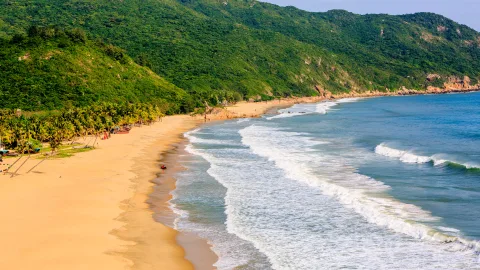
Yevpatoria is one of the few Crimean towns with genuinely sandy beaches — not pebble, not concrete, but sand, with a gentle slope and shallow bottom. That matters a great deal for small children.
- The children's beach near Gorky embankment. The name speaks for itself: shallow water, a fenced-off area, lifeguards, minimal depth. Cramped at the height of the season, but the safest spot for toddlers.
- "Zolotye Peski" ("Golden Sands"). A paid beach between the sea and Lake Sasyk-Sivash. A wide stretch of clean sand, loungers with sunshades. Fewer people than on the city beaches, since entry costs money. For families willing to pay for comfort, this is the best option.
- The beaches along Simferopolskaya Street. "Solaris," "Oazis," and others — free, spacious, and less crowded than the central beaches. The infrastructure is simpler, but the sand and water entry are just as good. A great choice for families bringing their own mat and umbrella.
- "Lazurny Bereg" ("Azure Coast") beach. One of the longest — several kilometers of sand. Part of it is equipped (loungers, cafés), part remains wild. Shallow, gently sloped, spacious. It sits outside the city, so you'll need a car or a taxi.
A Health Bonus: Mud and Brine
Yevpatoria isn't just a beach resort — it's a balneological one. Lakes Moynaki and Sasyk-Sivash supply therapeutic mud and brine (highly concentrated salt water), used at local sanatoriums to treat musculoskeletal, skin, and respiratory conditions.
For children prone to frequent colds, adenoids, or bronchitis, Yevpatoria's steppe air and sea swimming have long been considered one of the best wellness options — which is exactly why the city served as the Soviet Union's leading children's health resort.
Sanatoriums operate year-round, but for combining treatment with swimming, the best windows are June, September, and the first half of October — treatments are easier to tolerate then than in the full heat of July.
Getting There
- By plane
The nearest airport is in Simferopol, 65 km from Yevpatoria. From Moscow, the flight takes 2.5 hours, with tickets starting at 5,000 rubles one-way. From the airport, get to Yevpatoria by bus (~1.5 hours, from 300 rubles), taxi (~1 hour, from 2,000 rubles), or a private transfer.
- By train
The "Tavria" train from Moscow takes roughly 24 hours; from St. Petersburg, about 33 hours. Third-class (platzkart) tickets start at 4,000 rubles. The train arrives in Simferopol, with a connecting commuter train or bus onward.
- By car
From Moscow, it's roughly 1,500 km via the Crimean Bridge — 16–18 hours nonstop. With kids, it's more sensible to split the trip over two days, with an overnight stop in Krasnodar.
What to Know If You're Traveling With a Child
Yevpatoria is one of Crimea's sunniest cities — around 260 clear days a year. Great for adults, but a real risk of overheating and sunburn for kids. A sun hat is essential, SPF 50 sunscreen needs reapplying every two hours, and beach time should run before 11 a.m. and after 4 p.m.
The shallow water is both a benefit and a drawback. A child can stand in water up to their knees a hundred meters from shore — genuinely safe. But by August, that shallow water warms to 82–84°F (28–29°C), and extended time in that "bathtub" tires kids out rather than refreshing them. Watch the clock: 20–30 minutes in the water, then a break on shore.
In late July and August, jellyfish appear in Kalamitsky Bay. They're not venomous (moon jellyfish and barrel jellyfish), but the barrel jellyfish can sting sensitive children's skin. If jellyfish numbers are high, shift swimming to the morning, when the breeze pushes them away from shore.
The "Banana Republic" water park (10 km from the center), a dolphinarium, the "Crimea in Miniature" park, the local history museum, and the Karaite kenesas offer enough to fill a week's worth of kid-friendly activities without any trouble.
Yevpatoria is a resort where you don't need to chase experiences — they find you right there on the beach. Sand, shallow warm sea, steppe air, and a pace of life where the biggest decision of the day is whether to buy a watermelon before or after lunch.
With a child, aim for the second half of June onward, once the water reliably clears 72°F and you don't have to count the minutes in the water. With a preschooler, aim for September, when the beach is empty, the sun doesn't scorch, and tickets cost half as much.