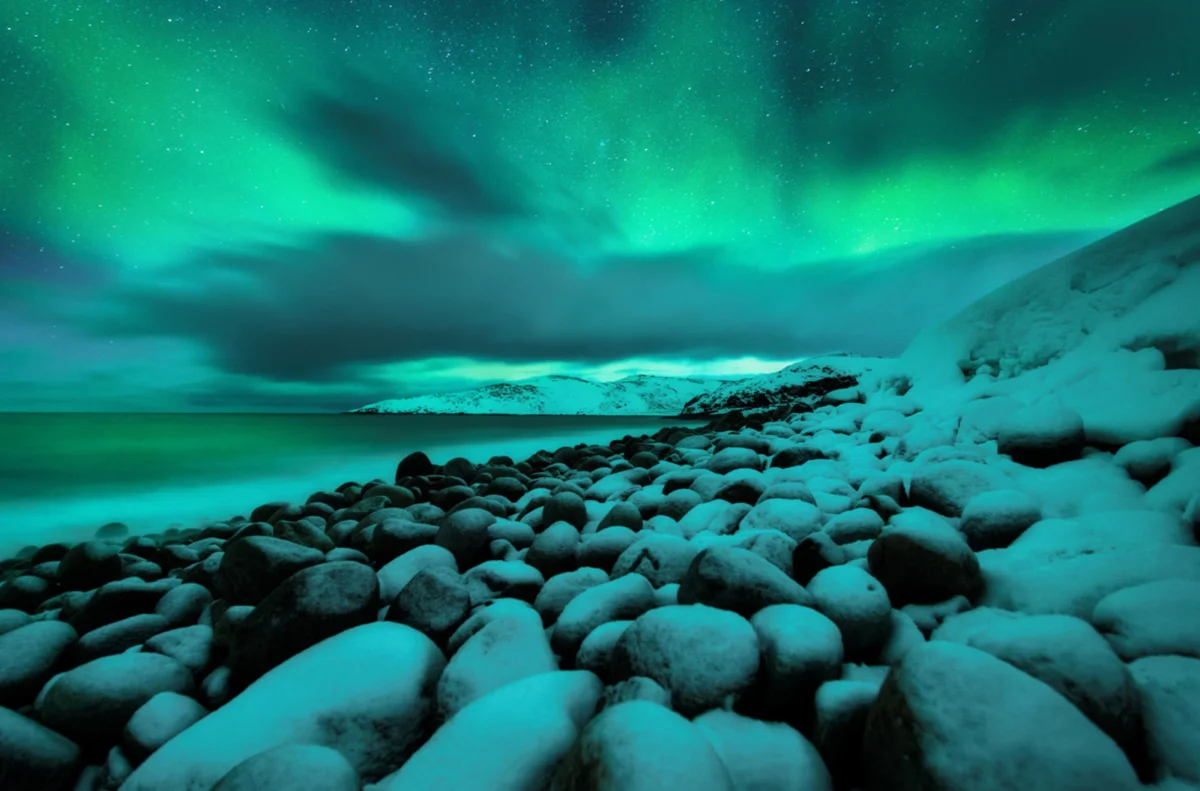
The Barents Sea is running a heavy swell, wind cutting through three layers of clothing — and suddenly, 50 meters from the boat, the dark back of a humpback whale rises out of the water. A blast of exhaled breath, a pause — and then the tail lifts clear above the surface. That same evening, the sky over Teriberka blazes green. Two spectacles in a single day? It's possible — if you time it right.
Murmansk Oblast is one of the few places on Earth where you can see both whales and the northern lights. But these two spectacles run on different seasons, different logic, and very different odds. The aurora is a winter attraction; whales are a summer one.
Between them lies a narrow window where the chances for both overlap. Here's when that window opens — and how realistic it actually is to combine everything into one trip.
Whales: When and Where
Humpback whales, minke whales, fin whales, and orcas appear off the coast of Murmansk Oblast from April to October, following their food source — capelin, herring, and krill that rise to the surface in the coastal waters of the Barents Sea.
Peak season runs May through August. These are the months when your odds of a sighting are highest: the water warms to 43–54°F (6–12°C), fish are active, and whales feed close to shore. Cetacean activity peaks in the early morning, between 4 and 8 a.m., when the sea is calmer and food sits closer to the surface.
The main viewing spot is Teriberka, a village on the Barents Sea coast 130 km from Murmansk. Boats depart from here for sea excursions lasting 2–4 hours, scanning the open water for spouts and splashes. Prices run from 7,000 to 15,000 rubles per person.
It's important to understand: this isn't a dolphinarium. There's no guarantee. A boat can head out to sea and come back without a single sighting. According to operator statistics, the odds of spotting cetaceans during peak season run 60–80%, but on any given day, the number could be zero. Weather also plays a role — trips get canceled if swells exceed 0.5 meters or wind exceeds 5 m/s.
In 2026, Murmansk Oblast updated its rules for sea excursions: boats are now required to keep their distance from whales, avoid pursuing them, and stay outside a set minimum approach distance. The goal is to avoid scaring the animals out of coastal waters.
The Northern Lights: When and Where
The aurora borealis is visible in Murmansk Oblast from September to April — during the dark part of the year. The main requirement is a dark sky: while the sun's up, the aurora simply can't be seen, even if it's active. That means the polar day (late May through late July) is a guaranteed zero.
The best months run November through February. Nights are long (in December–January, the polar night sets in and the sun doesn't rise at all), and with clear skies, your odds of seeing the aurora peak. October and March also work, but the nights are shorter and the viewing window narrower.
Three conditions need to line up simultaneously for a sighting: a dark sky, clear weather (cloud cover blocks the view), and sufficient solar activity (charged particles from the sun that create the aurora). The first two come down to season and luck. The third can be tracked through apps and sites like Aurora Forecast and SpaceWeather, using the Kp-index (the higher the number, the brighter the aurora; for Murmansk, a Kp of 3–4 is enough).
The best viewing spots sit away from city light: Teriberka, Lovozero, and the hills around Murmansk (the Alyosha memorial, Mount Gorelaya, Mishukova Hill). The aurora is visible in the city of Murmansk itself too, but urban light pollution dims its brightness.
The odds of catching the aurora over 3–4 nights during peak season (December–February) run fairly high, if you're willing to stay up watching each night. Over a single night, it's a lottery. Over a week, it's nearly a sure thing.
Combining Both: A Narrow Window Does Exist
Here's the key question — and the honest answer: yes, you can combine them, with caveats.
September is the only month where both windows overlap. Nights are already dark enough for the aurora (darkness falls around 9–10 p.m.), while whales haven't yet left coastal waters.
Your odds of spotting whales in September are lower than in June–July (some animals have already migrated), and your odds of an aurora sighting are lower than in December (nights are shorter, solar activity more variable). But the chance is real.
Early October offers another window. Nights are long, and the aurora is already active. A few whales linger near shore, though most of the population has moved on. Boat trips still run in October, but less frequently and with greater dependence on the weather — the Barents Sea gets stormier by October.
From November through April, it's aurora only — the whales are gone, and the sea is too cold and rough for boat excursions to make sense. From May through August, it's whales only — the polar day means the sun never sets and the sky stays light around the clock, making the aurora impossible to see.
What an "Ideal" Trip Looks Like
Say you decide to try combining both. Here's roughly how it could go.
- Day 1. Arrive in Murmansk. The drive to Teriberka is 130 km, 2.5–3 hours by car (the final stretch is unpaved and turns rough after rain). Check in.
- Day 2. Morning whale-watching boat trip, departing at 5–6 a.m. (whales are more active at dawn), returning by 10–11 a.m. In the afternoon, explore Teriberka: the "Dragon Eggs" beach, the ship graveyard, the waterfall. In the evening, wait for the aurora starting around 10 p.m.
- Day 3. A buffer day in case the previous one didn't pan out: a second boat trip, or another night watching for the aurora. Teriberka is small but atmospheric — an abandoned school, a swing on the shore, an ethnographic park.
- Day 4. Return to Murmansk. Visit the nuclear icebreaker Lenin (now a museum on the embankment), the Alyosha memorial, and the local history museum. If you missed the aurora in Teriberka, try again from Murmansk's surrounding hills.
Three to four nights is the minimum for a realistic shot at both.
What to Pack
Murmansk Oblast in September isn't a resort. Air temperatures run 41–54°F (5–12°C), and it's colder still out at sea. Wind off the Barents Sea cuts right through.
- Clothing: several layers. Thermal base layer, fleece, and a wind- and waterproof jacket. For the boat, add waterproof pants, gloves, a hat, and a neck gaiter. Even if it's 50°F on shore and feels mild, open water with wind can feel like 32°F.
- Footwear: waterproof, with a non-slip sole. Trekking boots or rubber boots — Teriberka doesn't forgive sneakers.
- For photos: a tripod (essential for the aurora — exposures run 5–15 seconds), a camera with manual settings, and spare batteries (cold drains them twice as fast). Phones capture the aurora less well than a dedicated camera, though modern night modes manage decently.
- Motion sickness pills. The Barents Sea isn't the Gulf of Thailand — it rocks hard, and if you're prone to seasickness, the boat trip will be rough without medication.
Getting There
- By plane: Moscow to Murmansk takes 2.5 hours, with direct flights from several airlines. Tickets start at 5,000 rubles one-way with early booking.
- By train: roughly 35 hours from Moscow, about 27 hours from St. Petersburg. Slow, but with views of Karelia and the Kola Peninsula along the way.
- To Teriberka: 2.5–3 hours by car from Murmansk. Public transport runs a bus from Murmansk twice a day, though the schedule can be unreliable. Car rental starts at 3,000 rubles a day — but keep in mind the last 40 km is unpaved and turns to mud after rain. A four-wheel drive is advisable.
How Much It Costs
- Flights, Moscow–Murmansk: from 5,000 rubles one-way.
- Lodging in Teriberka: from 3,000 rubles a night (guesthouses), from 6,000 (hotels).
- Whale-watching boat trip: 7,000–15,000 rubles per person.
- Aurora tour from Murmansk: from 4,000 rubles (group tour, overnight, transfer included).
- Car rental: from 3,000 rubles a day.
A 4-day budget (flight + lodging + boat + aurora tour + food) runs 35,000–50,000 rubles per person from Moscow.
If You Don't Get Lucky
Sometimes the whales don't show, or clouds swallow the aurora — it happens. But Teriberka and the Kola Peninsula offer plenty beyond those two spectacles.
- "Dragon Eggs" beach — boulders worn by the sea into near-perfectly round shapes.
- The ship graveyard — rusted hulls of old fishing vessels set against the tundra.
- A waterfall in a nearby gorge, a 15-minute walk from the village.
The tundra in September turns crimson and gold, blanketed in moss, lingonberries, and dwarf birch. And then there's the silence — the kind you never hear in a city. Wind, waves, the cry of gulls, and nothing else. That alone is worth the trip, even if the whale and the aurora end up waiting for next time.