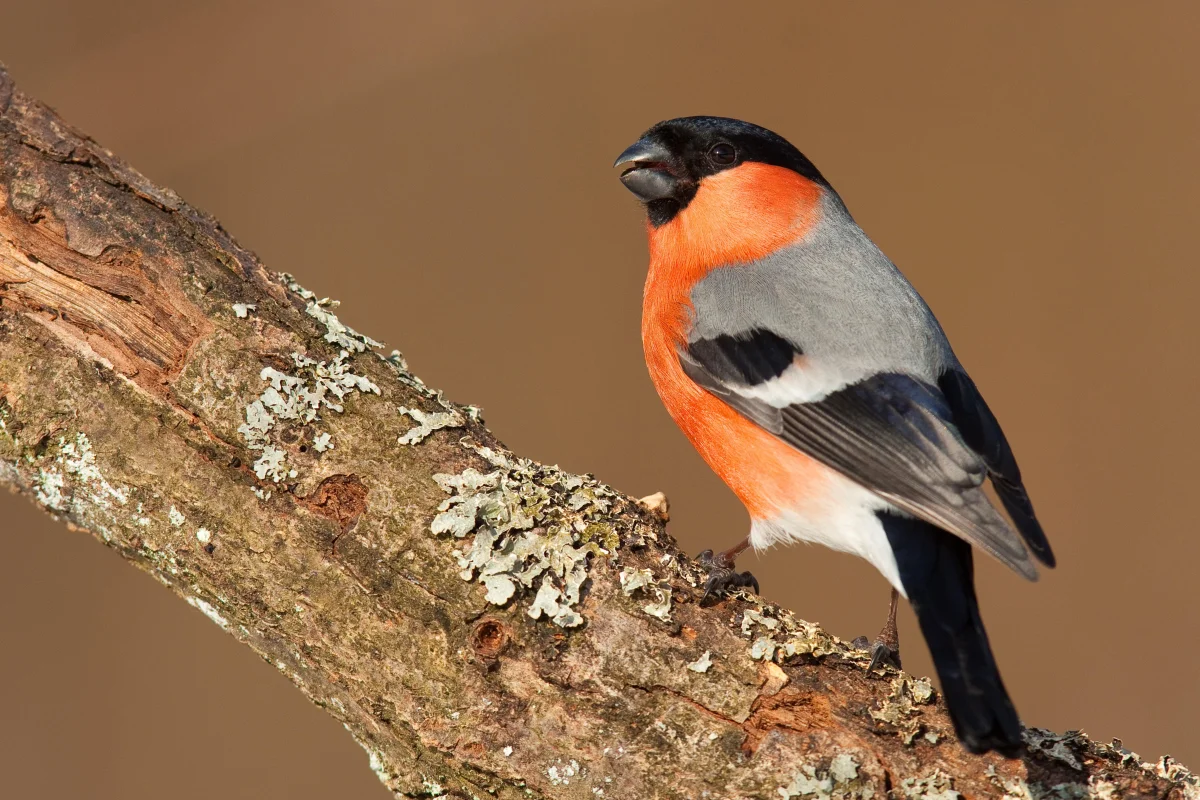
January, a bird feeder outside the window: a red-breasted bullfinch perches on a branch, feathers puffed up against the cold. Walk right up to the glass, and it won't even fly off. It's a familiar winter scene that repeats every year. Then March arrives — and the bullfinches vanish. Not a single one until the following winter. So where do they go?
People ask this question so often that it's become a kind of folk riddle. Some are convinced the birds fly north. Others assume they're simply "winter birds" that don't exist in summer at all. A few even suspect something mystical.
The real answer is both simpler and more interesting: bullfinches don't go anywhere. They're right there, close by, all summer long. You just don't see them — and there are specific reasons for that, tied to behavior, habitat, and how our own attention works.
Bullfinches Aren't Migratory Birds
The first and most important fact: the Eurasian bullfinch (Pyrrhula pyrrhula) is a resident, semi-nomadic species, not a migratory one. It doesn't fly off to Africa in autumn and return in spring the way a swallow or swift does. Bullfinches live year-round in the coniferous and mixed forests of Eurasia — from Scandinavia to Kamchatka.
Their seasonal movements are short local shifts, not migration. In winter, once food runs low in the forest, the birds move closer to people — into towns, villages, toward feeders and rowan tree groves.
In spring, once the forest comes back to life, they move back — deeper into the woods, out of sight. The distances involved are tens of kilometers, maybe a couple hundred at most — not a flight south, just a shuttle between forest and town.
Three Reasons They Disappear in Summer
Reason One: They Retreat Into the Forest
With the arrival of spring, bullfinches leave urban environments and move into dense coniferous and mixed forest. There, they pair up, build nests, and raise chicks. A bullfinch nest is a small cup of twigs and moss, tucked away 1.5 to 5 meters up in the branches of a spruce or juniper. Finding one is a challenge even for an experienced ornithologist.
Bullfinches do occasionally nest in city parks too, but rarely — they need dense coniferous cover that most cities simply don't have. So even the birds that sat at your feeder all winter head out of town come spring.
Reason Two: They Go Quiet and Secretive
In winter, bullfinches are easy to spot for two reasons: they perch on bare branches (visible from a distance) and constantly call to each other — a soft, distinctive whistle audible dozens of meters away.
Summer changes everything. Trees fill out with dense foliage, and a bird the size of a sparrow disappears into the canopy. On top of that, during nesting season bullfinches go quiet on purpose — staying silent so as not to draw predators to the nest. A pair with chicks lives as discreetly as possible; it's a survival instinct, not shyness.
Reason Three: We Don't Notice the Females
When people picture "a bullfinch," they think of a bright red chest against white snow. But that's the male. The female looks entirely different — her chest is a muted gray-brown, and in the green of the forest, she's practically invisible.
In summer, even males look duller than in winter, worn from molting. Add in the leaf cover, and it's clear why a bird that stands out so sharply in winter simply blends into the background in summer.
Our Attention Is Selective, Too
A winter landscape is monochrome: gray sky, white snow, bare branches. Against that backdrop, a red bird is like a bright spot on a blank page — the brain can't help but notice it.
A summer landscape is colorful, noisy, and cluttered with detail. Dozens of bird species, insects, flowers, moving leaves. A bullfinch in that flood of information is just one signal among a hundred, and the brain filters it out.
Psychologists call this selective attention: we notice what contrasts with the background and overlook what blends into it.
Ornithologists confirm that bullfinches can, in fact, be heard in forests outside Moscow all summer — if you know their call. But most people can't tell a bullfinch's whistle from a chickadee's, and they walk right past, never suspecting the "vanished" bird is sitting five meters over their head.
The Winter Feeder: Why They Actually Show Up
Bullfinches don't appear in cities during winter out of choice — it's out of necessity. Their main food source is tree seeds: rowan, ash, maple, lilac, and conifer seeds. In autumn and early winter, there's usually enough of this in the forest. But by January–February, supplies run thin, and the birds have to expand their search.
Cities are a concentrated food source: rowan tree-lined streets, feeders, weed seeds in vacant lots. Bullfinches don't come into town to "visit" — they come to eat.
The moment fresh food appears in the forest — buds, catkins, the first seeds — the birds head back. That typically happens in March–April, right around the moment we assume bullfinches have "disappeared."
In mild winters, when rowan and ash trees produce a heavy crop, bullfinches may not show up in cities at all. There's enough food in the forest, so there's no reason to come down to people. City dwellers then conclude "there were no bullfinches this year," when really the birds simply didn't need the urban cafeteria.
How Their Winter Life Works
In winter, bullfinches travel in small flocks — usually 5 to 12 birds. A flock includes males (red), females (gray), and juveniles (with a brownish chest, lacking the bright red). The hierarchy runs opposite to what you'd expect: females dominate males. At a feeder, a female can chase off a male, and he'll yield without a fight.
Bullfinches are slow, unhurried birds. They don't dart around like sparrows or hop along branches like chickadees. They sit in one spot, calmly cracking seeds and dropping the husks into the snow. That very sluggishness is what makes them so easy to spot in winter — the bird doesn't flit around, it just sits there, as if posing.
What to Feed Them If They Show Up
If bullfinches have started visiting your feeder, here's what they actually eat.
- Sunflower seeds (raw, unsalted) work as a universal food — bullfinches crack the shell with their powerful beak and eat the kernel inside.
- Rowan berries are the classic choice. But a bullfinch doesn't eat the whole berry — it crushes the fruit, extracts the seeds, and discards the pulp.
- Ash, maple, lilac, and nettle seeds — anything oil-rich works. Skip the bread: it swells up in the crop and can harm the bird.
Where to Actually Spot a Bullfinch in Summer
If you want proof that bullfinches haven't disappeared, you'll have to head into the forest.
Coniferous and mixed forests across central Russia make up their main range — around Moscow, that means the forests of the Ruza, Mozhaysk, and Dmitrov districts. The best time is early morning (5–7 a.m.), when the birds are most active and vocal.
A bullfinch's whistle is soft, melodic, and slightly mournful — something like a "fyu-fyu" sound. If you hear it, freeze and scan the nearest spruce canopy.
In June–July, you might spot fledglings — young bullfinches that have just left the nest. They're brownish, lacking the bright red, clumsy, and less wary than adults. Sometimes they venture out to forest edges and suburban groves — a rare chance to actually see a bullfinch in summer.
Will There Be Fewer Bullfinches?
The Eurasian bullfinch population in Russia is stable: the species isn't listed in the Red Data Book and isn't considered under threat. That said, ornithologists note that urban sightings are declining — not because the birds are dying out, but because cities are losing their rowan tree-lined streets and coniferous plantings. Fewer seed-bearing trees means fewer reasons for bullfinches to visit in winter.
Warmer winters are another factor. The milder the winter, the more food stays available in the forest, and the less often bullfinches need to come down to people.
If a winter is snowless and the rowan crop hasn't frozen through, you may not see a single bullfinch in town all season. That's not a warning sign — it's simply a sign that things are fine in the forest, with or without your feeder.
So the next time someone asks where bullfinches go in summer, the answer is simple: nowhere. They're sitting in a spruce grove twenty kilometers from your house, feeding their chicks, waiting for the rowan berries in the forest to run out. When they do — the birds will be back.