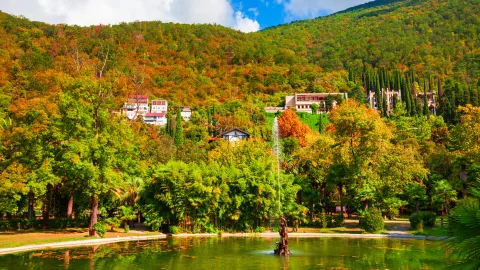
Just three hours from Bangkok sits Hua Hin: a quiet town with a long beach, where seafood night markets stand in for go-go bars, a royal palace overlooks the shore instead of neon signs, and Thai families settle into the sand at sunset instead of crowds of tourists. It's a place Russian travelers usually don't even consider. That's a mistake.
Hua Hin is Thailand's oldest seaside resort — the royal family has vacationed here since the 1920s, and the Klai Kangwon summer palace still stands on the shoreline.
For Thais, Hua Hin is what Peredelkino is for Muscovites or Komarovo for St. Petersburg residents: a place for calm, status-conscious relaxation, where people go for quiet, food, and the sea rather than nightlife. Foreigners are a minority here — and that's exactly what makes the resort unlike Phuket, Pattaya, or Koh Samui.
Where It Is, and Why It Flies Under the Radar
Hua Hin sits on the western shore of the Gulf of Thailand, in Prachuap Khiri Khan Province, 200 km southwest of Bangkok. It's a mainland resort, not an island.
You can get there from the capital in 2.5–3 hours by car, or 4 hours by train. That proximity to Bangkok is the main reason Thais love it — it's their weekend spot, their beach dacha.
For Russian tourists, Hua Hin sits in the shadow of the island resorts — Phuket and Samui grab most of the attention. There are no direct flights from Russia to Hua Hin, and getting there from Bangkok takes extra effort. But that obscurity is exactly the advantage: no mass tourist flow, no Russian-language menus on every corner, no aggressive tuk-tuk touts. What you get instead is real Thailand — the version Thais themselves actually experience.
Climate: Milder Than the Islands
Hua Hin sits on the Gulf of Thailand, shielded from the west by the Tenasserim mountain range. Those mountains block the southwest monsoon that, at the same time of year, drenches Phuket and Krabi. The result: Hua Hin gets significantly less rain than the Andaman coast — around 1,000 mm a year, compared to 2,500–3,000 mm in Phuket.
Air temperatures stay stable year-round at 82–91°F (28–33°C). The water in the Gulf of Thailand runs 81–86°F (27–30°C). There's no distinct cold season — even in December–January, daytime temperatures hold at 82–86°F (28–30°C). But there are real differences between months, and they determine when to go.
Hua Hin's Three Seasons
Dry and Cool (November–February)
Air at 82–88°F (28–31°C), humidity drops to 60–70%, and breathing feels easy. Rain falls only 1–3 days a month, and the sea stays calm and clear. Skies are clear, with just a light breeze. Evenings can feel cool by Thai standards (75–77°F / 24–25°C), and locals will pull on a sweater — for Russians, of course, this still counts as summer. This is the best time to visit.
December–February is high season: European tourists and well-off Thais fill the town. Hotel prices climb, but never reach Phuket's level.
Hot (March–May)
The hottest months: air temperatures run 90–97°F (32–36°C), and humidity climbs. April is the hottest month of the year, with the thermometer sometimes hitting 100°F (38°C) in the shade. The sea warms to 84–86°F (29–30°C) — practically hot. Rain is still scarce, though the first showers arrive by May.
For beach time, March–April work fine if you can handle the heat. Mornings and evenings are comfortable; daytime means seeking out shade or a pool.
Rainy (June–October)
Monsoon season, but Hua Hin gets it easier than Phuket. Rain doesn't fall every day, and usually arrives in the evening or overnight. On average, expect 10–15 rainy days a month. Between showers, it's sunny and hot. The sea stays warm (82–84°F / 28–29°C) but can get choppy, and red flags occasionally go up on the main beach.
September–October are the wettest months (up to 150–180 mm of rain). But even then, Hua Hin stays drier than Phuket — the mountains do their job.
Why Thais Love Hua Hin
For a foreigner, Thailand means beaches, temples, and islands. For a Thai, it means considerably more — and Hua Hin sits squarely in the part of the map most tourists never see.
- Proximity to Bangkok
Three hours by car and you're at the sea. For a metro area of 12 million people, this is the nearest decent beach. Pattaya is closer, but middle- and upper-class Thais consider it too touristy and loud. Hua Hin feels more elegant.
- Royal status
The Klai Kangwon palace has stood here since 1926, and Thailand's royal family spends a significant part of the year in Hua Hin. That gives the town a particular atmosphere: well-kept streets, order, and an absence of aggressive tourist hustling. Hua Hin isn't a place where people push services on you.
- Food
Hua Hin ranks among Thailand's best food towns. The night market on Dechanuchit Road is a long row of seafood stalls: shrimp, squid, crab, fish — all freshly caught and cheap. A plate of fried shrimp runs 80–120 baht (roughly 220–330 rubles). The daytime Chatchai Market offers fruit, spices, and Thai sweets.
- Golf
About ten golf courses surround Hua Hin, several of world-class caliber. For Thailand's middle class, a Hua Hin weekend means golf in the morning, beach in the afternoon, seafood in the evening.
The Beaches: Long, but Not Postcard-Perfect
Hua Hin's main beach is a wide stretch of sand roughly 5 km long, running alongside the town. The sand is firm enough to bike or ride a horse on — beach horseback rides are something of a local specialty. The water is warm, with a gentle, shallow entry.
Worth saying honestly, though: Hua Hin's beaches aren't a Bounty commercial.
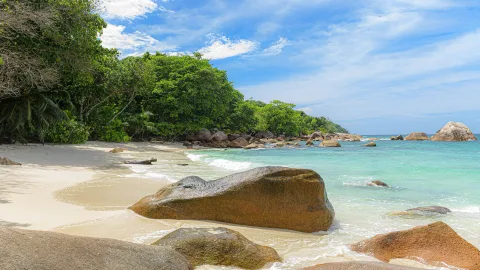
The water in the Gulf of Thailand is less clear than the Andaman coast or Koh Samui. The sand is light beige, not blinding white. Conditions for snorkeling and diving aren't great here — coral is sparse and visibility modest. If your main goal is postcard-turquoise water, Hua Hin isn't the right pick.
What you do get is an absence of that tourist-conveyor-belt feeling. On the beach: Thai families with kids, fresh-fruit vendors, horses, kites. It's a lived-in beach, not a backdrop for Instagram.
Some 15–20 km south of Hua Hin, the beaches at Khao Tao and Sam Roi Yot are wilder and less crowded, framed by cliffs and national parkland. They're more scenic — but you'll need a car to get there.
What to See Beyond the Beach
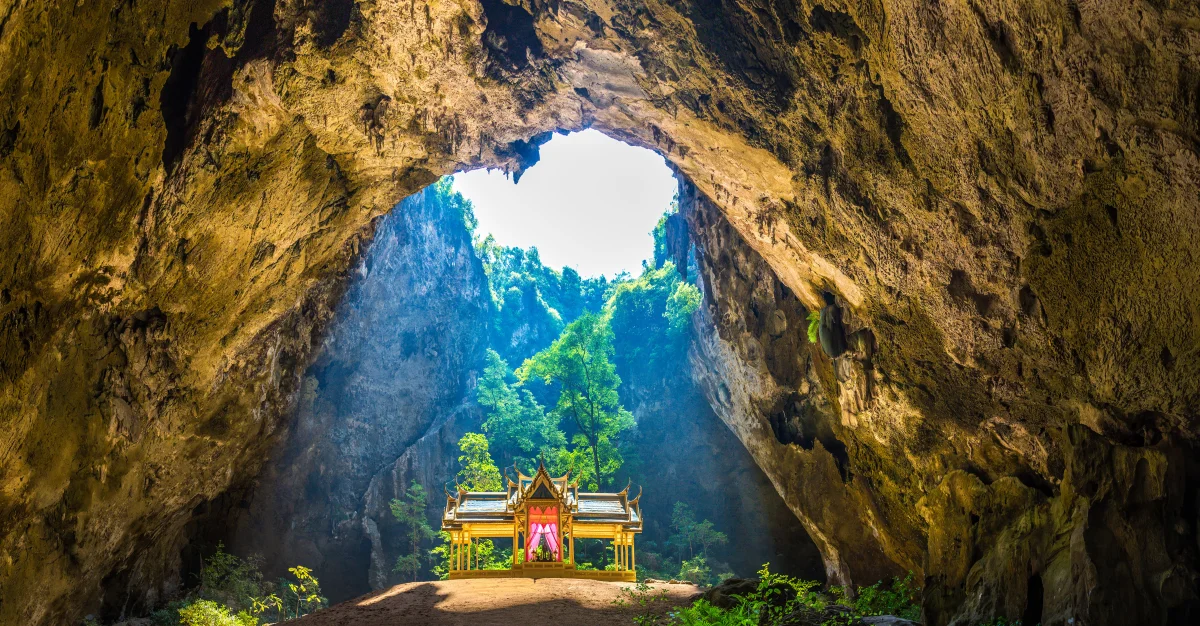
Khao Sam Roi Yot National Park — the "Mountain of Three Hundred Peaks," 30 km south of Hua Hin. Limestone cliffs, mangrove forests, and Phraya Nakhon Cave, home to a royal pavilion inside it. When sunlight streams through the opening in the cave's roof and hits the golden pavilion, it produces one of Thailand's most photographed shots. The best time to visit is morning, when the light reaches inside.
The Hua Hin night market isn't an excursion — it's a way of life. Every evening from 5 to 11 p.m., Dechanuchit Road turns into one long strip of food stalls. Both tourists and locals eat here — and it's the rare case where prices are the same for everyone.
Wat Huay Mongkol — a massive statue of the revered monk Luang Pu Thuat, 15 km outside town. A pilgrimage site for Thais, and an impressive one for tourists too: the sheer scale of the statue, the quiet, and the views over the surrounding hills.
Hua Hin Hills Vineyard — yes, Thailand makes wine. This vineyard 30 km outside town offers tours with tastings and lunch overlooking the hills. The wine isn't Burgundy, but for the tropics, it's surprisingly decent.
Getting to Hua Hin
There are no direct flights. The route runs through Bangkok.
Bangkok → Hua Hin: bus from Sai Tai Mai bus terminal, 3.5 hours, tickets 200–300 baht (roughly 550–820 rubles). A minivan is faster, at 2.5 hours, for 250–350 baht. Train from Hua Lamphong station takes 4 hours — cheap and atmospheric, but slow. Taxi runs from 2,500 baht (about 6,800 rubles) — comfortable, with no transfers.
Visa and Money
Russian citizens get visa-free entry to Thailand for 60 days, requiring only a passport valid for at least 6 months. The local currency is the Thai baht. Russian bank cards don't work. UnionPay is accepted at larger stores. Cash in dollars or euros is essential — exchange it locally.
Hua Hin is cheaper than Phuket and Samui: a seafood dinner for two at the night market runs 200–400 baht (roughly 550–1,100 rubles). Decent hotel rooms start at 800 baht (about 2,200 rubles). Massages start at 250 baht (roughly 680 rubles) an hour.
When's the Best Time to Visit Hua Hin
- Ideal: November–February. Dry, comfortable, calm sea. The best month is December or January, if high-season prices don't bother you.
- Good: March, late October. A bit hot, or rain has started (or hasn't quite ended), but tolerable.
- Workable if you can handle heat: April–May. Fine for hardy Russians; tough for everyone else.
- For the adventurous: June–September. Rain does fall, but Hua Hin isn't Phuket — showers are shorter, and there are more dry days between them. Prices sit at their lowest.
Hua Hin is a resort for people who've already been to Thailand and want to see it from a different angle — not the tourist version, but the Thai one, with night markets, horseback rides on the beach, a palace at the water's edge, and a dinner of fresh shrimp for a few hundred rubles.
You won't find the turquoise sea of the postcards here, but you will find something the islands can't sell you: the feeling that you're not in tourist Thailand — you're in the real one.