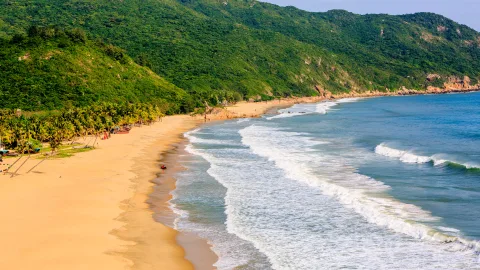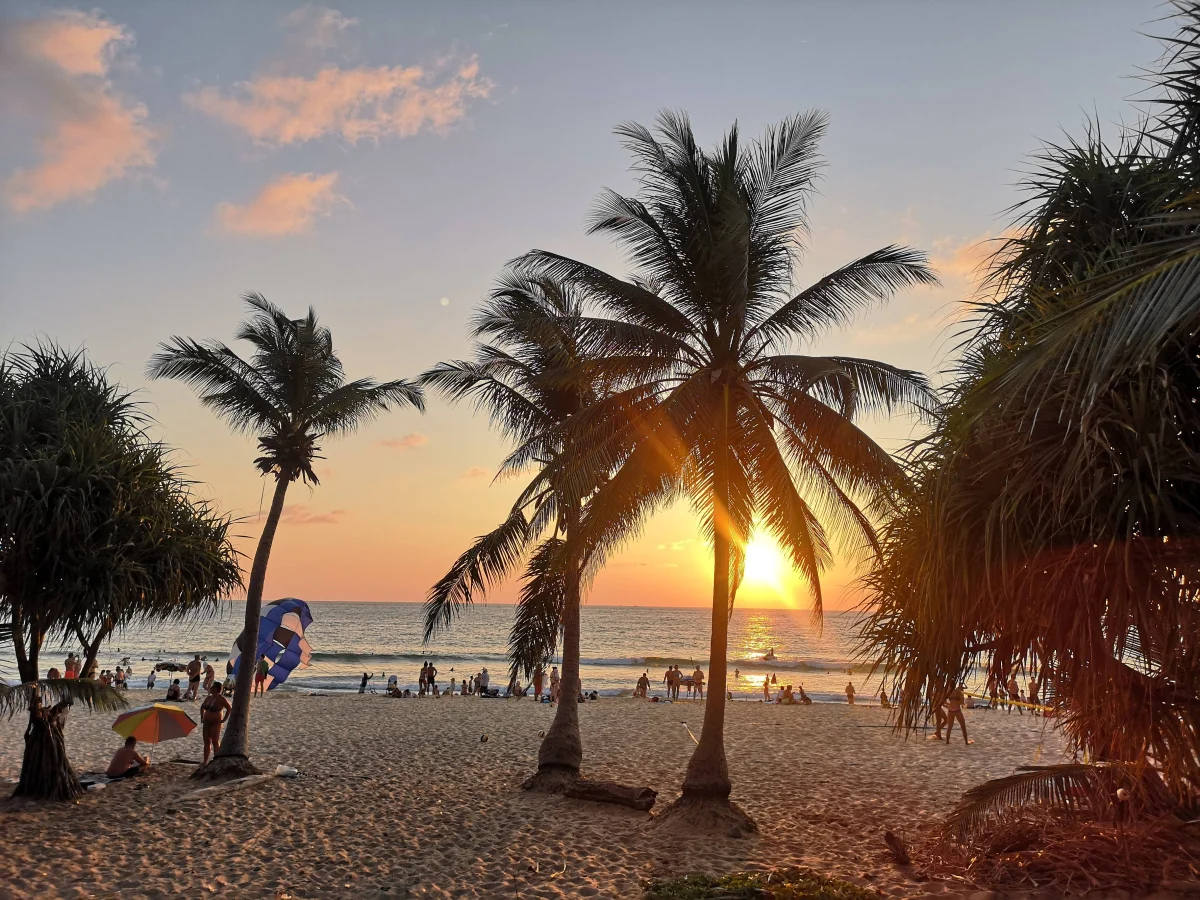
February, Phuket: not a cloud in the sky, water in turquoise, and Karon Beach without a single wave. That same Karon in August: red flags, six-foot surf, and rain by lunchtime. Same beach, same island — but two completely different vacations.
Phuket runs year-round: air temperatures never drop below 82°F, even in the "cool" months, and the water stays a steady 82–86°F all twelve months. It would seem like you could fly here whenever you want.
But beach conditions on Phuket aren't determined by temperature — they come down to two other factors: rainfall and the state of the sea on the west coast. Those two things decide whether your vacation turns out postcard-perfect, or a compromise.
Three Seasons, Not Two
The year gets casually split into "dry" and "rainy," but in practice there are three seasons, each with its own character.
Dry and Comfortable (November–February)
The northeast monsoon brings dry air off the mainland. Rain falls just 3–5 days a month, and briefly at that. The sea stays calm: the west coast beaches (Karon, Kata, Patong, Nai Harn) go wave-free, with water clarity reaching 50–80 feet.
Humidity runs 65–75%, which by Thai standards counts as nearly dry. Evenings can dip to 75–77°F, cool enough that you might reach for a light layer on an open-air terrace.
The Hot Transitional Period (March–May)
The monsoon shifts, and before the rains arrive, there's a lull during which temperatures peak: 91–97°F (33–36°C) with 80% humidity. April is the hottest month of the year. Rain shows up by May, but it's still rare and brief.
The sea stays calm for now, though the first swells can arrive by late May. For anyone who can handle the heat, it's a good time to visit — prices are already below winter levels, but the beach weather is still good.
Rainy Season (June–October)
The southwest monsoon carries moisture in off the Indian Ocean. Rain falls 15–20 days a month, but it's mostly brief evening downpours lasting 30–60 minutes, not extended gray skies.
The real issue isn't the rain — it's the waves. The monsoon stirs up surf on the west coast to 2–3 meters, and red flags go up on most beaches. Swimming in that surf is risky: rip currents claim lives here every year.
When the Island Is at Its Best
Short answer: December, January, and February. During these three months, every factor lines up:
- Rainfall drops to its lowest — 3–5 rainy days, and even those last only half an hour.
- The sea goes calm. All the west coast beaches open up, the water runs clear, and snorkeling and diving hit peak visibility.
- Humidity turns tolerable — 86°F at 65% humidity feels very different from 86°F at 85%.
- Excursions run without restriction. The Similan Islands (the region's best snorkeling) stay open from mid-October to mid-May, as do the Surin Islands. Phi Phi, Bamboo, and Racha islands are all accessible without caveats.
The flip side of peak season is price and crowds. December–January brings the New Year and Christmas boom: hotels in Karon and Kata fill up, prices run 30–50% higher than in March, and Patong in the evening gets more packed than Moscow's metro at rush hour.
February is the sweet spot of peak season: the same weather as January, but the holiday surge has passed, prices are a touch lower, and finding an empty lounger doesn't require a morning sprint.
Month by Month
- November
Transitional: rain is still falling (8–12 days), but noticeably weaker. The sea calms down, and the west coast beaches start reopening. The second half of November is essentially already high season. Prices run 20–30% below December's. A great choice for anyone willing to tolerate a couple of downpours.
- December
Dry, sunny, the sea like glass. Peak demand: New Year holidays, bookings 3–4 months out, prices at their maximum. Beaches are full, restaurants have lines. But the weather is flawless.
- January
A continuation of December: 86–90°F (30–32°C), water at 82°F, no rain. The most stable month of the year. Beaches stay busy, though the crowds thin out after January 10.
- February
The best month by weather-to-price-to-crowds ratio. Same sun and calm seas, but without the New Year price tag. Rainfall hits its yearly low (30–50 mm). The Similans are in peak condition.
- March
Heat starts climbing (90–93°F / 32–34°C), humidity rises, but rain is still scarce. The sea stays calm. Prices run below winter levels. A good month for a beach trip if the heat doesn't bother you.
- April
The hottest month: 91–97°F (33–36°C), humidity at 80%. Days feel muggy, with the first evening downpours arriving. The sea stays calm for now. Songkran (Thai New Year, April 13–15) brings joyful, soaked chaos — water fights fill the streets. Good time for budget travel: prices drop.
- May
The monsoon begins. Rain falls every other day, with downpours by evening. Waves on the west coast start building. Some excursions close for the season (the Similans shut until October). Prices run 1.5 to 2 times below winter levels.
Full-blown low season arrives in June–August. Rain falls daily (though briefly), waves get serious, and red flags go up at Karon, Kata, and Patong. Swimming moves to the east coast (Chalong, Panwa, Rawai) or hotel pools. Surfing peaks. Prices bottom out — luxury hotels go for standard-room prices.
- September–October
The wettest months: up to 20 rainy days and 350–400 mm of precipitation. The sea gets stormy. But even this isn't a disaster — mornings are often sunny, with rain arriving by afternoon or evening. Works fine for a budget trip.
Beaches: Where to Go During Peak Season
During high season, all the west coast beaches are in peak condition. The choice comes down to personality.
- Patong. The loudest and liveliest — bars, clubs, shopping streets. The beach is wide and sandy, but crowded. Best for anyone who wants energy and infrastructure.
- Karon. Long (3 km) and spacious, less cramped than Patong. The sand is pale and squeaks underfoot (quartz-based). A good balance between amenities and space.
- Kata. A compact bay ringed by cliffs. Family-friendly atmosphere, gentle entry, snorkeling off the southern point. In high season, clear water with small fish visible right off the shore.
- Nai Harn. A small beach on the island's south end, surrounded by hills. Locals consider it one of the best — and protect it from mass development. Parking is limited, hotels are sparse, but you get quiet and beautiful sunsets in exchange.
- Nai Yang and Mai Khao. The northern coast, near the airport. Long, sparsely populated, lined with pine trees. Mai Khao is Phuket's longest beach (11 km). During nesting season (November–February), sea turtles come ashore here — a rare sight worth catching.
What High Season Actually Costs
Phuket at its peak isn't a budget destination, but it's not sky-high either.
The flight from Moscow requires a connection (Bangkok, Dubai, or Doha), taking 11–14 hours. December–January tickets start at 45,000–60,000 rubles round-trip; February–March fares start at 35,000. A three-star hotel runs from about 2,500 baht a night (roughly 7,000 rubles). A five-star hotel in Karon starts at 6,000 baht (about 16,500 rubles). In low season, the same hotels cost half as much.
Street pad Thai costs 60–80 baht (170–220 rubles). Dinner at a beachfront restaurant runs 600–1,200 baht (1,700–3,300 rubles) for two. The night market in Phuket Town is cheaper and tastier. A day tour to the Similan Islands starts at 2,500 baht (roughly 7,000 rubles); Phi Phi starts at 1,500 baht; two dives start at 3,500 baht.
Russian citizens get 60 days visa-free entry. The currency is the Thai baht; Russian bank cards don't work; UnionPay is accepted at some places; cash is essential.
Common Mistakes
- Flying in November expecting no rain. Early November is still monsoon season. If you want a guarantee, choose the second half of the month, or wait for December.
- Booking a hotel in Patong expecting quiet. Patong means noise, bars, and nightlife. For a calmer beach trip, choose Karon, Nai Harn, or Bang Tao.
- Skipping sunscreen because it's "cloudy." UV rays on Phuket cut right through cloud cover. You can get sunburned even on an overcast day — SPF 50 is non-negotiable.
- Planning a Similans trip for summer. The national park closes from mid-May through the end of October. If snorkeling is the goal of your trip, book high season.
Phuket at its absolute best runs December through February: clear seas, blue skies, every beach open, every excursion running. But March, November, and even April are still months when the island delivers its best — just with a few caveats.
And the gap between "perfect" and "nearly perfect" here comes down to a couple of downpours and a few extra degrees of heat — both of which the Andaman Sea offsets with water that never drops below 82°F, all year round.