At Cape Denison in Antarctica, the wind blows at an average speed of 50 mph — every day, year-round. Anyone standing in that airflow has to lean forward at a 45-degree angle just to stay on their feet.
Wind is such a routine part of the weather that we only notice it when it gets in our way — yanking an umbrella inside out, slamming a door, tearing a hat off our head. But there are places where wind isn't an occasional event — it's a permanent condition of the environment, a backdrop you simply can't escape.
Trees grow sideways there. Houses go up without roofs. Residents learn to walk leaning into the airflow. The geography of these places — from Antarctic glaciers to capital-city waterfronts — and the physics behind constant wind deserve a closer look.
Cape Denison: The Absolute Record
The windiest place on Earth by average annual wind speed is Cape Denison, on the coast of Adélie Land in East Antarctica, near Commonwealth Bay.
The average annual wind speed here is 43 mph (19.4 m/s), and the highest monthly average ever recorded — in July 1913 — hit 56 mph (24.9 m/s). Gusts have exceeded 149 mph — hurricane-force territory.
Australian polar explorer Douglas Mawson, who established a base here in 1912, described life at the cape as a constant struggle against the wind. People crawled to get around, tied themselves to buildings with ropes, and anything left unsecured got instantly swept out to sea.
Records from Mawson's expedition became some of the first systematic wind observations ever taken in Antarctica — and that record still stands unbroken.
The cause is katabatic winds: cold air forms on the Antarctic ice dome (up to 4,000 meters high) and, under the pull of gravity, flows downhill toward the coast. Along the way, it accelerates through narrow valleys between rock formations, like water funneling through a chute. Cape Denison sits directly in the path of one of the most powerful of these downslope flows — and absorbs the entire current.
Patagonia: Wind as a Way of Life
If Cape Denison holds the record for uninhabited terrain, Patagonia is the windiest inhabited region on the planet. The southern tip of South America, split between Chile and Argentina, sits within the "Roaring Forties" and "Furious Fifties" — latitudes where westerly winds face nothing to slow them down. All that surrounds them is open ocean, and airflows circle the planet without hitting any continental barriers.
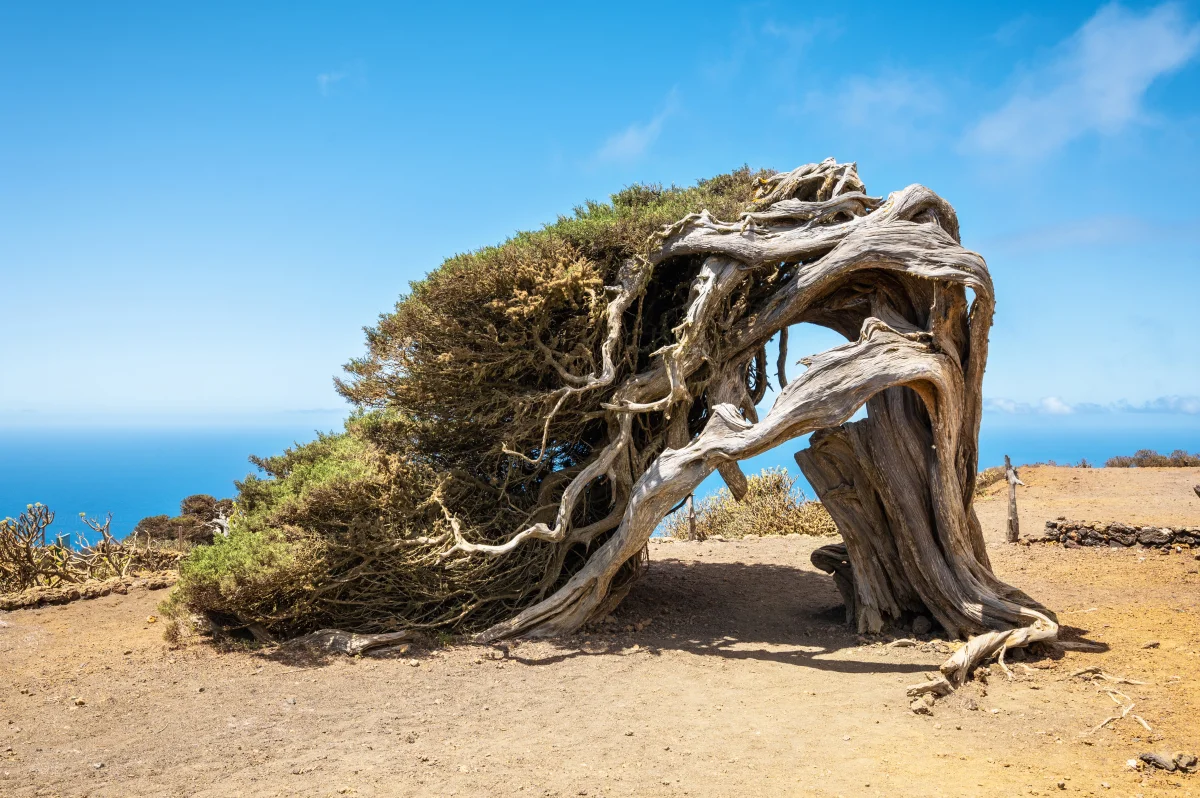
In Punta Arenas, Chile (53°S), average wind speed runs around 19 mph, with gusts of 62–75 mph a routine occurrence. Trees here grow permanently tilted — their crowns bent forever in the direction of the wind, unable to straighten back out. Locals joke that Patagonia has two seasons: windy, and very windy.
At Torres del Paine National Park, one of Chile's premier attractions, the wind gets strong enough that trekking routes close on especially dangerous days — a gust can knock a hiker off a rocky section of trail. Tents are only pitched in sheltered ravines, and even there, they need to be anchored with rocks.
Living in Patagonia is a matter of habit. Homes are built low and compact, fences made of stone (wooden ones get torn down). Clothing always includes windproof layers. Cars get parked nose-into-the-wind so their doors don't get ripped off. On stormy days, school buses simply don't run.
Wellington: The Windiest Capital in the World
Wellington, New Zealand's capital, sits at the southern tip of the North Island, right at the entrance to Cook Strait — a narrow corridor between the two islands where airflow accelerates like it's moving through a wind tunnel. Average annual wind speed runs around 16–18 mph, and days with wind under 6 mph are practically nonexistent.
Locals call the city "Windy Welly" and treat the wind with humor. On the waterfront stands the famous sculpture "Solace in the Wind" by Max Patté — a figure leaning forward at a 45-degree angle, straining against the current.
City streets have installed glass and steel wind screens. Skyscrapers are engineered to account for wind loads, and certain pedestrian bridges close on the stormiest days.
On April 10, 1968, a storm hit Wellington with gusts up to 171 mph. It tore off roofs, flipped cars, and caused the sinking of the ferry Wahine in the harbor — the largest maritime disaster in New Zealand's history, with 51 people killed.
Despite all this, Wellingtonians don't leave. The city is compact, green, and culturally vibrant — and the wind has become part of its identity: kite festivals, sailing regattas, and wind-themed street art.
Novorossiysk: Russia's Record-Holder
The windiest place in Russia is the coast of Novorossiysk, where a powerful cold wind called the bora roars down from the Markotkh Range onto the city and its bay every winter.
The mechanism: cold air pools behind the ridge on a plateau and, under the right conditions, spills over a low mountain pass, crashing down onto the coast. During a bora event, wind speeds can reach 90–134 mph (40–60 m/s) — comparable to a hurricane.
Temperature drops sharply during these events — from 41°F down to 14°F (+5 to –10°C) within just a few hours. Novorossiysk's harbor gets coated in freezing spray, ships develop a layer of ice, and port cranes have to shut down.
The bora is seasonal, occurring between November and March, and not every day. But when it hits, the city grinds to a halt: the port closes, schools close, street traffic gets restricted. Pedestrians get literally knocked off their feet.
In summer, Novorossiysk is an ordinary resort town with warm seas. In winter, it's a place where the wind reminds everyone who's in charge.
The Roaring Forties: Why There, Specifically
The windiest latitudes on the planet run from 40° to 60° south — nicknamed by sailors the Roaring Forties, the Furious Fifties, and the Screaming Sixties. Here, westerly winds blow continuously and with enormous force.
The reason lies in geography. In the Northern Hemisphere, continents at these latitudes (Eurasia, North America) slow down airflow. In the Southern Hemisphere, it's almost entirely open ocean — thousands of kilometers of water lie between South America, Africa, Australia, and Antarctica. The wind has nothing to grab onto, so it circles the planet, gaining speed.
Average westerly wind speeds at these latitudes run 19–31 mph, and during storms, waves can reach 15–20 meters. The Drake Passage, between South America and Antarctica, is one of the most dangerous sea crossings on Earth: wind and current get compressed into a narrow 800-km-wide corridor, and waves there can climb to 30 meters.
How Wind Changes Everything
Constant strong wind isn't just a discomfort — it reshapes the environment itself.
- Architecture
In windy regions, houses are built low and streamlined, with no protruding features. On the Faroe Islands (North Atlantic, average annual wind around 19 mph), traditional houses have grass roofs — not for aesthetics, but because grass holds the roofing in place better than tiles, which the wind would tear off.
- Vegetation
Trees in permanently windy zones develop a "flag" shape: their crown stretches in one direction, with the branches on the windward side dead or entirely absent. In Patagonia, some trees grow horizontally, spreading along the ground because the wind won't let them rise past a certain height.
- Mental well-being
Research suggests that constant wind affects mood and stress levels. Foehn winds (warm downslope winds) in the Alps have been linked to increased irritability and migraines. The mistral in southern France and the khamsin in the Middle East are winds so distinctive locals give them their own names and wait for them with dread.
- Energy
Windy regions are a haven for wind power. The Faroe Islands generate over 50% of their electricity from wind. Patagonia ranks as one of the world's most promising sites for wind farms. Denmark, spread across a flat, windy plain, covers about 55% of its energy consumption with wind power.
Wind as a Resource, Not a Problem
People living in the world's windiest places long ago stopped fighting the wind — they've learned to use it. Patagonian farmers install wind pumps for their water supply. Wellingtonians run kite festivals. The Faroese generate electricity from it. Novorossiysk sailors know exactly when to head out to sea and when to stay in port.
Wind that blows year-round can't be canceled, tamed, or waited out. All you can really do is learn to live with it — leaning forward at 45 degrees, just like the bronze figure on Wellington's waterfront.