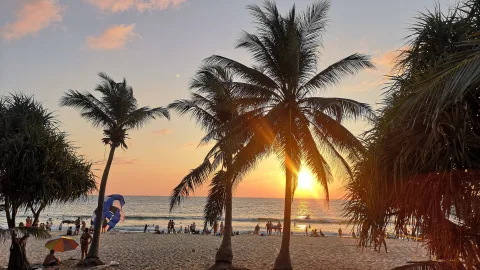
December, Sanya: 79°F, clear skies, dead calm. In Beijing at the same moment, it's 14°F with wind cutting into your face. A billion and a half Chinese people know this contrast well, and every winter, several million of them head south, turning Hainan into a tropical getaway the size of an entire island.
Hainan is China's southernmost island, separated from the mainland by the 30-km-wide Hainan Strait. Roughly the size of Crimea, it shares its climate with Vietnam or Thailand: tropical, warm year-round, palm trees, mangoes hanging right off the tree.
Unlike Phuket or Nha Trang, Hainan remains a relatively unknown destination for Russian tourists. And yet Russians can enter visa-free, direct flights already run, and prices sit noticeably below Thailand or Bali.
Two Coastlines, Two Personalities
The island stretches north to south, and the climate differs between its coasts.
The south (Sanya and surroundings) is the main resort zone. Shielded from northern winds by mountains, it stays warmer and drier than the rest of the island, with minimal rain from October through March.
Three main bays anchor the area: Yalong Bay (the most upscale), Dadonghai (more accessible, closer to the city), and Haitang Bay (a newer district with luxury hotels).
The east and north (Haikou, Wenchang, Wanning) feel less touristy and more "authentic" — cities, markets, rice paddies. Beaches exist, but the infrastructure is more modest. Winter here runs 3–5 degrees colder than Sanya and windier. For surfing, the bays of Shimei and Riyue on the east coast rank among the best in China.
When people say "Hainan beach season," they usually mean Sanya — and that's mainly what this piece will focus on.
Why Winter Beats Summer Here
At first glance, it seems counterintuitive: why visit a tropical island in winter, when summer is warmer? But Hainan's summer isn't like Phuket's. The difference lies in the details — and those details decide everything.
- Summer heat
From May through September, air temperatures run 90–97°F (32–36°C) with humidity at 85–90%. This isn't the dry heat of Egypt — it's thick, clinging heat that even wind can't cut through. It feels like 104°F or higher. Being on the beach between 11 a.m. and 4 p.m. is genuinely uncomfortable. Locals avoid the sea entirely during these months.
- Typhoons
From July through October, Hainan sits within the tropical cyclone belt. Not every year, and not every month, but August–September mark peak risk. A typhoon isn't just rain — it means a closed airport, canceled flights, a stormy sea under red flags, and sometimes even evacuations from coastal hotels. Typhoon insurance is a necessity if you're flying in during summer.
- Rain
The rainy season runs May through October, peaking in August–September (up to 250–300 mm a month). The downpours are tropical — intense, but often brief, with sun in between. Combined with heat and humidity, though, it creates a greenhouse feeling you can't escape.
Winter has none of the above. Walking the promenade, going on excursions, sitting at an open-air café — all comfortable, all day long. This is exactly why millions of Chinese tourists flock to Hainan each winter — and exactly why it's worth the trip for Russians too.
Air temperatures run 72–81°F (22–27°C), humidity sits at 60–70%, rain falls just 3–5 days a month, and typhoons drop to zero. The sun is gentle, and the wind is just a light breeze.
Month by Month
- November
The start of high season. Rain tapers off, air runs 75–82°F (24–28°C), water at 77–79°F (25–26°C). The sea calms down after the monsoon. Prices haven't peaked yet — one of the best months for the weather-to-cost ratio.
- December
Air at 72–79°F (22–26°C), water at 73–75°F (23–24°C). Dry, clear, comfortable. Evenings run 64–68°F (18–20°C), so a light layer doesn't hurt. Chinese tourists start flooding in (their "winter holiday" overlaps with our New Year, plus the Chinese New Year in January–February). Prices climb.
- January–February
The "coolest" months: air runs 68–77°F (20–25°C), water at 72–73°F (22–23°C). Swimming sits right at the edge of comfortable — mornings and windy stretches can feel brisk. But for walking, sightseeing, and spa days, it's ideal. Chinese New Year (late January–early February) marks peak occupancy and pricing — everything books up and costs more.
- March–April
Air at 77–86°F (25–30°C), water at 75–81°F (24–27°C). True velvet season: warm, dry, the sea fully warmed up. Chinese tourists have gone home after the holidays, and prices drop below winter levels. Many consider March–April Hainan's best window.
- May
The heat starts building (86–91°F / 30–33°C), and rain begins. A transitional month: the first half is still good, the second half turns muggy.
- June–September
Hot (91–97°F / 33–36°C), humid, rainy, with typhoon risk. Not recommended for a beach trip. But prices drop to 1.5–2 times below winter rates, and for anyone traveling for shopping, spas, and restaurants (all air-conditioned), summer still works fine.
- October
Rain tapers off, though typhoons remain possible. Temperatures run 81–86°F (27–30°C), water at 81°F (27°C). An unpredictable month — you might get a great week, or a stormy one. The second half of October usually settles down.
What to See
Nanshan Park — a Buddhist complex home to a 108-meter statue of the goddess Guanyin on an artificial island, one of the largest Buddhist statues in the world. Temples, gardens, a vegetarian restaurant. Budget half a day.
Yanoda Rainforest — rope bridges, waterfalls, a zipline over the forest canopy. The air here is humid and fresh, running 5–7 degrees cooler than the coast.
Wuzhizhou Island — a small island 30 minutes by boat from Haitang Bay, offering clear water, coral reef, snorkeling, and diving. Best visibility runs November through April.
Nantian Hot Springs — outdoor thermal pools at 104–140°F (40–60°C), with dozens of soaking pools infused with different additives: coffee, wine, herbal, coconut. Admission starts at 200 yuan (roughly 2,600 rubles).
Jiefang Street — a long strip of night-market seafood stalls where you pick your own crab, shrimp, or lobster and have it cooked on the spot. Dinner for two starts at 150–300 yuan (roughly 2,000–4,000 rubles).
Visa and Flights
Russian citizens can enter China visa-free for 30 days (a policy in place since 2024 and extended through 2025–2026 — verify current status before your trip). Hainan additionally runs its own 30-day visa-free program for tour groups of two or more people, which stays in effect even during periods when the general China visa-free policy is suspended.
Direct flights from Moscow to Sanya take about 9 hours (Hainan Airlines and charters). From other cities, expect a connection through Beijing or Shanghai. Tickets start at 35,000 rubles round-trip in low season, and 50,000 at peak.
The currency is the Chinese yuan (CNY). Russian bank cards don't work. UnionPay is accepted almost everywhere (China is, after all, home to this payment system). Carry some cash in yuan just in case, but most payments across Hainan can be handled by card or through Alipay (if you set up the app).
English proficiency on Hainan runs low. Staff at major hotels speak English, but markets, taxis, and the city at large operate almost exclusively in Chinese. A translation app on your phone is essential.
Hainan vs. Thailand: The Short Version
The question people ask most often: why choose Hainan when Phuket exists?
- Prices. Hainan is cheaper: hotels of comparable quality run 20–30% lower, food costs about the same, and excursions cost less.
- The sea. The South China Sea off Hainan runs slightly less clear than the Andaman Sea off Phuket. For snorkeling and diving, Phuket wins.
- Infrastructure. Phuket is a well-oiled tourism machine with decades of experience. Hainan is developing fast, but less polished — navigation is trickier, the language barrier is bigger, and service is less predictable.
- Hainan's edge. Duty-free shopping: Hainan is the largest duty-free zone in the world. The CDF complex in Sanya is a massive mall where global brands sell for 30–50% below European prices.
Hainan is an island Russia is only just starting to discover. Before it becomes a mass-tourism destination, it's quieter, cheaper, and simpler than it will be in a few years. And in winter — when Moscow sits at 5°F and it's dark by four in the afternoon — landing on Yalong Bay's beach at 79°F under a clear sky is well worth a nine-hour flight.