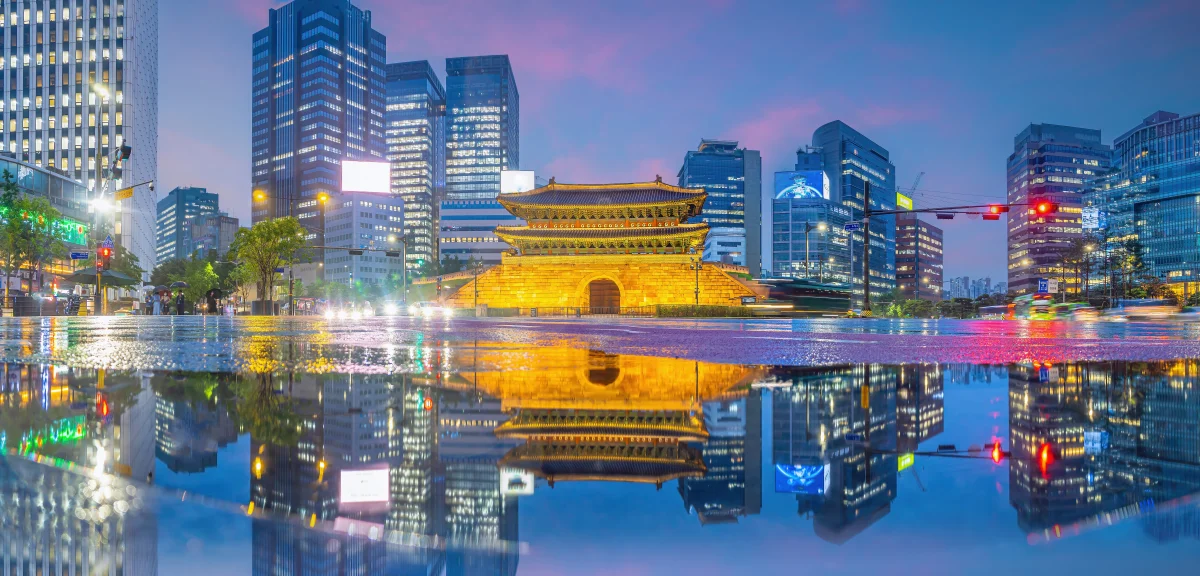
Seoul, late June: the sky looks like someone drew a curtain across it. Rain has been falling for three straight days — a wall of water flooding subway underpasses and turning gutters into streams. The next morning: sunshine, steam rising off the asphalt, and a line forming for shaved ice at a café in Myeongdong. This is exactly how jangma, Korea's rainy season, operates.
South Korea has a monsoon climate, and its rainy season isn't an anomaly — it's a predictable part of the annual cycle. Koreans call it jangma (장마) and treat it roughly the way Muscovites treat slush: unpleasant, but familiar. For a traveler, jangma raises a practical question — fly anyway, or reschedule? The answer depends on what you actually plan to do in Korea, and how willing you are to adapt.
What Jangma Is, and When It Arrives
Jangma is a monsoon rain season caused by a stationary atmospheric front that parks itself over the Korean Peninsula. Warm, moist air moving up from the south (the Pacific) collides with cooler continental air — and rain falls along that collision line.
According to the Korea Meteorological Administration (KMA), the average jangma dates (based on records since 1973) run as follows:
- Jeju Island: starting around June 19, ending around July 20 (about 32 days).
- The southern region (Busan, Gwangju): starting around June 23, ending around July 24 (about 31 days).
- The central region (Seoul, Incheon): starting around June 25, ending around July 26 (about 31 days).
Overall, that's roughly a month, from late June to late July. But these are averages — in any given year, jangma might start a week earlier or later, run for just three weeks, or stretch to six. The KMA doesn't issue advance forecasts for jangma's start date — it only confirms the timing based on observed data.
What It Actually Looks Like
Jangma isn't the same as Japan's tsuyu. Where Japan's rainy season brings weeks of persistent drizzle, the Korean version is downpour-driven: intense bursts of rain that can dump 50–100 mm within a few hours, then stop for a day or two. Rain doesn't fall constantly — there are sunny windows, sometimes long ones. But when it pours, it pours hard enough that an umbrella only helps conditionally.
In July, Seoul receives around 350–400 mm of rain — roughly half of Moscow's entire annual total, in a single month. Humidity runs 85–90%, with temperatures at 82–91°F (28–33°C). It feels like a steam room: heavy air, clothes sticking to your skin, glasses fogging up the moment you step out of an air-conditioned space.
An important detail: between rain spells, it's hot and muggy. Jangma isn't cool relief — it's an alternation between downpour and sauna. For anyone who struggles with humid heat, that's arguably harder to deal with than the rain itself.
Typhoons: A Separate Story
Korea's typhoon season runs from July through September, peaking in August. Typhoons aren't part of jangma — they're a separate phenomenon: tropical cyclones that form over the Pacific and occasionally make landfall on the Korean Peninsula.
The southern regions (Jeju, Busan, the east coast) sit at the highest risk. Seoul gets hit less often, and less severely. When a typhoon passes through, expect canceled flights, closed parks and attractions, and storm warnings. On average, 2–3 typhoons affect Korea each season, and not every one passes close by.
Should You Change Your Tickets?
Short answer: not necessarily. Longer answer: it depends on your plans.
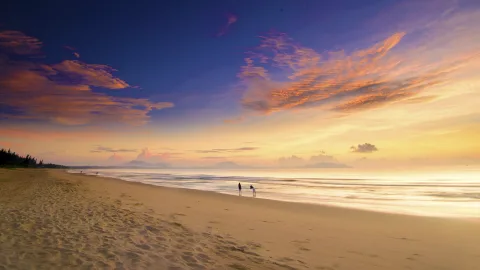
Reschedule if your only goal is beach time on Jeju or the east coast. The sea during jangma turns murky and rough, beaches sit under rain, and there's little enjoyment to be had. For a beach trip, the best window is August (after jangma) or September.
Reschedule if you're planning a multi-day mountain trek (Seoraksan, Jirisan, Hallasan on Jeju). Trails turn slick and dangerous in the rain, mountain streams flood, and parks may close individual routes.
Don't reschedule if you're going for cities, food, and culture. Seoul, Busan, and Gyeongju all function fine in the rain — and honestly, work better:
- Fewer tourists
Jangma is low season: fewer European and American visitors, while Koreans simply go about their normal lives. Gyeongbokgung Palace without the crowds, Gwangjang Market without a line for pancakes, and Ikseondong Street where you can take photos without strangers' heads in frame.
- Lower prices
Hotels in Seoul run 20–30% cheaper in July than during cherry blossom season (April) or the fall foliage peak (October). Flights follow the same pattern.
- Korean cuisine was practically made for rainy days
This isn't a joke: Korea has a genuine cultural association between rain and specific dishes. On rainy days, Koreans eat pajeon (scallion and seafood pancake) and drink makgeolli (rice wine). The sizzle of frying pajeon is said to resemble the sound of rain — which is why one naturally leads to the other.
Restaurants during jangma stay full — but with locals, not tourists — making it one of the most authentic culinary experiences in the country.
- Museums and shopping run rain or shine
The National Museum of Korea (one of Asia's largest, with free admission), the Leeum Museum of Art, Bukchon Hanok Village, and the underground shopping districts of COEX and Gangnam are all indoors.
What to Wear and What to Pack
Jangma isn't really about the umbrella. You'll still want one, but during a downpour of 50 mm/hour, it only protects your head — everything else gets soaked.
- Footwear. Waterproof, non-negotiable. Sneakers soak through within five minutes. Koreans widely switch to rubber shoes and sandals paired with quick-drying socks. Any Daiso (Korea's version of a dollar store) sells foldable rubber boots for around 5,000 won (roughly 350 rubles).
- Clothing. Light and quick-drying. Cotton doesn't work; synthetic fabrics do. A poncho-style raincoat is more practical than an umbrella if you're navigating hilly Seoul's staircases.
- A waterproof pouch for electronics. A ziplock bag for your phone and camera. 90% humidity kills electronics slowly; a downpour kills them fast.
- A towel and a spare shirt in your bag. Getting wet is a matter of "when," not "if." Being able to change into something dry is a luxury worth the extra 200 grams in your backpack.
What to Do in Rainy Seoul
Seoul is a city that doesn't depend on the weather. Much of daily life happens underground or indoors: underground shopping districts, subway transfer tunnels stretching for kilometers, malls, museums, and cafés on every block.
Gwangjang Market, Seoul's oldest market, offers covered rows of street food — tteokbokki, gimbap, mandu, and that same pajeon. It runs in any weather, but rain makes it especially atmospheric: steam rising off griddles, the smell of frying batter, rain drumming on the roof.
Jjimjilbang, Korean bathhouses, are the perfect rainy-day activity. Dragon Hill Spa in Yongsan spans five floors: hot pools, saunas, an ice room, a lounge area, and cafés. Admission runs 15,000–20,000 won (roughly 1,000–1,400 rubles) — enough for a half-day visit.
Hongdae, the youthful district full of cafés, galleries, vintage shops, and karaoke bars, is entirely indoor-friendly — rain doesn't get in the way.
Coffee culture. Seoul ranks among the world's great café cities: designer coffee shops housed in converted hanoks (traditional houses), concept cafés with city views, and animal cafés. On a rainy day, hopping between three or four coffee shops makes for a complete itinerary.
When to Go Instead of Jangma
If you decide to reschedule, here are the best alternatives.
- April to early May. Cherry blossom season (late March to mid-April), mild temperatures (59–72°F / 15–22°C), dry weather. The most popular season — book 2–3 months ahead.
- Late September through October. Golden autumn: red maples, yellow ginkgo trees, crisp air, 64–75°F (18–24°C). The second most popular period. Gyeongju's temples in autumn color rank among the best sights in Asia.
- November. Leaves still holding on, fewer tourists, lower prices. Cool (46–57°F / 8–14°C), but comfortable for sightseeing.
Visa and Flights
Russian citizens don't need a visa for tourist travel to South Korea — a visa-free regime applies (up to 60 continuous days). However, you're required to complete an electronic K-ETA (Korea Electronic Travel Authorization) application at k-eta.go.kr before your flight.
The form takes 10–15 minutes online, is typically processed within a day, and remains valid for 3 years with multiple entries allowed. K-ETA is mandatory for Russian citizens ages 18–64; children and older travelers complete a paper arrival card on landing instead.
There are currently no direct flights from Russia to South Korea. Routes run through Beijing (Air China), Shanghai (China Eastern), or Ulaanbaatar (MIAT), with total travel time of 10–16 hours including the connection. Tickets start at 35,000 rubles round-trip during low season.
The currency is the South Korean won (KRW). Russian bank cards don't work. Bring cash — dollars or euros — to exchange at local banks and currency exchanges.
Jangma isn't a disaster — it's a character trait. Four weeks in which Korea shows off its humid, noisy, steamy side, with downpours that arrive without warning, and pajeon frying up precisely because rain is drumming outside.
You don't necessarily need to change your tickets. What's worth changing is your expectations: instead of postcard-perfect Korea, you get the real version — the one Koreans actually live in, rather than the one shown to tourists in April.