On the Norwegian island of Jan Mayen, morning is barely distinguishable from evening: the sky holds the same shade of gray for months on end. In winter, it's dark around the clock; in summer, it stays light for nearly as long — except the sun is still almost never visible, hidden behind cloud cover.
When people talk about climate records, they usually think of the hottest or coldest place on Earth. But there's another extreme: places where the sun technically rises, yet almost never breaks through the clouds.
For the people who live there, this isn't a meteorological curiosity — it's part of daily life. Lights get switched on during the day, laundry can take weeks to dry, and the phrase "go out and get some sun" sounds like a joke.
Where on Earth Gets the Least Sunlight
There's no single official world record recognized by one governing body — different meteorological services calculate sunshine hours differently. But the same handful of places keep showing up on every list of the world's cloudiest spots, and all of them sit in the north.
- Jan Mayen, a Norwegian island in the Atlantic between Greenland and Norway, gets an estimated 800–850 hours of sunshine a year, by various measures — roughly a fifth of what sunny Mediterranean cities receive. The island has no permanent population; only meteorological station staff and a military base crew live there.
- Tórshavn, the capital of the Faroe Islands, is the cloudiest genuinely populated place on Earth. It gets around 840–880 hours of sunshine a year, despite sitting south of the Arctic Circle and never experiencing a true polar night — it's simply blanketed in cloud cover off the Atlantic almost constantly.
- Tromsø, in northern Norway, gets around 1,270 hours of sunshine a year, plus several weeks of a genuine polar night, when the sun never rises above the horizon at all.
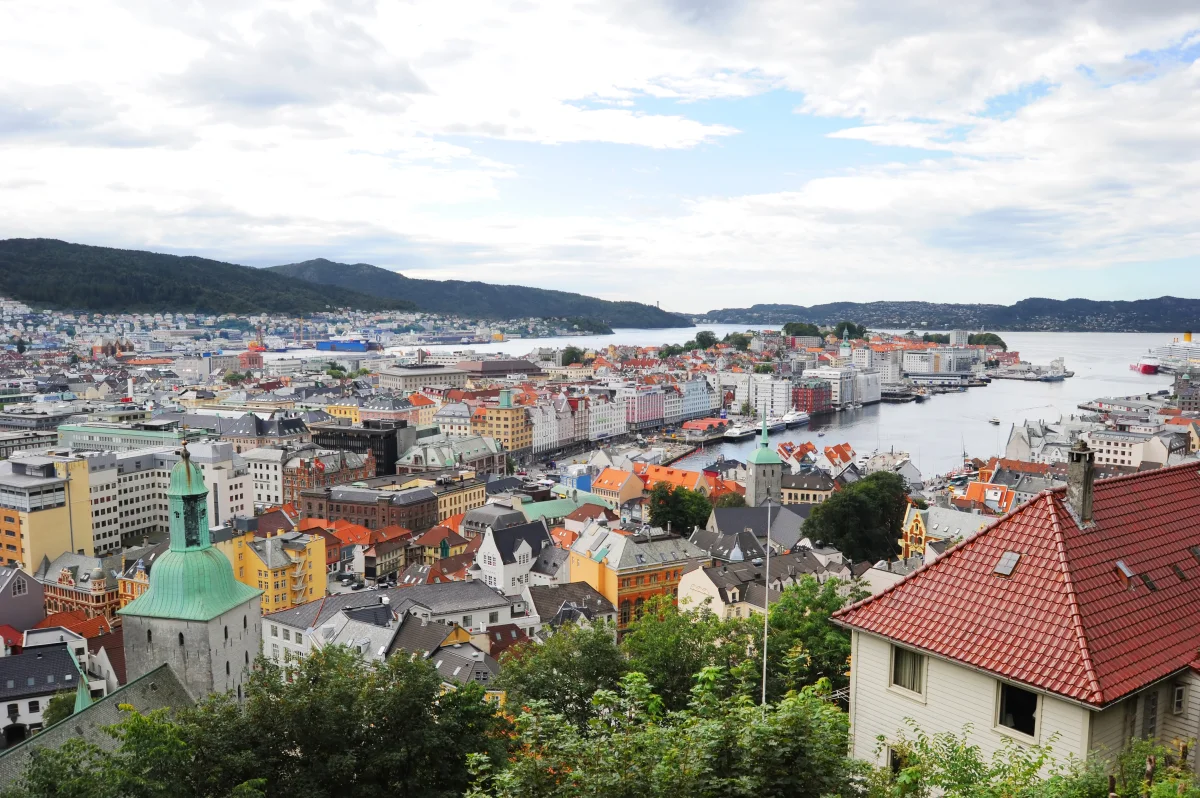
- Bergen, Norway's second-largest city and famous for its fog, gets roughly 1,200 hours. The city sits in a basin surrounded by mountains that further block the horizon, so even on clear days, the sun appears later and sets earlier than it technically should.
For comparison, Yuma, Arizona — recognized as the sunniest city on Earth — gets over 4,000 hours of sunshine a year, roughly five times more than Jan Mayen.
Why the Clouds Don't Clear for Months
It's not simply about latitude — Siberia, at similar latitudes, also has little sun in winter, but for a different reason, and makes up for it with abundant summer light.
The Atlantic's cloudiest record-holders run on a different mechanism: the warm Gulf Stream continuously delivers moist air to their shores, which then meets cold Atlantic air masses and condenses into thick, low cloud cover.
That cloud layer rarely breaks up — one weather system after another rolls through with barely any pause in between. Add mountainous terrain, as in Bergen, and you get a place where even on a theoretically bright day, sunlight simply never reaches the ground.
What It Feels Like From the Inside
Living with chronic sun deprivation isn't just about the aesthetics of a gray sky — it produces genuinely measurable physiological effects. Light regulates the production of serotonin, the neurotransmitter that shapes mood, and melatonin, the sleep hormone.
When light is scarce, that balance shifts: melatonin rises, serotonin drops, and the body essentially settles into a permanent state of dusk.
"A reduction in sunlight can negatively affect the immune system and trigger apathy, weakness, and fatigue," notes Alina Kirichenko, a general practitioner at Russia's National Medical Research Center for Rehabilitation and Balneology.
According to her, less sunlight also means less serotonin production — on overcast days, the body produces noticeably less of the so-called "happiness hormone," which directly affects mood and energy levels.
What About Russia
Russian territories above the Arctic Circle face a similar problem, though through a different mechanism — not chronic cloud cover, but a genuine polar night, when the sun physically doesn't rise above the horizon.
In Murmansk, this lasts from December 2 to January 11 — about 40 days. In Norilsk, it runs from November 30 to January 13, and even after the sun technically "rises" again, it barely clears the horizon during that stretch — genuine daylight doesn't return there until late January.
In summer, the situation flips entirely: the same cities enter a polar day, when the sun doesn't set for months. Paradoxically, this excess of light is easier to tolerate than winter darkness — the body finds it simpler to fake nighttime by drawing the curtains than to compensate for its total absence.
What You Can Do If You're Not Getting Enough Light
You can't fully compensate for a lack of sunlight, but reducing its effect on well-being is genuinely achievable. In Scandinavian countries, this is a normal part of daily routine rather than something exotic:
- Light therapy lamps that mimic the solar spectrum are as common a household item in northern European homes and offices as a desk lamp. It's typically recommended to sit near one for 20–30 minutes in the morning.
- Walks during daylight hours, even brief and overcast ones — what matters to the body isn't brightness, but the simple fact of natural light reaching the retina.
- Blackout curtains and a sleep mask matter more for the polar day, when excess light interferes with sleep, than for a shortage of light.
- Regular ventilation and time outdoors during the day, rather than only in the evening after work — even in overcast weather, natural light is far more intense than indoor artificial lighting.
If seasonal low mood feels severe and doesn't lift for months, that's worth a conversation with a doctor, not just a lamp purchase — but for most people living with limited sunlight, simple daily habits turn out to be enough to get through the darkest months of the year without losing their energy.