A funnel appears over the horizon — and within a minute, it's already close: a roar like a freight train, flying debris, darkness in the middle of the day. You don't have half an hour to pack up, and no time to think it over. You have 60 to 90 seconds to decide where to run. That's enough — if the decision was already made ahead of time.
A tornado (often called a smerch in Russia) is the fastest and most destructive atmospheric phenomenon on the planet. Wind speeds inside the funnel can reach 310 mph, and the time between its appearance and impact is measured in minutes.
Unlike a hurricane, which shows up on radar a full day in advance, a tornado can form directly overhead and move unpredictably. That's exactly why preparation isn't something to plan for tomorrow — it's a set of reflexes that need to be drilled before the sky ever turns black.
Tornadoes in Russia Aren't Exotic
It's easy to assume tornadoes are strictly an Oklahoma-and-Kansas problem. In reality, Russia ranks among the top ten countries for tornado frequency. According to AiF, meteorologists expect tornado activity in 2026 across the Central, Southern, and Volga regions.
Every year, Russia records anywhere from a few dozen to a hundred tornadoes — most of them simply pass over sparsely populated territory and never make the news.
Moscow and the surrounding region sit within the risk zone. In June 1984, a series of tornadoes swept through the Ivanovo, Kostroma, and Yaroslavl regions: 69 dead, hundreds injured, villages wiped off the map. In August 2023, a tornado was recorded in Tula Oblast. In summer 2024, tornadoes struck the Kursk and Belgorod regions.
Tornadoes in central Russia occur between May and September, peaking in June–July, when atmospheric convective activity hits its maximum: hot, humid air rises and collides with a cold front, and rotation begins.
How to Recognize One: Minutes to React
A tornado doesn't always look like the funnel from a disaster movie. Here are the warning signs that indicate a genuine threat:
- A greenish sky. An unusual yellow-green tint to storm clouds signals a powerful thunderstorm cell carrying large hail — the kind of cell that can spawn a tornado.
- Large hail. If ice balls the size of a cherry or bigger start falling, the updrafts inside the storm cloud are extremely powerful. These are exactly the updrafts that produce tornadoes.
- A roar. An approaching tornado is often described as sounding like a freight train or a jet engine. If you hear a growing low-frequency rumble during a storm, that's not thunder.
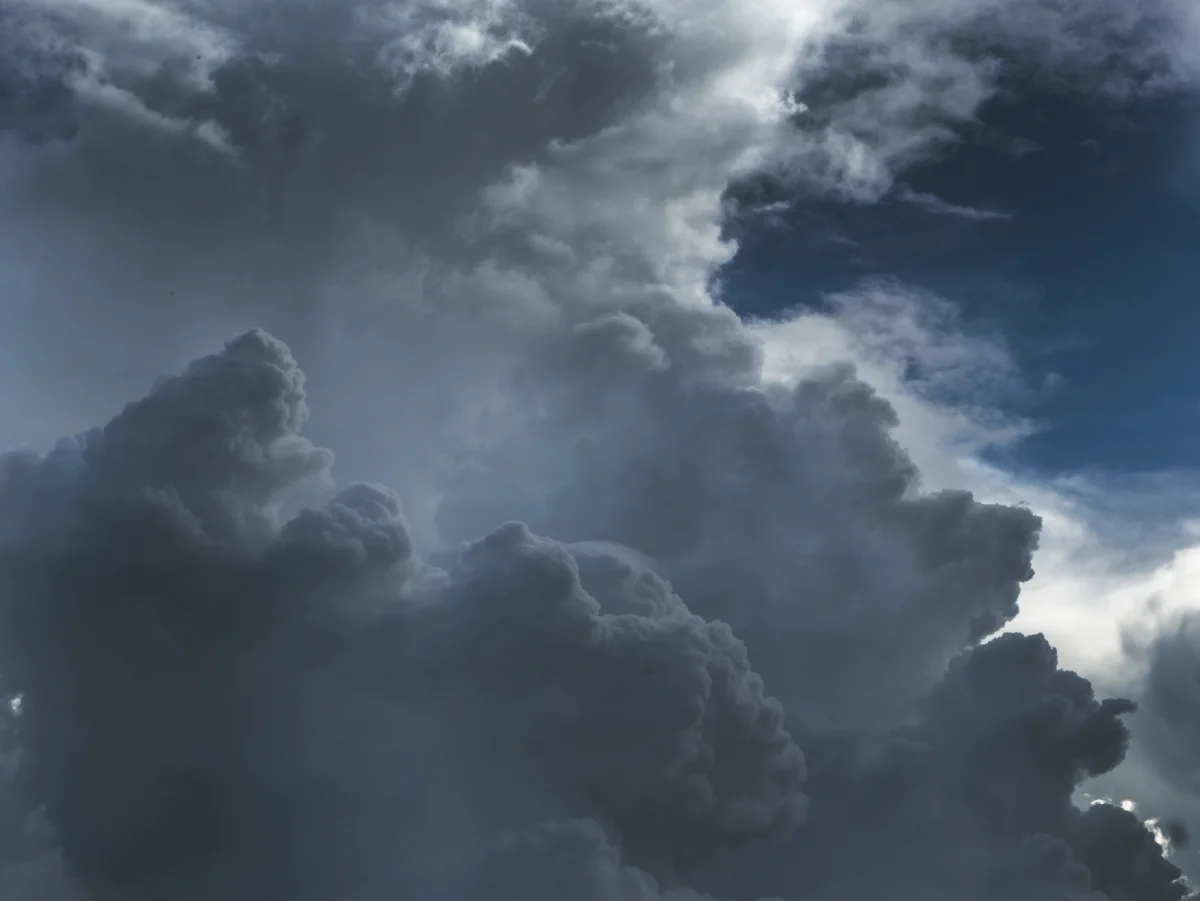
- A wall cloud. A dark, low-hanging cloud with visible rotation — this is what meteorologists call a "wall cloud," and a funnel can descend from it.
- Sudden silence after a storm. The wind dies, the rain stops, but the sky stays black — this can mean rotation is forming inside the storm cell.
- Flying debris on the horizon. If you see a cloud of dust and debris without a clearly defined funnel, the tornado is already on the ground. Not every tornado has a visible funnel — sometimes only the debris cloud at its base is noticeable.
Indoors: The First Few Seconds
If you're at home, in an office, or in a shopping mall, the building itself is your shelter — but not every spot inside is equally safe.
- Head down and low. A basement is the best location. If there's no basement, go to the ground floor, into an interior room with no windows: a bathroom, a closet, a hallway, a stairwell. The more walls between you and the outside, the better.
- Stay away from windows. Glass turns into flying shrapnel during a tornado. Don't try to watch the approaching funnel through a window.
- Lie on the floor and cover your head. A mattress, blanket, pillows, even a jacket — anything that can soften the impact of a flying object. The priority is protecting your head and neck. Get under a heavy table, or climb into a bathtub and cover yourself with a mattress.
- Don't open windows. The old myth about "equalizing pressure" is a dangerously wrong idea. An open window lets wind rush inside, and the roof tears off faster, not slower. Everything should stay closed.
Outdoors: No Building Nearby
If a tornado catches you out in the open, the situation is worse — but not hopeless.
- Look for any depression in the ground
A ditch, a gully, a ravine, a pit — lie face-down at the bottom and cover your head with your arms. The main threat outdoors is flying debris: boards, sheet metal, branches, rocks. The lower you are, the smaller a target you make.
- Don't hide under a bridge or overpass
This is one of the most common and dangerous mistakes. The space under a bridge acts like a wind tunnel — air accelerates, and flying debris hits with double the force.
- Don't try to outrun it
A person can run at 9–12 mph. A tornado moves at 25–45 mph, sometimes up to 60. Running from a funnel is pointless. If you can see its direction of travel, move perpendicular to its path — but the priority is finding shelter, not distance.
- Don't lie under trees
Trees are the first things a tornado snaps and rips out of the ground.
In a Car: The Most Vulnerable Spot
A car is the worst possible shelter during a tornado. A tornado rated EF2 or higher (winds over 111 mph) can lift vehicles into the air. Even an EF1 (74–111 mph) can flip a passenger car.
If the tornado is still far off and you can see its direction, try driving perpendicular to its path — not toward it, not away from it, but sideways. This only works on an open road with no traffic.
If the funnel is close, stop the car, turn off the engine, buckle your seatbelt, duck below window level, and cover your head with your arms. If there's a ditch or depression nearby, get out of the car and lie down in it — a ditch is safer than a car.
After It Passes
The tornado has moved on, but the area remains dangerous.
- Downed power lines. On the ground and in puddles, these pose a lethal risk. Don't approach, don't touch.
- Gas leaks. If you smell gas, don't light anything, don't flip a light switch. Leave the building.
- Damaged structures. Buildings with cracks, sagging ceilings, or shifted foundations can collapse. Don't go inside — wait for professionals.
- Glass and debris. The ground is covered in shards, nails, and rebar. Wear sturdy footwear and watch where you step.
What a Tornado Can Do: The Fujita Scale
- EF0 (65–85 mph): breaks branches, tears down signs. Injuries are rare.
- EF1 (86–110 mph): tears off roofs, flips mobile homes. Dangerous in open areas.
- EF2 (111–135 mph): destroys light structures, lifts cars, uproots trees. Serious injuries and fatalities.
- EF3 (136–165 mph): destroys well-built structures. Widespread destruction.
- EF4–EF5 (166–200+ mph): levels everything. Only concrete foundations remain. Extremely rare in Russia, but recorded (Ivanovo, 1984).
Most Russian tornadoes fall into the EF0–EF1 range — but even those can be lethal in the open.
How It Differs From a Typhoon: Why the Rules Change
A typhoon (hurricane) gives you one to three days of warning — enough time to prepare, evacuate, or reinforce your home. A tornado gives you minutes of warning — sometimes none at all. A typhoon lasts hours or days; a tornado lasts seconds or minutes. A typhoon spans hundreds of kilometers; a tornado's path runs anywhere from 50 meters to 2 kilometers wide.
This produces the key strategic difference: with a typhoon, you prepare and ride it out. With a tornado, you react instantly. There's no time to tape up windows, gather documents, or fill the bathtub with water. There's time for exactly one action: getting to the right spot.
What to Remember
A tornado leaves no time to look up instructions. Everything you've just read needs to become automatic: hear the roar, go down, get to an interior wall, drop to the floor, cover your head. No windows, no bridges, no stopping to film it on your phone.
A tornado lasts anywhere from a few seconds to a few minutes. Unlike a hurricane, which rages for days, this is a single blow, followed by silence. Surviving it comes down to those 60 seconds when a choice still exists — getting lower, deeper, and further from glass. Everything after that comes down to how many walls stand between you and the funnel.