While St. Petersburg hides under umbrellas as usual, and Sochi gets hit with yet another downpour, in several Russian regions people spend weeks staring at cloudless sky — and that's not cause for celebration.
When Russian climate comes up in conversation, the first image is slush, snow, gray skies. But a country spanning 11 time zones also holds the complete opposite: territories where annual rainfall doesn't reach 200 mm.
For comparison: Moscow gets around 700 mm a year, Sochi a full 1,700 mm. The gap between the country's wettest and driest points is tenfold or more. And aridity isn't just a figure in a climate reference book — it's a different way of life, a different economy, and an entirely different relationship with water.
Why Some Places Get Downpours and Others Get Dust
Rainfall distribution across Russia follows several simple but unyielding rules. The primary moisture supplier for European Russia is the Atlantic Ocean.
Air masses laden with water vapor travel west to east, releasing moisture along the way. Peak precipitation falls on the western slopes of highlands (Valdai, Central Russian); the minimum falls in the southeast, in the Caspian Lowlands, where Atlantic air arrives already wrung out.
The second factor is mountain barriers. The Urals intercept part of the moisture, and Western Siberia gets less rainfall than comparable latitudes in European Russia. In Eastern Siberia, winter is dominated by the powerful Siberian anticyclone — a high-pressure zone with dry, frigid air.
The third factor is temperature. Cold air simply can't hold as much moisture as warm air. That's why polar regions are formally among the country's "driest": the Arctic coast gets 250–350 mm a year. But due to low temperatures, evaporation is minimal, and there's no water shortage there — it just doesn't go anywhere.
Genuine aridity is when precipitation is low and evaporation is high. That exact combination occurs in southeastern European Russia.
The Caspian Lowlands: Russia's Semi-Desert
The country's driest corner is the Caspian Lowlands, spanning southern Astrakhan Oblast, eastern Kalmykia, and northwestern Dagestan. Annual rainfall here drops to 150–200 mm, and in some years, even lower. Summer heat reaches +40–45°C, and what little moisture exists evaporates before it can soak into the soil.
The landscape is a flat, sun-scorched plain below sea level (down to –28 m). Vegetation consists of wormwood, saltworts, and scattered tamarisk shrubs. In spring, the steppe briefly turns green thanks to March–April rains, but by June, everything burns to brown.
Soils here are brown semi-desert and solonetz — unsuitable for agriculture without irrigation. The local population historically practiced nomadic livestock herding and fishing, and that's no accident: plowing this land makes no sense without a water canal.
Kalmykia: Europe's Only Desert
The most vivid illustration of what drought does to land is the "Black Lands" in southeastern Kalmykia. The name doesn't come from soil color but from its winter appearance: snow never settles here — wind blows it away before it can cover the steppe. On land that was once pasture now stand sand dunes — Europe's first and only anthropogenic desert.
Eastern Kalmykia receives 170–210 mm of rainfall a year. Summer brings up to 120 days of sukhovei — a hot, desiccating wind that cracks lips and curls leaves. Soil temperature can climb to +60°C. According to EMERCOM, Kalmykia is the driest region in southern European Russia.
80% of the republic's land is at risk of desertification. Open sand covers roughly 100,000 hectares — and that's after decades of countermeasures: planting shelterbelts, stabilizing dunes, regulating grazing. In the 1970s–80s, the situation was even worse: uncontrolled sheep farming destroyed vegetation cover, and wind began shifting exposed soil.
Honored agronomist of Kalmykia Boris Goldvarg told RIA Kalmykia: "Even though open sand doesn't cover a huge area, 80% of the land still faces desertification risk. The most alarming part is that desertification threatens not just pastures but also the settlements where people live."
The republic's capital, Elista, gets around 300 mm of rainfall a year — formally slightly more than the Caspian coast, but it still feels dry: heat under +40°C, dusty winds, cloudless skies for weeks on end. Lawns in the city survive only on regular watering.
Astrakhan: The Driest Major City
If you're looking for a large city with minimal rainfall, it's Astrakhan. Average annual total: around 220 mm, sometimes even less. For a half-million-person city sitting in the Volga Delta, that's a paradox: water is everywhere around, and rain is almost nowhere.
Summer in Astrakhan is long and hot: temperatures regularly climb above +40°C, and dust storms are not rare. Winter is short and nearly snowless: when snow does fall, it lasts only days.
The city's entire existence hinges on the Volga. Water for irrigation, drinking supply, industry — all from the river and its tributaries. Without the Volga, Astrakhan would sit in the middle of a semi-desert — which, in essence, the surrounding territory already is.
Local melon fields — the famous Astrakhan watermelons — grow exclusively on irrigated land. Rainfall alone wouldn't be enough for even a flowerbed.
Volgograd: A Steppe Metropolis
Volgograd is another city where rainfall scarcity shapes daily life. The average annual norm is around 260–270 mm, and summer rainfall is a genuine rarity. At +35–40°C in the shade (and often higher in practice, since the city stretches along the Volga through flat steppe), the air turns into a dry, hot blanket.
Dust storms, when wind lifts fine particulate from open fields, occur regularly — visibility drops, and cars get coated in an orange film.
Greenery in the city survives thanks to artificial irrigation and Soviet-era forest plantings. Without watering, lawns burn out by July. Dacha owners outside the city know: if a summer passes without rain — which happens often — the harvest depends entirely on a well or a water line.
Kosh-Agach: Dryness at Altitude
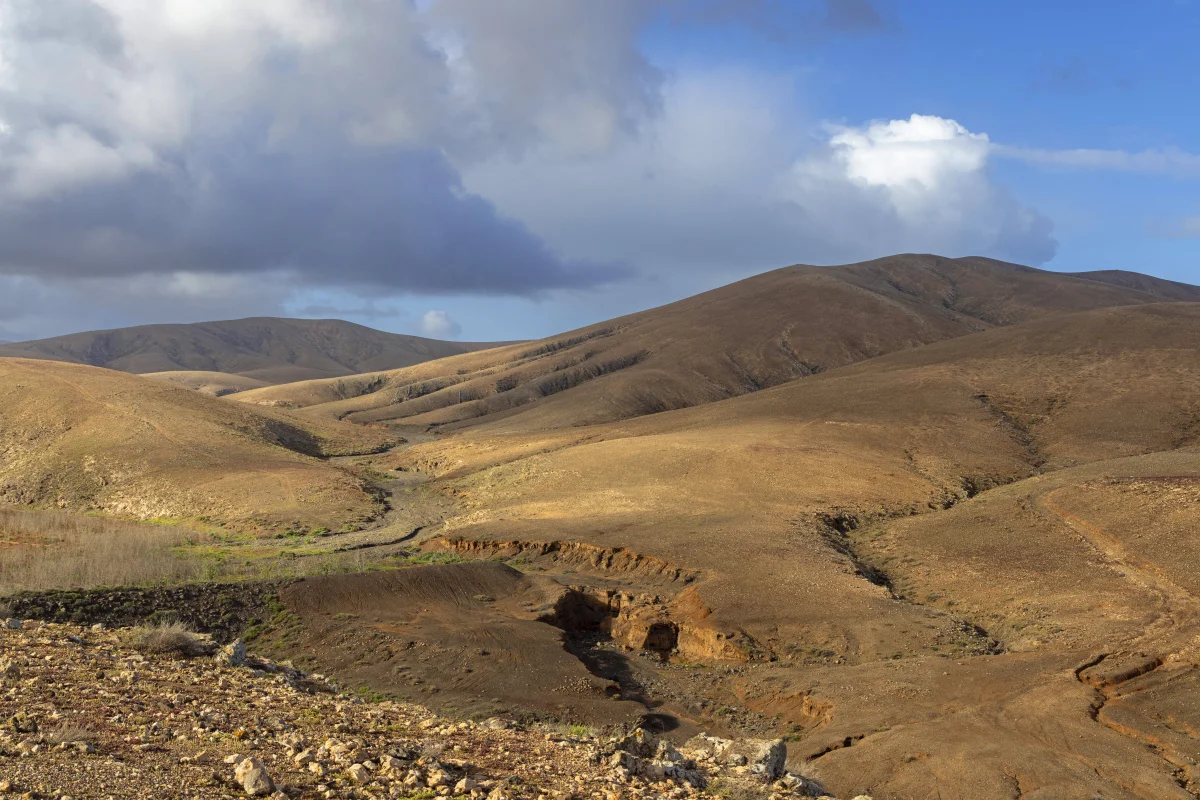
Far from the Caspian steppes, in the mountains of Altai, sits a place that formally claims the title of Russia's driest. The village of Kosh-Agach (Altai Republic) sits in an intermontane basin at 1,760 meters elevation — and receives no more than 100–150 mm of precipitation a year.
The mechanism is simple: the basin is surrounded by mountain ranges that intercept moisture from every direction. Already dried-out air reaches the interior, and rain clouds simply never make it to Kosh-Agach. The "rain shadow" effect works here just as it does in the famous Atacama Desert — only on a more modest scale.
Winter in Kosh-Agach reaches –45°C; summer brings +30°C and higher. The temperature swing is colossal. Snow is nearly absent: the cold is dry, skies clear, sun bright. The landscape — a rocky steppe more reminiscent of Mongolia than the "green Altai" of postcards. Population: around 4,500, primarily Kazakhs and Altaians engaged in livestock herding.
Yakutsk: Frost and Dryness in One Package
Yakutsk, the largest city sitting in the permafrost zone, receives about 240 mm of precipitation a year — less than Volgograd. But here's the paradox: Yakutsk doesn't feel dry. In summer, the surrounding taiga is waterlogged, the air humid from river and lake evaporation, and in winter rainfall is low simply because air at –40°C holds almost no moisture.
The difference from Astrakhan or Kalmykia lies in evaporation. Where it's hot, scarce rainfall instantly escapes into the atmosphere. Where it's cold, even small amounts of moisture linger in the soil for months. That's why Yakutsk is the antipode of the Caspian region: rainfall is low, but the sensation of drought is absent.
This is a critical distinction in climatology: low rainfall and aridity aren't synonymous. Drought means moisture falls short relative to need — for plants, soil, people. Yakutsk has enough. Kalmykia doesn't.
How Drought Reshapes Daily Life
In Russia's arid southern regions, the relationship with water is the central axis of life. A few details unfamiliar to residents of central Russia:
- Watering isn't a luxury — it's a necessity. In Astrakhan Oblast, Kalmykia, and southern Volgograd Oblast, a garden without irrigation is just a plot of scorched earth. Water for irrigation comes from canals, wells, and pipelines. Rainwater is a bonus, not something you can count on.
- Dust is a constant companion. In steppe and semi-desert districts, wind lifts soil from bare patches, and fine particulate clogs windows, settles on furniture, and grits between teeth. After especially windy days, cars are coated in an orange or gray layer.
- Greenery is the result of effort. Forest shelterbelts along roads in southern Russia's steppe zone are a legacy of Stalin's 1948 "Great Plan for the Transformation of Nature." Without them, wind would strip topsoil from fields. Many of these plantings are degrading: trees age, and new ones aren't planted everywhere.
- Well water is brackish. In the Caspian Lowlands, groundwater is often saline. Drinking water arrives by tanker truck or comes from artesian wells.
Is It Getting Drier?
Scientists document that aridity is increasing in Russia's southern regions. Research shows the area of degraded land nationwide exceeds 120 million hectares. Rostov Oblast, Stavropol Krai, southern Saratov Oblast — territories once considered zones of stable agriculture — increasingly face spring and summer droughts.
The primary threat isn't so much declining rainfall (over decades, the decline is modest) as rising temperatures, which increase evaporation faster than moisture accumulates. Soil dries earlier, the growing season shifts, and yields without irrigation become a gamble.
In Kalmykia, after the 1970s–80s catastrophe, the situation was stabilized — dunes were fixed, part of the pastureland restored. But scientists warn: a few consecutive dry years could restart the degradation.
What This Means in Practice
If you're planning a trip through Russia's arid south, a few practical notes. Spring (April through early May) is the only window when the Kalmyk steppe turns green and blooms with tulips. This period lasts literally two or three weeks, after which everything burns out. Wild tulip blooming in Kalmykia is a spectacle photographers travel here for from across the country.
In summer, prepare for heat exceeding +35°C in Astrakhan, Elista, and Volgograd, with a complete absence of shade outside city parks. A sun hat, water, and sunscreen aren't a recommendation — they're a survival kit.
And if you find yourself in Kosh-Agach, don't be surprised by a landscape resembling the Mongolian steppe more than the Russian mountains. Here, at the edge of the country, where annual rainfall is less than Moscow gets in two months, people have long since learned to live without an umbrella. And according to climate forecasts, there will be more such places in Russia going forward.