In July, the temperature gap between Russia's hottest and coldest inhabited settlements reaches 50 degrees. While Kalmykia hits +45°C and the asphalt softens, the Kara Sea coast sits at +5°C, with fog and wind that numbs bare fingers.
Russia is the only country where tropical heat and Arctic cold coexist at the height of summer. The reason is its sheer north-south sprawl: from the 41st parallel (Dagestan) to the 81st (Franz Josef Land). Forty degrees of latitude — and every one of them strips summer of warmth.
The Arctic Coast: Summer That Barely Exists
Russia's coldest summer temperatures belong to the Arctic Ocean coastline. Even in July, air here doesn't warm past +5–8°C, and the sensation is like Moscow in November.
The settlement of Dikson, on the shore of the Kara Sea, holds the record: the average temperature of the warmest month is +5.2°C. Around 500 residents — meteorologists, border guards, port workers — live where the frost-free period lasts under 60 days, and snow can fall in any summer month.
A similar picture appears in Tiksi (Laptev Sea coast, average July +8°C) and Pevek in Chukotka (+7–9°C). Pevek is the country's northernmost city, and its summer means wind off the East Siberian Sea, fog, and rare sunny days that residents greet as an event.
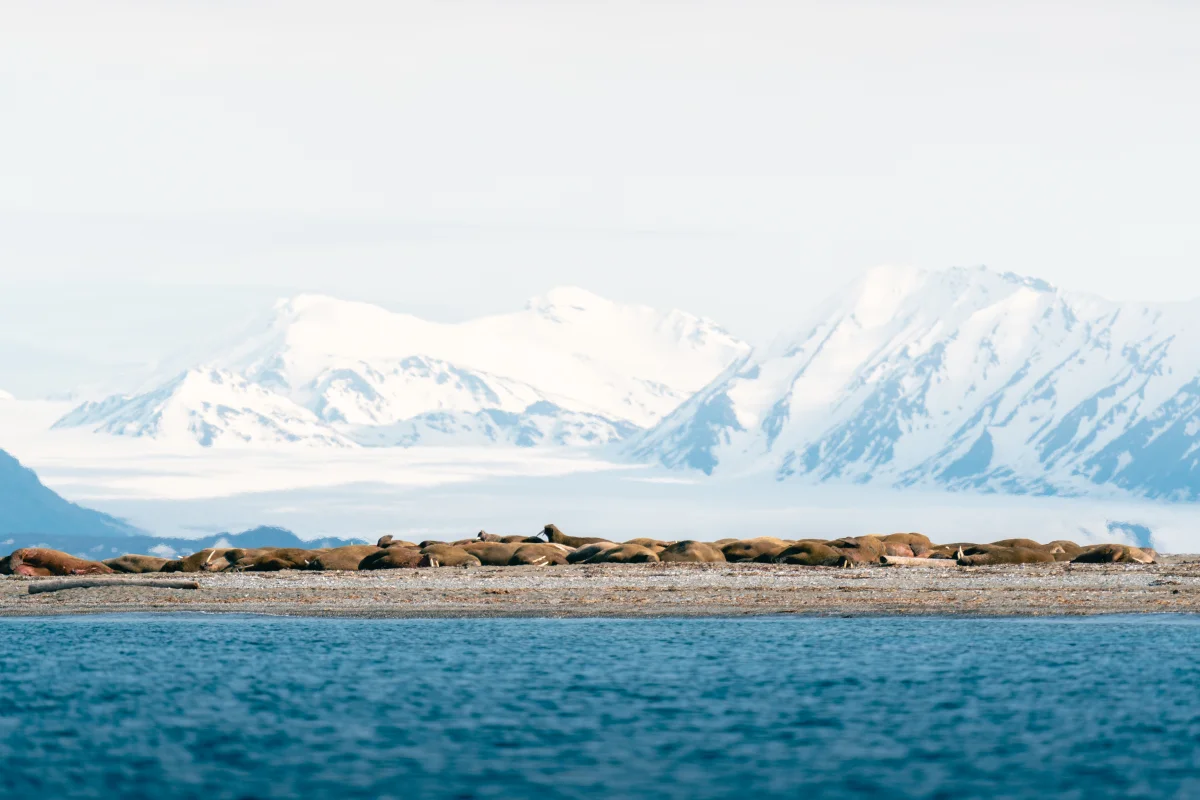
On the islands, it's even colder. Franz Josef Land, Severnaya Zemlya, Novaya Zemlya — average July temperature runs 0 to +3°C. Technically this is Arctic desert, where summer in any conventional sense doesn't exist: snow only partially melts, glaciers cover most of the territory, and vegetation is limited to lichens and moss.
Tundra and Forest-Tundra: Two Warm Months, Total
South of the Arctic coast lies the tundra and forest-tundra zone, where summer formally exists but is so brief that nature lives it in sprint mode.
Vorkuta (Komi Republic) — average July temperature +13.1°C. The city sits above the Arctic Circle, in the tundra zone. The frost-free period lasts around 70 days. When temperatures rise to +20°C, which happens a few times each summer, Vorkuta residents flock outdoors en masse: firing up barbecues, sunbathing along riverbanks, swimming in the ice-cold waters of the Usa and Vorkuta rivers. Because tomorrow could bring +8°C and rain — and summer won't offer a second chance.
Salekhard (Yamalo-Nenets Autonomous Okrug) — the only city in the world sitting directly on the Arctic Circle. Average July: +14.5°C. White nights run from late May through late July, and at two in the morning, it's still light out. But that adds no warmth: the sun sits low, warms weakly, and even in July nighttime temperatures run +8–10°C.
Norilsk — the largest city in this climate zone (170,000 residents). Average July: +14.3°C. Norilsk residents say they have "two seasons — winter and July, and July sometimes has winter too." When the thermometer hits +20°C, it's an event people arrange around: "They're forecasting twenty tomorrow — let's go to the lake." At +25°C, it feels tropical: windows thrown open, kids running around in shorts, adults sunbathing on the rocks by Norilsk's lakes.
The Kola Peninsula and Murmansk: Cold From the Ocean
Murmansk is the largest city above the Arctic Circle: 270,000 residents. Average July: +13.2°C. Close to Norilsk's numbers on paper. But it feels different, and the reason is the Barents Sea.
Ice-free thanks to the Gulf Stream, the sea is a blessing in winter: Murmansk runs 15–20 degrees warmer than Norilsk in January. But in summer, that same sea acts as a refrigerator: it prevents the air from warming and blankets the coast in fog and damp. Murmansk can hit +18–20°C and sunshine — then, an hour later, fog rolls in off the sea and it's +10°C. A jacket in your backpack is the summer norm.
The polar day (late May through late July) creates a paradox: an abundance of light, a shortage of warmth. The sun doesn't set for weeks, but warms so weakly that tanning is easier than staying warm.
The Far East: Cold Summers at Southern Latitudes
A separate story belongs to the Pacific coast. Here, cold summers occur at latitudes that would bring genuine heat on the other side of the country.
Petropavlovsk-Kamchatsky sits on the 53rd parallel — the same as Samara. In Samara, average July temperature is +21.5°C, occasionally hitting +38°C. In Petropavlovsk, it's +13°C, with fog and drizzle. The Pacific Ocean cools the coast so powerfully that Kamchatka's summer resembles Murmansk's, despite sitting 15 degrees farther south.
Magadan offers another example. Its latitude matches Moscow's closely (59° vs 55°, a mere 4-degree difference). Average July temperature in Moscow: +19.7°C; in Magadan: +12.4°C. The Sea of Okhotsk, one of the coldest in Russia, prevents coastal air from warming.
The Commander Islands (the village of Nikolskoye, 600 residents) are perhaps the cloudiest and windiest inhabited spot in the country. Summer here barely exists in any real sense: average temperature of the warmest month is around +10°C, sunny days are rare, and wind blows year-round.
What +15°C Means to Northerners
In Moscow, +15°C is a reason to put on a jacket. In Norilsk, it's a reason to take one off. Temperature perception is entirely shaped by habit, and the scale in the north is radically shifted.
At +12–15°C in Vorkuta, Murmansk, and Norilsk, people sunbathe. Not figuratively — literally: spreading blankets on lake or river banks and lying under the northern sun in swimsuits. Tans develop slowly, but they develop — UV is weaker in the north, but the polar day compensates in duration what it lacks in intensity.
At +18–20°C, what northerners call a heat wave begins. Windows thrown open, complaints about the mugginess, ice cream in every hand. In homes designed for –40°C (thick walls, sealed windows, powerful heating), sleeping at +20°C outside becomes impossible: heat has nowhere to escape, and air conditioners in northern cities are rare, because — why would you need one?
At +25°C, it's extreme heat, occurring a few times each summer. On days like this, Norilsk and Vorkuta resemble southern cities: people in shorts, lines for kvass, kids running through fountains. Two days later: back to +12°C and wind, and everything returns to normal.
Why Some Places Are Colder Than Others at the Same Latitude
Latitude is the main factor, but not the only one. Two cities on the same parallel can differ by 10 degrees in summer temperature.
- Proximity to the ocean
The sea evens out temperatures — preventing air from warming much in summer (and cooling too dramatically in winter). Murmansk and Petropavlovsk are colder than Norilsk and Yakutsk at the same or even more northern latitudes, because they sit on the coast.
- Continentality
The farther from the ocean, the hotter the summer and the colder the winter. Yakutsk, on the 62nd parallel (north of St. Petersburg), warms to +20–25°C in summer, occasionally reaching +35°C. The reason is extreme continentality: the ocean is far away, and land air heats freely.
- Terrain
Mountain basins trap cold in winter and heat in summer. Yakutia's valleys are an example: –50°C in winter, +30°C in summer. Open plateaus (like the Central Siberian Plateau) are windswept and never fully warm.
Can You Actually Travel There in Summer?
Not only can you — it's worth it, if you know what you're signing up for.
- Murmansk in June–July offers the polar day, whales in the Barents Sea (departing from Teriberka), and the Khibiny Mountains with blooming alpine meadows. Jacket, fleece, and rain gear are the basic kit.
- Norilsk is a closed city (requires a permit), but the Putorana Plateau nearby is one of the most breathtaking places on the planet: thousands of waterfalls, canyons, lakes. The season runs July–August, and every warm day counts.
- Kamchatka offers volcanoes, geysers, bears. Summer is the only time all of it becomes accessible. +15°C and fog is normal Kamchatka weather, and you adjust by day two.
Summer in the north isn't about beaches or tans. It's about light that never ends, silence that rings in your ears, and the feeling of standing at the edge of inhabited land. And +15°C under a midnight sun is warmer than it sounds — tested and confirmed by northerners themselves.