Viper
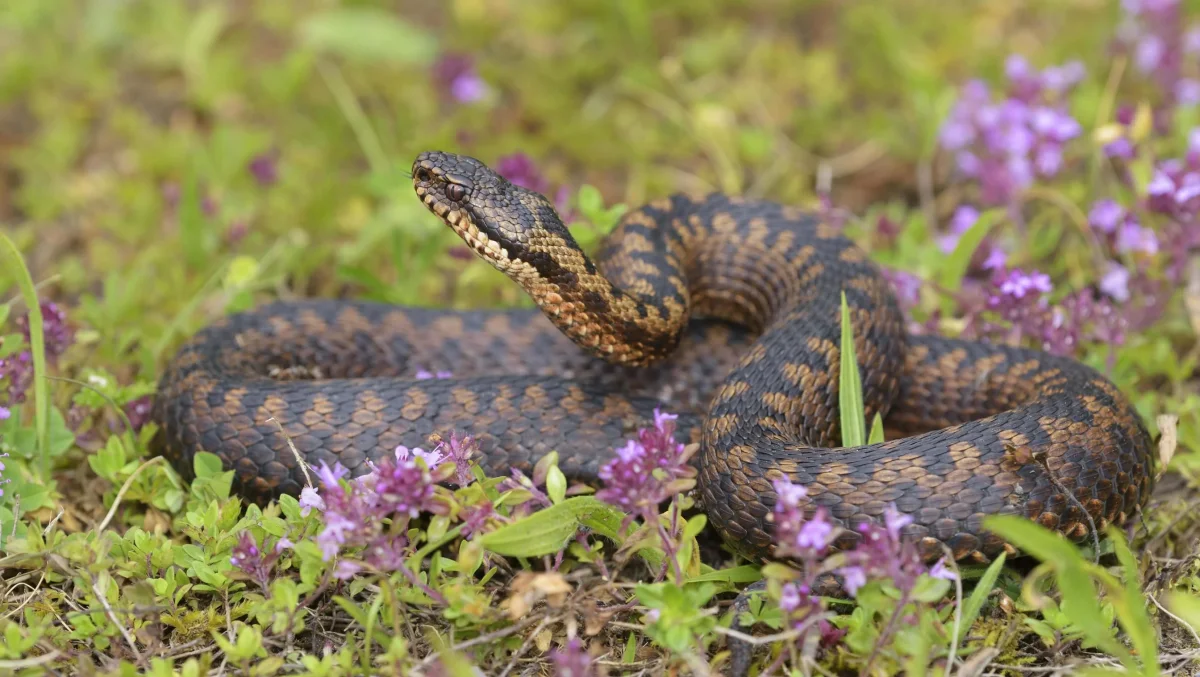
Three subspecies of these snakes live on the territory of our country. The common viper and the steppe viper can be found almost everywhere in Russia. The first most often inhabits mixed forests, near swamps, in fields, and on the banks of bodies of water. The second prefers coniferous forests and arid areas.
The third subspecies – the Caucasian viper – lives in the Krasnodar Region. The coloring of all three subspecies can vary: from black to light gray or brown.

The distinctive features of these snakes – an almost triangular head, a sharp tail tip, and a zigzag pattern on the back. Vipers usually do not attack people; they show aggression only in the event of a potential threat.
A viper’s bite extremely rarely leads to a person’s death. The more likely outcomes are swelling, an allergic reaction, or vomiting. When bitten, the most important thing is to try to protect your hands and head, since the toxin badly affects muscles and skin. However, the best course of action is simply to try to stay calm and let the snake crawl away.
Pit viper (shchitomordnik)

The body of pit vipers has a gray-brown or brownish color. Along the sides run rows of large dark spots with light centers. The snake’s head is covered with large scutes (shields), which is how the reptile got its name. These snakes show aggression only when they have no opportunity to retreat. At the same time, the pit viper, unlike many of its relatives, will warn its victim of an attack. As the snake approaches, you will hear the vibration of the tip of its tail.
They live in the lower reaches of the Don, the Salsk steppe, in the coastal regions of the Volga or in Primorye, in the Far East. A pit viper’s bite is very painful, but not fatal. When the venom enters the body, tissue necrosis occurs. That is why full recovery and healing take a person from 7 to 10 days.
Blunt-nosed viper (gyurza)
Of all the reptiles presented here, the blunt-nosed viper – is the largest and most dangerous. The snake’s bite destroys the red blood cells in the blood. Because of this, oxygen stops reaching the tissues, and unless antivenom is administered to the person immediately, they may die.
The reptile becomes active in spring, when the temperature reaches +10 degrees. The coloring of the blunt-nosed viper depends on its habitat; however, on the territory of Russia the snake’s body has a grayish-sandy tint, with brown spots running along the back. This subspecies is also distinguished by a large number of ventral scutes and a small number of black spots on the belly.
In addition to crawling along trees, the blunt-nosed viper has learned to leap from them and thereby strike with lightning speed.
In Russia, the reptile lives on the territory of Dagestan. Therefore, when visiting this region, it is especially important to steer clear of foothill areas, cliffs, canal banks, river valleys, and gorges.
Tiger keelback (tigrovy uzh)

The tiger keelback — is a snake with very bright coloring. The rear part of its body — is green with dark stripes, and closer to the head the color turns reddish-orange. Tiger keelbacks do not pose a great danger. Their venom-bearing teeth are located very deep in the mouth, and the snake itself is not even venomous on its own. However, the keelback can accumulate venom if its diet consists of a large number of poisonous frogs.
In Russia, tiger keelbacks live in the Khabarovsk and Primorsky Regions, dwelling in forests and near bodies of water. There have not been many attacks by tiger keelbacks on people, so accounts of how the venom affects the body vary. Most likely, a bite will cause only slight swelling and soreness.