Dombai is one of the oldest ski resorts in Russia, and its chief advantage over the competition isn't infrastructure — it's natural snow. So much of it falls here that the slopes operate from December through April, and on the upper lifts you can ride into May.
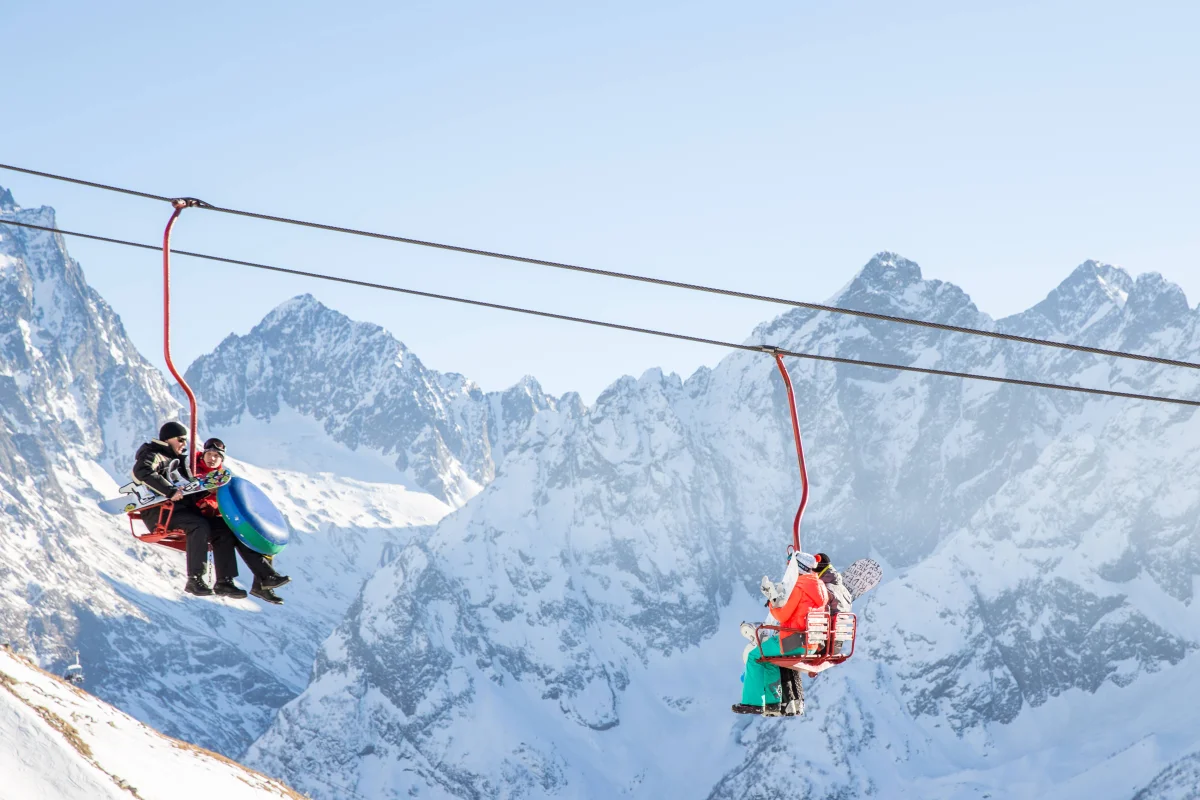
The resort village of Dombai sits at 1,600 meters elevation inside Teberda National Park in Karachay-Cherkessia. Cable cars climb to 3,200 meters — an elevation drop of more than one and a half kilometers. All around: the peaks of the Western Caucasus, glaciers, and coniferous forest.
In scale and scenery, Dombai trails Krasnaya Polyana — but in atmosphere, it holds its own: quieter, more intimate, and noticeably cheaper.
When the Season Opens and Closes
The official opening of the 2025/2026 season took place on December 20, 2025. But on the upper sections of the runs — above 2,500 meters — riding begins as early as late November, once sufficient snow cover has accumulated.
Closing comes in mid to late April. In good years, the upper lifts keep running into early May, but by then snow on the lower sections has already melted, and riding is only possible above 2,500 meters.
With the arrival of snowmaking systems, the season has become more predictable: even if December turns out to be low on snow, runs are supplemented by snow guns.
December: A Start With Caveats
The first month of the season is unstable. Snow cover is building, but on the lower runs it's still thin. At 2,500–3,200 meters, riding is already possible; below that, it depends on the weather.
Temperature in the village: –3°C during the day, –8°C at night. At altitude: 5–7 degrees colder. Daylight is short — riding ends early.
The New Year holidays bring peak capacity. Lift lines stretch to 30–40 minutes, accommodation prices double. The atmosphere is festive — a tree on the meadow, fireworks, mulled wine at a café at 3,000 meters. But for quality riding, it's not the best window: runs get scraped down to ice by noon.
January: Plenty of Snow, Very Few People
After the holidays, the best time for relaxed riding arrives. The New Year's crowd has dispersed, and snow depth reaches its maximum — up to three meters on the upper sections. Temperature: –5 to –8°C during the day, reaching –15°C at altitude. The snow is dry, powdery, and holds up well.
The downside: short daylight and frequent cloud cover. Some days, visibility on the upper lifts drops to just a few meters — riding is only possible on the lower runs.
Prices return to normal, and there are virtually no lines.
February and March: The Golden Window
Locals and experienced riders call February and March the best months — and here's why.
February. Snow is at its maximum. Sunny days are noticeably more frequent than in January. Temperatures are milder — –2 to –5°C in the village, around –10°C at altitude. Days are getting longer, and riding continues until 4–5 p.m. The snow is still dry and light, and runs are in excellent condition.
March. The marquee month. The sun is bright, the air transparent, and the mountains are in their full glory. Village temperatures cross into positive territory: +2 to +5°C during the day. At altitude — around zero. Snow is still abundant, but its character shifts: hard-packed in the morning, soft and pliable by noon — ideal for carving.
March in Dombai also means a tan. The sun at 3,000 meters burns fast: UV radiation increases by 10–12% with every thousand meters of elevation, and snow reflects up to 80% of the rays. Without ski goggles and sunscreen — a burn in half an hour.
April: Spring Riding
April is the season's finale. On the lower runs, snow is melting — puddles and bare patches. Above 2,500 meters, riding continues, but the snow is heavy, wet, and turns to slush by noon. Mornings start with a hard crust that softens by 10–11 a.m.
Experienced skiers hit the slopes early and wrap up by midday. Afternoons shift to loungers on the meadow, sun-drenched cafés, and walks to waterfalls. Village temperatures reach +8 to +12°C, and Dombai gradually transitions from a ski resort into a mountain retreat.
By late April, most lifts shut down. Season over.
Runs and Lifts
Dombai is a compact resort. The main ski zone occupies one slope of Mount Mussa-Achitara, served by several cable car lines:
- First through third stages (1,600–2,277 m) — the lower runs. Forest, gentle turns, suitable for beginners. Snow melts here first.
- Fourth through fifth stages (2,277–3,008 m) — the main riding zone. Wide, open slopes with a 730-meter vertical drop. Snow lasts the longest here.
- Upper station (3,168–3,200 m) — panoramic platform. Riding here is for the advanced: steep sections, ice, wind.
Total run length: roughly 25 km. By the standards of Krasnaya Polyana or European resorts, that's modest. But for two or three days of riding — enough.
Dombai vs. Krasnaya Polyana
The comparison is inevitable — both resorts sit in the Caucasus, both run in winter. The difference is in scale and price.
- Krasnaya Polyana — more runs (over 100 km), more modern lifts, higher service standards. But prices are 40–60% steeper: lift passes, accommodation, food. In season — lines and crowds.
- Dombai — smaller, simpler, cheaper. A day lift pass starts at 2,500 rubles (2025/2026 season), lunch at a café from 500 rubles, accommodation from 2,000 rubles per night. The atmosphere is homey, without the polish.
Getting There
The nearest airport is Mineralnye Vody (MinVody), 200 km from Dombai. Direct flights from Moscow, St. Petersburg, Yekaterinburg, and a dozen regional airports. Flight time: 2.5 hours.
From MinVody to Dombai: 3–3.5 hours by car along a mountain road through Karachayevsk and Teberda. Transfers start at 3,000 rubles; scheduled buses run, but infrequently. The drive itself is scenic: gorges, rivers, mountains gradually gaining elevation.
Which Month to Choose
Want maximum snow and minimum people — January. Want the best riding conditions — February or the first half of March. Want sunshine, a tan, and a spring vibe — the second half of March. Want a festive atmosphere — New Year's holidays, but prepare for lines.
And if you're looking for the best deal — come in late January or early February: snow at its peak, prices at their lowest, and the entire slope is practically yours.