Japanese Bobtail
Japanese Bobtails have been known in Japan since the 6th century and are considered a natural, not artificially bred, breed. The imperial family loved these cats so much that Japanese Bobtails were granted all the privileges of the ruling class: they were pampered and revered like members of the royal family. The Bobtail is considered a lucky cat, and having one guarantees prosperity and happiness.
The Japanese Bobtail is an active, affectionate and extremely intelligent breed. They love being in the company of people and easily adapt to a routine. Bobtails are small but quite muscular cats. Their fur is soft and silky, and the cats have large oval eyes. However, the main feature of Japanese Bobtails is considered to be their tail. The Bobtails' tail is short, and the thick, dense fur gives it the appearance of a pompom. The Japanese themselves call this shape a chrysanthemum flower. What is also interesting is that Bobtails' tails are unique, and it is almost impossible to find two identical ones.
Devon Rex
The story goes that in 1960, near an abandoned mine in England, an amazing cat with curly fur was spotted. For a long time people tried to catch it, but to no avail. However, they managed to catch an ordinary cat that was near the curly one. The cat was given to a certain Miss Beryl Cox, where the animal produced offspring. One of the kittens turned out to be an unusual little one with the same kind of fur as the presumed tomcat. The kitten was named Kirlee (from the English «curly»), and it is sometimes believed that it was precisely he who gave rise to the appearance of the Devon Rex.

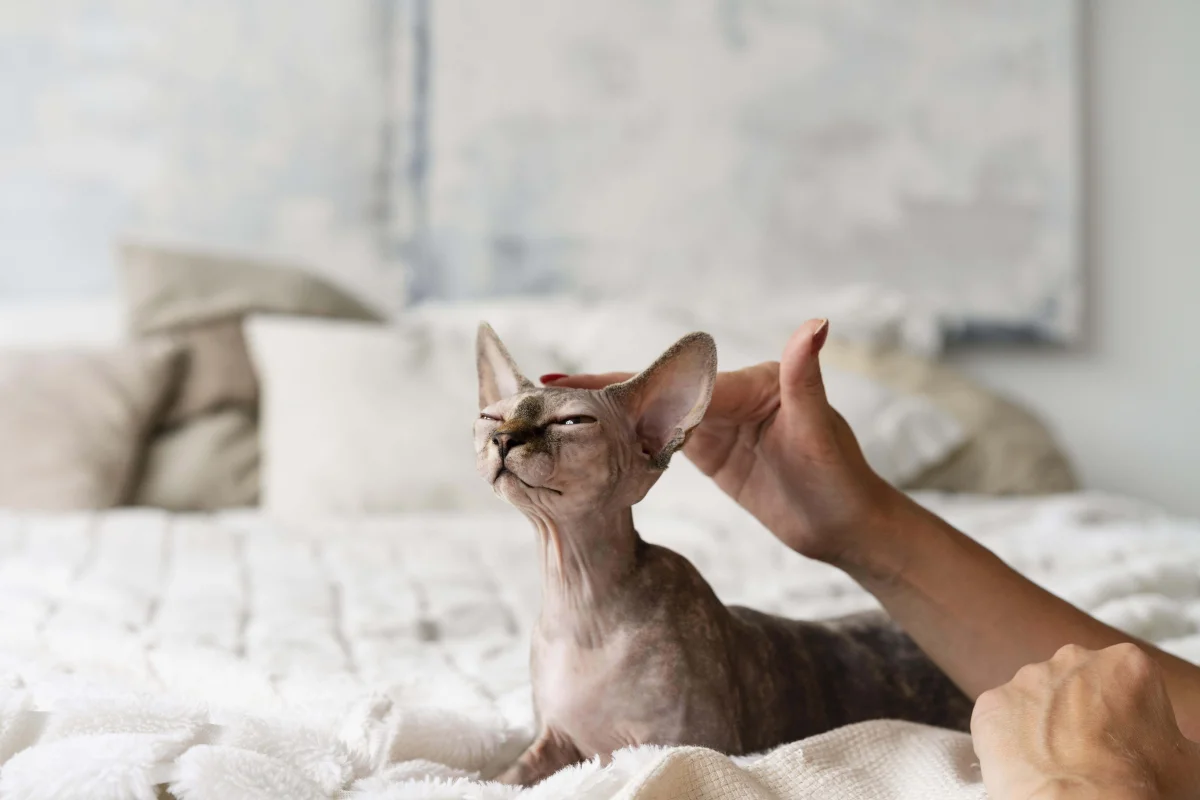
As already mentioned, the Devon Rex's fur is curly and soft, but also – very fragile. That is why these cats usually have no fur in those places where they might break it off by licking with their tongue. Another feature of the Devon Rex is their large ears, which make the animals resemble elves or pixies. The breed itself is active and friendly; Devon Rexes are attached to their owners and expect the same love and care in return.
Munchkin
Although this breed was not officially recognized until 2003, Munchkins have existed for many years. Their short legs are the result of a genetic mutation, which can also occur naturally. However, today short-legged cats are bred deliberately, which raises questions about the ethics of this process. Some argue over whether it is right to breed Munchkins, because it deliberately imparts a physical deformity to their legs. And this, in turn, can affect the animals' mobility.
Nevertheless, Munchkins are very friendly creatures that get along with children and other animals. These cats are also very curious – often they even sit up on their hind legs, like rabbits, to get a better view of the world around them. Because of their short legs, they sometimes find it hard to jump, although many manage it anyway. And they move quite differently from other cats – Munchkins' movements are more winding, as if they roll from one paw to another.
Elf
Since the Elf cat is a new and extremely rare breed, its history is limited. In 2004, two owners joined forces to breed a cat with curled ears. However, they wanted it to retain the personality and physical qualities of their beloved Sphynx cats. The Elf cat was successfully bred by crossing a Sphynx and an American Curl. The result was a hairless cat with curled ears.
Elves have a hairless, athletic, muscular body and characteristic cheekbones, like Sphynx cats. Their eye color ranges from blue to gold. There is not yet a group of characteristic colors for Elves. Given the breed's novelty, all color and pattern variations of Elf cats are considered normal. Elves are friendly and affectionate. They easily adapt to most home environments; however, it is important to remember that they also require a lot of attention.
Abyssinian cat
The true story of the Abyssinian cat's origin is shrouded in mystery. According to one legend, the first cat was brought to England in 1868 by a soldier after a battle in Ethiopia. Thus, a cat named Zula came to be considered the progenitor of all Abyssinians. According to other versions, Abyssinian cats once belonged to the Egyptian pharaohs or were brought in from India altogether by colonizers.

In the world of cats, Abyssinians are considered all but the ideals of beauty. These animals are graceful and extremely intelligent. And their large almond-shaped eyes and ears with little tufts beautifully adorn their handsome face. A feature of the Abyssinians' coat is also ticking, that is, several colors are mixed together on each individual hair. Abyssinian cats are very friendly; they are sometimes even compared to dogs. They choose an owner for themselves, and after that – follow him everywhere, while solitude brings them great suffering. Abyssinians are very active and love activity, but, amusingly – they can easily fall asleep suddenly right in the middle of play.