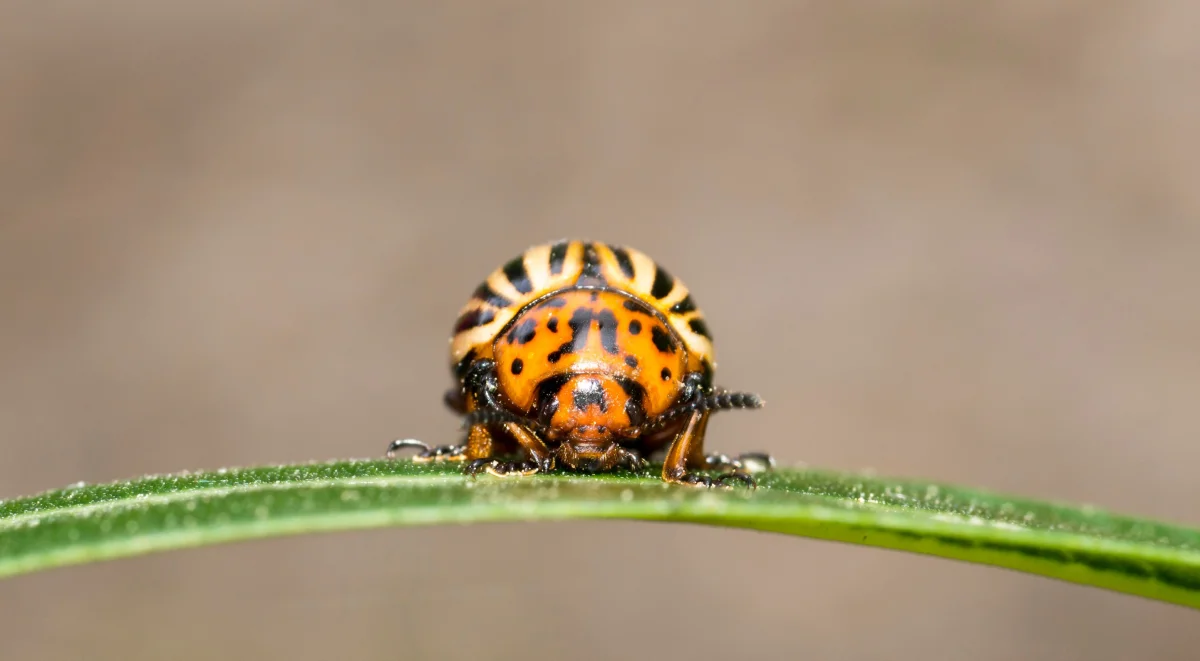
What Colorado potato beetles look like
Even in the most bitter frosts, at a depth of more than half a meter beneath the thickness of the snow, Colorado potato beetles feel at ease and comfortable. Few people know that female Colorado potato beetles burrow underground already fertilized as far back as late autumn. That is why, from the very first warm spring days, they begin to lay eggs, of which, by some accounts, up to a thousand can accumulate over a season – this depends on the weather conditions and climate. So it is no wonder that, closer to summer, «armies» of young beetles of an unpleasant bright-orange color attack the growing potatoes, eggplants, and other nightshade plants.
.jpg)
Photo: Erhard Nerger/imagebroker.com/#/search/
The growers of the «second bread» are not the least bit consoled by the information that these pests are short-lived. Colorado potato beetles live only a year, but they leave behind numerous offspring. Moreover, they can enter a state of so-called diapause. And sit it out in the ground for up to three years in a kind of hibernation, waiting for a favorable moment.
Who brought the pests to Russia?
Hardly a gardener could be found who would say «thank you» to the American entomologist Thomas Say, who in 1824 made a fateful discovery. He was the first to find an insect with a bright coloring in the Rocky Mountains. And it was enough to take along a few beetles for, just over three decades later, the farmers of the state of Colorado to raise the alarm. The insects, multiplying with furious force, destroyed all the potato crops and forever discouraged anyone from growing this crop. And the Colorado potato beetle, with astonishing speed, continued to conquer the lands of the planet. And over time it became a headache for dacha owners and gardeners.
.jpg)
Photo: Friedhelm Adam/imagebroker.com/#/search/
In the Soviet Union, people first began talking about the Colorado potato beetle only in 1940. And in the mid-seventies these harmful insects, merciless toward potatoes, appeared in huge numbers already in the harsh Urals. Colorado potato beetles reached Russia by various routes, but most often they got to us from European countries along with vegetable crops. Curiously, the potato leaf beetles, in search of plant food, were capable of covering tens of kilometers. And the Colorado potato beetles calmly sat it out in the holds of ships transporting various cargoes.
How to combat the Colorado potato beetle: 5 methods
It must be admitted that the fight against the Colorado potato beetle is waged with varying success. And it would seem that in this serious battle with the tenacious pests, all means are good. However, practice shows that using chemical agents – is a double-edged sword. On the one hand, we effectively get rid of the Colorado potato beetles. And on the other – we get a harvest of potatoes stuffed with insecticides.
.jpg)
- The Soviet method of collecting Colorado potato beetles by hand in the heat and dropping them into a jar of salt solution is an extremely tiring but useful occupation. Every child of the Soviet Union remembers how they were handed a foul-smelling jar of gasoline or kerosene and sent off into the potato thickets. Laborious, yet such a method gave good results and significantly cleared the crops.
- Colorado potato beetles find the potatoes and eggplants they love to feast on by smell. And experienced gardeners advise throwing the pests off the scent. For example, plant calendula, thyme, or marigolds in the potato beds. Their aroma will mask the aroma of the potatoes, and the beetles simply will not find them.
- Wood ash and a decoction of bitter pepper, sprinkled over the beds, also have a destructive effect on the larvae of Colorado potato beetles.
- A good way to scare off the beetles – is to sprinkle the soil with wood shavings, preferably coniferous ones.
- Juniper shoots can be placed right into the holes before planting the tubers – the strong aroma will make them flee.
By the way, you must not crush Colorado potato beetles! If it is a female, then inside her is a huge number of larvae, which will spread out and continue their destructive work.
Aphids, mites, scale insects: how to get rid of pests on houseplants