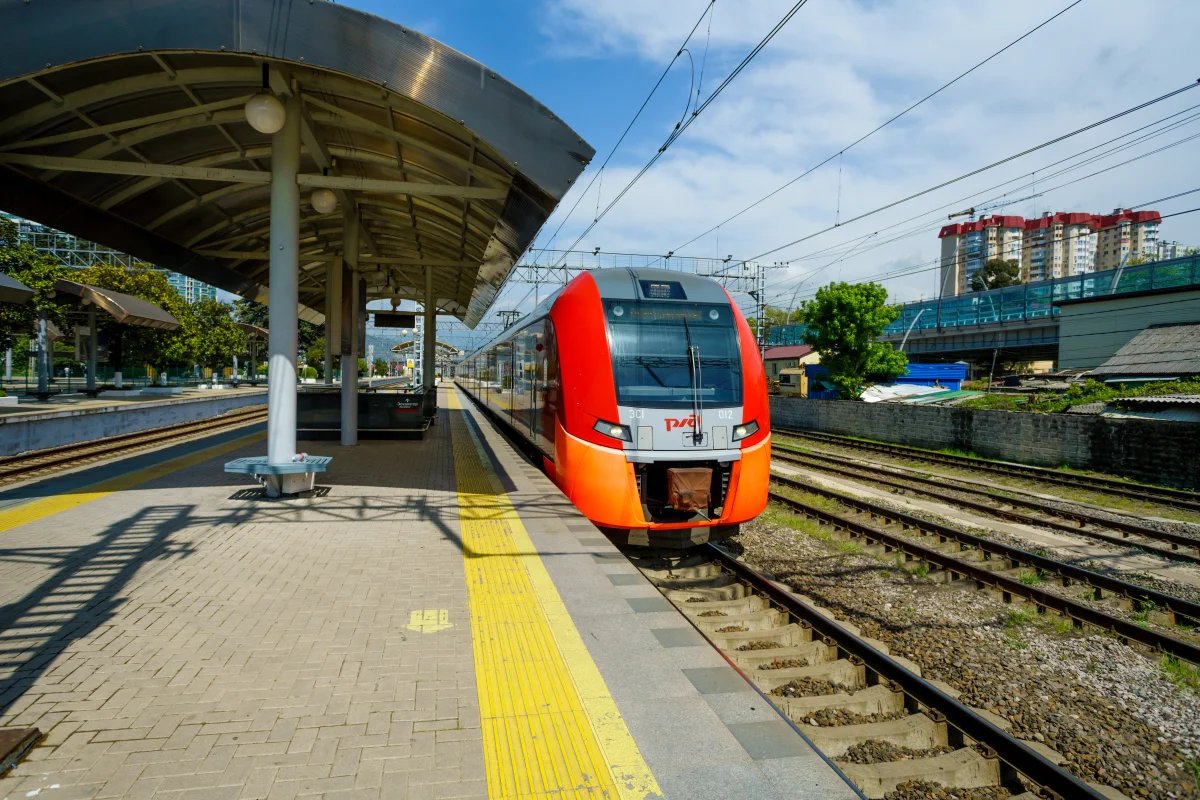
In July, the Moscow–Anapa train sits stationary on an open stretch of track for forty minutes. The air conditioning only runs while the train is moving. Outside: +35°C. Inside: +33°C and climbing. Passengers in the platskart (open) carriage simultaneously realize that a 1.5-liter bottle of water for a 20-hour journey is nowhere near enough.
A summer train trip to the south is an ordeal you need to prepare for in advance. Not every carriage has air conditioning, it doesn't always run, and when it does, half your fellow passengers will ask you to turn it off because "it's blowing on them."
The difference between a comfortable trip and a miserable one often comes down not to the carriage class, but to what's in your bag.
How to Avoid Ending Up in a Carriage Without AC
The first step to avoiding train heat is not ending up in a carriage where nothing can be done about it. When buying your ticket, pay attention to the service class.
Air conditioning is guaranteed in carriage classes 3E, 3T, 3D, 3B (platskart) and 2E, 2B (kupe). If it's a branded train with a name — "Volga," "Lev Tolstoy," "Severnaya Palmira" — air conditioning will be present in every carriage.
The risk lies with the additional trains that Russian Railways (RZD) runs to southern destinations in summer: Anapa, Adler, Novorossiysk. These are assembled from whatever rolling stock is available — sometimes old carriages with wooden window frames, two outlets for the whole car, and ventilation that hasn't worked since the last decade. Such a train's number usually starts with 6 — a signal to double-check the service class.
One more nuance: carriages with air conditioning have windows that don't open. That's the carrier's policy. If the AC breaks down while the train is stopped on an open stretch, there's no ventilation at all. That exact scenario generates most complaints.
What to Pack
The right bag for a summer train ride solves more than choosing which bunk to take. A kit that turns the journey from survival into something tolerable:
- Water — at least 2 liters per person per day. Not juice, not soda — plain water. In heat, the body loses moisture faster than it signals thirst. You can buy water at station stops, but the train stops for 2–5 minutes, and the kiosk is at the far end of the platform.
- A frozen bottle of water. Freeze a one-liter bottle before your trip. In the first hours, it works as a cold compress — press it against your neck, forehead, wrists. As it melts, you drink the cold water.
- A portable USB fan. Small, foldable, runs off a power bank. Inexpensive, but in a carriage without AC or with a broken one, it's the only source of moving air.
- A water spray bottle. A plastic pharmacy sprayer. Mist your face and arms — the water evaporates and cools your skin. A simple mechanism, but it works.
- Wet wipes or a damp towel. A wet towel around the neck is one of the most effective cooling methods. Water evaporates off the fabric and draws away heat.
- Light cotton clothing. Synthetics are the enemy in heat. Cotton and linen absorb sweat and let the skin breathe. A loose cut beats tight-fitting clothing.
- A cooler bag or insulated pouch. For food you bring along. At +33°C inside the carriage, food spoils within hours.
How to Cool Down En Route
If the AC can't keep up or is missing entirely, and eight hours remain until your destination, a few techniques genuinely help.
Cool your pulse points: wrists, temples, neck, inner elbows, ankles. Blood vessels run close to the skin at these spots, and cooling the blood there lowers overall body temperature.
Apply a frozen bottle, a wet towel, or simply hold your wrists under cold tap water.
Keep curtains closed on the sunny side. Direct sunlight through the window heats the carriage further. The difference between a closed and an open curtain near the window is 3–5 degrees.
Choose the lower bunk. Hot air rises — the upper bunk is always 2–3 degrees warmer than the lower one. In platskart, the upper side bunk in heat is the worst spot in the carriage: right under the ceiling, no ventilation, minimal space.
Avoid heavy, hot food. Digesting protein raises body temperature. Fruits, vegetables, and light salads are the better choice for a hot journey. A cup noodle with boiling water at +33°C inside the carriage is not a great idea.
Drink water frequently and in small sips, without waiting for thirst. Dehydration in an enclosed space happens faster than outdoors — the carriage's dry air and lack of breeze accelerate moisture loss.
What to Do If the Air Conditioning Isn't Working
Under RZD regulations, carriage air temperature in summer must not exceed +26°C. If your thermometer reads higher, you have the right to act.
Start with the conductor. Often the problem has a simple fix: the AC was switched off at another passenger's request, or it's running on low. The conductor can switch it to full power or open ventilation flaps.
If the conductor doesn't help, escalate to the head conductor of the train. They're obligated to take action — from repairing the AC to moving passengers to another carriage.
If that also fails, document the temperature (a phone app, a photo of a thermometer) and file a complaint through the RZD app, the hotline 8-800-775-00-00, or the complaint book found in every carriage. A documented violation is grounds for partial ticket compensation.
Children on a Hot Train: A Separate Concern
A child's body overheats faster than an adult's, and heatstroke occurs at lower temperatures. If you're traveling with children on a summer train:
- Double your water supply. Children drink less than they need — remind them every half hour.
- Light cotton clothing, minimal synthetics. A diaper in heat means additional overheating — change more often.
- Don't put a child on the upper bunk. That's where it's hottest.
- A damp cloth — sponge the child down every hour if carriage temperature exceeds +28°C.
- Watch for signs of overheating: lethargy, flushed skin, absence of sweat, a hot head. At the first symptoms — apply a cold compress to the head and neck, offer plenty of fluids, and ask the conductor for help.
Night in a Hot Carriage
Night is the hardest stretch if the AC isn't working. Carriage temperature drops slowly, and until two or three in the morning it can still sit at +28–30°C inside. Falling asleep becomes a quest.
A damp sheet draped over the body is an old but working trick. Water evaporates and cools you. The downside: it dries out within an hour, so it needs re-wetting. Keep a spray bottle by your head so you don't have to get up each time.
Feet outside the blanket is another proven technique. The feet are a major zone of heat dissipation. Leave them uncovered, and falling asleep gets easier.
The Golden Rule
Heat on a train is a predictable problem, not a surprise. Southern-bound trains in July–August turn into ovens every single year, and every year, passengers find themselves unprepared.
Two liters of water, a frozen bottle, a USB fan, and a damp towel — items weighing less than a kilogram, tucked at the bottom of your bag. But those exact items determine whether you arrive at the seaside rested, or already exhausted before your vacation has even begun.