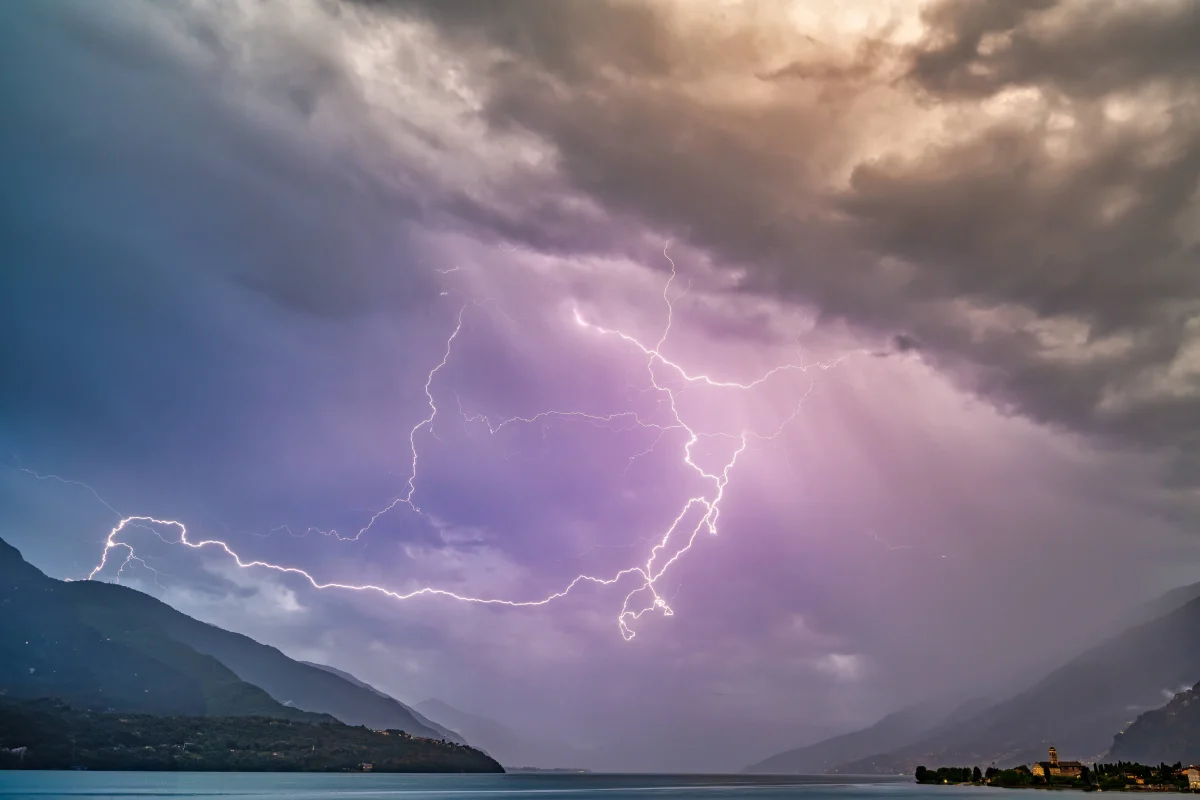
The forest is one of the safer places to be during a thunderstorm — if you know one rule: not all trees offer equal protection. A lone pine on a clearing's edge is a lightning magnet. Dense undergrowth of low trees is shelter that actually saves you.
Thunderstorms in the forest happen regularly: in summer, a storm cell can form within half an hour and end up directly overhead. Running away isn't an option — a storm moves at 40–60 km/h, and you can't outrun that through the woods. What's left is choosing the right spot and the right posture — and that genuinely works.
Why the Forest Is Safer Than Open Ground
EMERCOM statistics confirm it: fatalities from lightning are significantly rarer in forests than in open terrain. The reason is simple — in a forest, you're not the highest point. The trees take the hit for you.
Lightning primarily strikes elevated points: the tallest tree, a pole, a mast, a person standing alone in a field. In dense forest with a uniform canopy height, the odds that a strike lands on your specific tree are minimal. It'll go into one of the hundreds of crowns around you.
But "safer" doesn't mean "safe." Lightning striking a tree 10 meters away can still injure you through current running down the trunk into the ground and spreading through the root system. This is called step voltage — and it's the most common cause of forest lightning injuries.
Which Trees Attract Lightning
Not every species is equally dangerous. Lightning has favorite targets.
Most often struck are oak, pine, spruce, and poplar — tall trees with deep root systems that conduct current well into the ground. The resinous wood of conifers adds another conductive path: a moist inner core functions like a cable.
Birch, maple, and beech are struck less often — their wood is drier and conducts electricity poorly. But "less often" isn't "never." Relying on tree species as a guarantee is unwise.
A lone standing tree of any species is the most dangerous point in its radius. Even a short birch in the middle of a clearing is more likely to draw a strike than a tall oak deep within dense forest.
Where to Shelter From a Storm
The best spot during a forest thunderstorm is an area with low trees, dense crowns, and thick undergrowth. Young forest, shrub thickets, a low-lying spot among trees — all of these reduce the odds of a direct strike and protect against step voltage.
Ideally, position yourself among trees that are two or three times shorter than the surrounding ones. If twenty-meter pines surround you, your ten-meter spruces are the safe zone. Lightning will go for the tall trees, not the short ones.
Where not to shelter:
- Under a lone standing tree — the most common mistake and the leading cause of forest lightning injuries.
- At the forest's edge — the boundary between forest and field, where the edge trees become the tallest points.
- Under the tallest tree in the area — it will take the hit first.
- Right against the trunk of any large tree — current after a strike runs down the trunk into the roots. Keep a minimum of 2 meters from any trunk, ideally 4–5.
- Near a campfire — a column of hot air is highly conductive and can draw a strike. Any fire should be extinguished during a storm.
The Correct Body Position
Once you've found a suitable spot, adopt a posture that minimizes both your height and your area of contact with the ground.
Crouch down, feet together (this is critically important — the wider your stance, the higher the step voltage), wrap your arms around your knees, lower your head. If possible, place a dry insulating material beneath you: plastic sheeting, a backpack with dry contents, branches, a rock.
Wet ground conducts current — insulating yourself from it reduces the risk.
Don't lie down. Lying flat increases your contact area with the conductive surface — and if lightning strikes a nearby tree, current would pass through your entire body. Crouched, contact happens only through your feet, and current travels through the legs, bypassing the heart.
What to Do With Metal Objects
Metal doesn't "attract" lightning — that's a myth. Lightning strikes elevated points, not metallic ones. But metal conducts current excellently, and if a discharge hits a nearby tree, a metal object in your hands could become an additional conductor.
Practical steps:
- Remove metal items and set them 4–5 meters away: trekking poles, an axe, a saw, a portable grill, a fishing rod. Carbon fiber rods conduct electricity just as well as metal ones.
- A backpack with a metal frame should also come off and be set aside.
- Your mobile phone can stay with you — it's too small to influence lightning's path, and you may need it to call for help.
Step Voltage: The Invisible Threat
Lightning strikes a tree 15 meters away. You're unharmed — but don't relax yet. Current from the strike spreads through the ground via the roots, and a potential difference forms on the surface between points at different distances from the strike.
If your feet stand a stride apart, a voltage forms between them — greater the wider your stance and the closer you are to the strike point. That voltage is enough to trigger leg spasms, cause a fall, or induce loss of consciousness.
That's exactly why you should keep your feet together during a storm. The smaller the gap between contact points, the smaller the step voltage. Ideally: stand on one leg, or crouch with your feet held tightly together.
Step voltage is dangerous up to 10 meters from a strike point. Beyond that, current dissipates enough to become harmless.
If Lightning Strikes Very Close By
A loud crack, a flash, the smell of ozone — all of this happens simultaneously if a discharge hits a tree a few meters away. Here's what to do.
Don't jump up and run. Step voltage lingers for seconds after the strike. Stay crouched for at least 30 seconds after the discharge.
Check yourself and those around you. A step-voltage injury can be invisible: a person can lose consciousness without any visible trauma. If someone has collapsed, check breathing and pulse.
Inspect the tree. After a strike, the trunk can split, catch fire, or start smoldering. Dry thunderstorms (without rain) are a frequent cause of forest fires. If you see smoke or flame, move away and call 112.
Don't touch the struck tree. The trunk may carry residual current, and damaged branches can collapse.
First Aid for a Lightning Strike Victim
A person struck by lightning can and should be touched — there's no residual charge in their body. First steps:
- Call emergency services — 112. Give your coordinates (GPS on your phone) or describe your location as precisely as possible.
- Check consciousness, breathing, and pulse.
- If there's no breathing, begin CPR: 30 chest compressions, 2 rescue breaths. Don't stop until medical personnel arrive.
- If the victim is breathing but unconscious, place them in the recovery position on their side.
- Move the victim 30–50 meters from the strike site — a repeat discharge is possible.
In a lightning injury, you're working against minutes. The brain survives 4–6 minutes without oxygen. On-site resuscitation is often the only chance.
How to Tell a Storm Is Approaching
In a forest, you can't see the horizon, and a storm cloud might go unnoticed until the last moment. Watch for indirect signs:
- Birds and insects fall silent — one of the earliest signals.
- Gusty wind after a calm spell — the storm cell's leading edge.
- Distant thunder — the storm is 15–20 kilometers off. Count seconds between flash and thunder: three seconds equals one kilometer.
- Sudden darkening of the sky, even through the canopy.
- The smell of ozone — if you notice it before the first discharge, the storm is critically close.
At the first signs, don't wait for rain. Lightning outruns the rain and can strike from a cloud that's still several kilometers away. Seek shelter early, while you still have time to choose the right spot.
One Rule Worth Remembering
The forest during a storm isn't your enemy — it's your ally, if you choose the right position. A low-lying area with dense young growth, two meters from the trunks, feet together, head down, metal objects set aside. Thirty minutes of discomfort, and the storm moves on.
And if the storm catches you in a clearing or at the forest's edge, don't run for the nearest tall tree. That's the most dangerous decision you could make. Better to get soaked in the open, crouched down, than to stand beneath an oak that takes a hundred-thousand-ampere discharge — and passes part of it on to you.